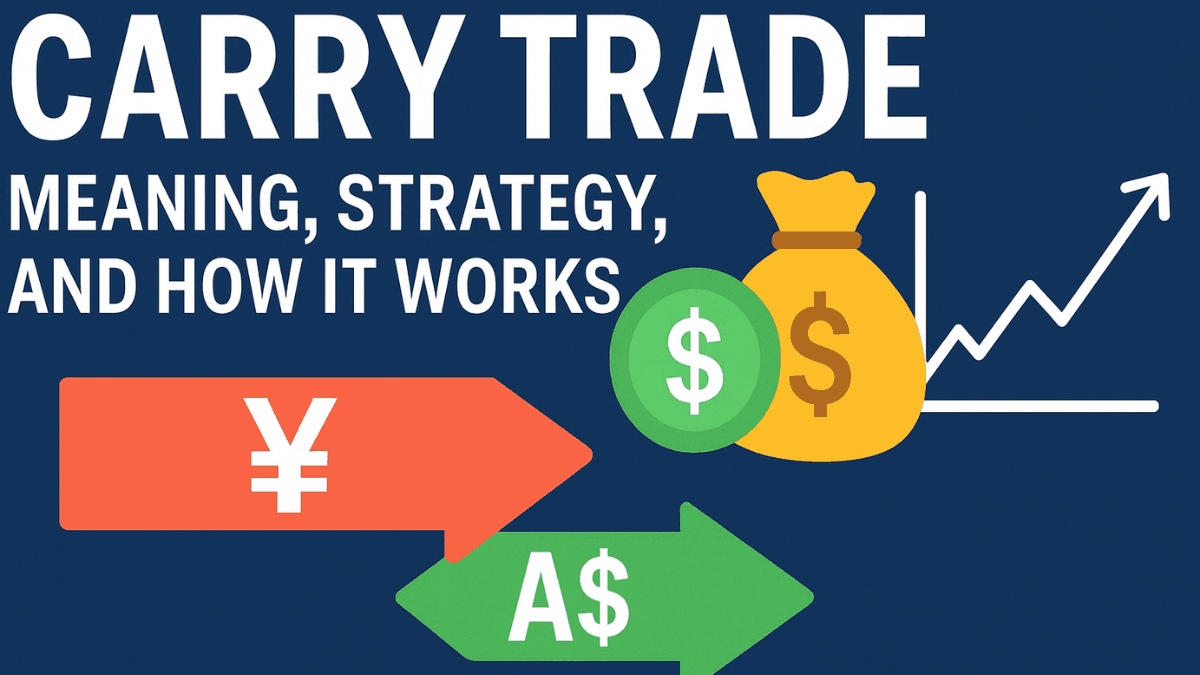
A carry trade is a trading strategy where an investor borrows money in a currency with a low interest rate and then uses that money to buy a currency with a higher interest rate. The goal is to profit from the difference between the two rates, known as the interest rate differential.
Carry trade is one of the most popular concepts in forex trading, especially during stable market conditions. It is widely used by banks, hedge funds, and experienced traders because it offers the potential to earn steady returns.
Click Here To Join our Telegram Community
What Is a Carry Trade?
A carry trade is based on borrowing low and investing high. In simple terms, a trader “carries” the higher interest rate while paying the lower one. The profit comes from the interest earned every day the position remains open.
This is known as the positive carry.
Currencies with high interest rates are often called high-yield currencies, while those with low interest rates are known as funding currencies.
How Carry Trade Works (Step-by-Step)
1. Choose a Low-Interest Currency
This currency is used for borrowing because it is cheap to finance.
Examples usually include:
- Japanese Yen (JPY)
- Swiss Franc (CHF)
2. Choose a High-Interest Currency
This is the currency you buy to earn a higher yield.
Examples often include:
- Australian Dollar (AUD)
- New Zealand Dollar (NZD)
3. Earn the Interest Rate Difference
Every day the trade is open, you collect the difference between the two interest rates. This is paid through a swap or rollover in forex.
4. Profit from Exchange Rate Movements (Optional)
If the high-yield currency gains value against the low-yield one, the profit becomes even bigger.
Why Carry Trades Are Popular
Carry trades can produce stable, predictable returns during calm markets. They are attractive because they do not rely solely on price movements.
Key Benefits
- Potential for daily passive income through rollover
- Works well in trending or stable markets
- Allows traders to profit even if the price barely moves
What Makes Carry Trades Work?
The strategy depends on economic conditions. When markets are stable and investors feel confident, they look for higher returns—making high-yield currencies attractive.
Central bank interest rate policies also play a huge role. Countries with strong economies and higher inflation often raise rates, increasing carry trade opportunities.
Risks of Carry Trade
Even though the strategy sounds simple, carry trades carry serious risks.
1. Exchange Rate Risk
If the high-yield currency falls in value, losses can quickly wipe out interest gains.
2. Market Volatility
During financial stress, investors rush to unwind carry trades, causing sharp currency movements.
3. Interest Rate Changes
If a central bank cuts rates on the high-yield currency, the carry profit shrinks.
4. Leverage Risk
Because forex trading often uses leverage, small price shifts can cause large losses.
Example of a Carry Trade
A trader borrows Japanese Yen at 0.1% interest. They use the money to buy Australian Dollars, earning 4.0%.
Interest Rate Differential:
4.0% − 0.1% = 3.9% profit per year
If AUD also strengthens against JPY, the total profit increases even more.
When Carry Trades Work Best
Carry trade strategies perform well when:
- Markets are stable
- Interest rate gaps are wide
- Investors feel confident (risk-on environment)
- There are clear central bank policies
They perform poorly when global uncertainty rises.
Carry Trade in Forex Trading
In forex, brokers pay or charge swap fees depending on the interest rate difference between two currencies. Traders who choose positive swaps can earn money by simply holding positions overnight.
High-yield pairs often used include:
- AUD/JPY
- NZD/JPY
These pairs have historically been favorites among carry traders.
Tips for Trading Carry Trades Safely
- Always check current interest rates
- Avoid high leverage
- Monitor central bank announcements
- Use stop-loss orders
- Trade during stable market periods
FAQs About Carry Trade
1. What is the main goal of a carry trade?
To earn profit from the interest rate difference between two currencies by borrowing low and investing high.
2. Is carry trading safe?
It can be profitable during stable markets, but exchange rate movements and leverage introduce significant risks.
3. Which currency pairs are best for a carry trade?
Pairs like AUD/JPY and NZD/JPY are commonly used because they offer large interest rate gaps.
4. How do traders earn money from a carry trade?
Through daily rollover payments based on the interest rate differential.
5. Can a carry trade lose money?
Yes. If the high-yield currency weakens, losses can exceed interest gains.
6. Do central bank decisions affect the carry trade?
Absolutely. Interest rate changes are the heart of this strategy.
Conclusion
Carry trade is a simple yet powerful strategy that allows traders to earn from interest rate differences between currencies. While it can offer steady returns, it also carries risks—especially during periods of market volatility or sudden central bank policy changes.
Understanding how carry trades work helps traders make smarter decisions and avoid unnecessary risk.
Trade on the Go. Anywhere, Anytime
If you’re ready to apply what you’ve learned, consider trading with a globally recognized forex and CFD broker like XM .
The platform offers competitive spreads, fast execution, and access to advanced trading tools, including real-time charts and flexible account types, making it suitable for both beginners and experienced traders. Open a trading account for free and start trading today and join millions of traders and investors on the global forex market.
Trading involves risk. Ensure you understand how the markets work before investing.