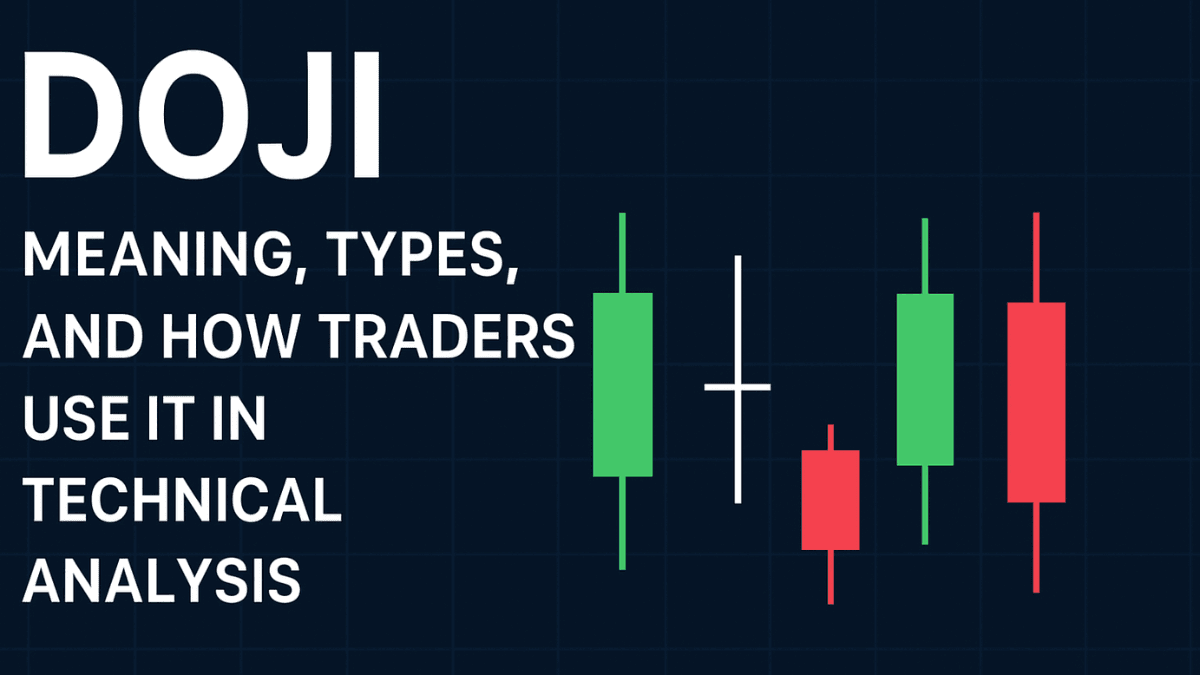
Understanding candlestick patterns is essential in trading, and the Doji is one of the most important signals you can learn. A Doji forms when the opening and closing prices of an asset are nearly equal. This balance creates a thin or nonexistent body on the candlestick, making the keyword Doji naturally appear in the first paragraph. Traders pay close attention to it because it often shows uncertainty or a potential shift in market momentum.
Before diving into its types and uses, it’s important to understand why traders see the Doji as a sign worth analyzing carefully.
Click Here To Join our Telegram Community
What Is a Doji?
A Doji is a single candlestick pattern that shows a neutral market state. It forms when buyers and sellers fight for control, but neither side wins. Because the open and close prices are nearly the same, the candle body is extremely small.
This pattern appears in all markets, including forex, stocks, commodities, and crypto. Many traders view it as a pause in price movement, giving them a moment to reconsider their next move. However, a Doji alone does not confirm a reversal or continuation. Its meaning depends heavily on context, especially market trend and volume.
How a Doji Forms on the Chart
Before exploring the different variations, it helps to understand the simple mechanics behind its formation.
A Doji forms through a tug-of-war between buyers and sellers. Prices may move up or down during the session, but by the end, neither group succeeds in pushing the price far from where it started. This balance creates a thin or cross-shaped candle with long or short wicks.
Because of this unique structure, traders view a Doji as a signal that the current trend may be weakening — but it must be confirmed with other indicators.
Types of Doji Candlesticks
Different market conditions create different Doji shapes. Each type provides slightly different insights. Understanding these variations helps you make sense of market behavior more accurately.
1. Standard Doji
A Standard Doji has almost equal open and close prices with small wicks. It usually means indecision.
This type often appears during quiet market phases or after a strong trend. When it appears in a trend, traders start watching for possible momentum weakness.
2. Long-Legged Doji
Before explaining why it matters, it is important to recognize its structure. A Long-Legged Doji has very long upper and lower shadows. These wicks show strong price volatility, but the closing price still returns near the opening level.
This type signals deep uncertainty. It often shows that both buyers and sellers attempted to control the session but ended the battle with no clear winner.
3. Dragonfly Doji
To understand this pattern properly, you need to look at its shape. A Dragonfly Doji has a long lower shadow and no upper shadow, with open and close at the top of the candle.
This pattern often appears after a downtrend. Many traders see it as a possible signal that buyers are stepping back in, because the price fell sharply but was pushed back up before closing.
4. Gravestone Doji
Now that you understand the Dragonfly Doji, the Gravestone Doji is its opposite in structure. It has a long upper shadow, no lower shadow, and the open and close sit near the bottom.
This pattern often appears after an uptrend and may warn that sellers are gaining strength. Traders sometimes treat it as a caution sign that a reversal could be developing.
5. Four-Price Doji
This type deserves special attention because of its rarity. A Four-Price Doji occurs when the open, close, high, and low are all identical. It appears in very low-volume markets or assets experiencing a temporary trading pause.
Because it shows absolute neutrality, traders rarely use it for major decisions. Instead, it simply indicates extremely quiet activity.
What a Doji Means in Trading
Understanding the meaning behind a Doji helps traders avoid misinterpretation. A Doji does not guarantee a reversal. Instead, it signals that the current trend may be losing strength.
A Doji during an uptrend can show buying pressure slowing down. A Doji during a downtrend can show selling pressure weakening. The true signal comes from what happens afterward — the candle following the Doji often provides confirmation.
Market Situations Where a Doji Matters
Before applying this pattern, it’s essential to know where traders find it most useful.
1. At the Top of an Uptrend
A Doji appearing after a strong upward move may indicate that buyers are hesitating. Traders may use it as an early warning of a possible price reversal.
2. At the Bottom of a Downtrend
A Doji at the end of a sharp decline suggests selling pressure is slowing. Some traders consider this a potential bullish signal — but only after confirmation.
3. During Consolidation
In sideways markets, a Doji simply reflects a lack of momentum. While this doesn’t predict direction, it helps traders avoid forcing trades during low-quality conditions.
How Traders Use a Doji in Technical Analysis
Before implementing the Doji in your strategy, it’s important to understand that it works best when combined with other tools. Relying on it alone can lead to misleading conclusions, especially in high-volatility markets.
Common ways traders use a Doji include:
- Checking trend strength
- Confirming with volume indicators
- Looking for breakouts after indecision
- Combining with support and resistance levels
- Partnering with patterns like Engulfing or Morning Star
Each of these methods provides additional structure and reduces the risk of misreading the candle. The goal is always to seek confirmation before acting.
Confirmation Is Key
Before you react to any Doji, you need supporting evidence. This is because a Doji alone does not predict direction.
For example, if a bullish candle forms after a Doji at the bottom of a downtrend, it may confirm a potential reversal. If the price breaks a key support level after a Doji, it may confirm continuation downward.
This careful approach helps traders avoid false signals and improve decision-making.
Common Mistakes Traders Make with a Doji
To interpret a Doji properly, you need to avoid a few common errors. These mistakes often cause traders to misjudge market direction.
- Treating every Doji as a reversal signal
- Ignoring the broader trend
- Forgetting to check the volume
- Trading without confirmation
- Over-relying on candlestick patterns alone
Avoiding these errors helps traders use the Doji more responsibly and with more accuracy.
Is a Doji Bullish or Bearish?
Before giving it a label, you must understand that the Doji is neutral. It represents indecision, not direction. However, its meaning becomes clearer once you evaluate:
- The trend that came before it
- The candle after it
- The volume behind it
- The support or resistance levels nearby
When interpreted with these factors, a Doji becomes a meaningful signal of potential change or continuation.
Final Thoughts
A Doji is one of the most important candlestick patterns traders learn, not because it predicts the future, but because it highlights market hesitation. When the market shows uncertainty, wise traders prepare for possible changes.
Using the Doji with strong technical context, confirmation signals, and risk management helps traders make more informed decisions. By understanding its variations and meanings, you gain a valuable tool for recognizing shifts in price behavior.
Trade on the Go. Anywhere, Anytime
If you’re ready to apply what you’ve learned, consider trading with a globally recognized forex and CFD broker like XM .
The platform offers competitive spreads, fast execution, and access to advanced trading tools, including real-time charts and flexible account types, making it suitable for both beginners and experienced traders. Open a trading account for free and start trading today and join millions of traders and investors on the global forex market.
Trading involves risk. Ensure you understand how the markets work before investing.