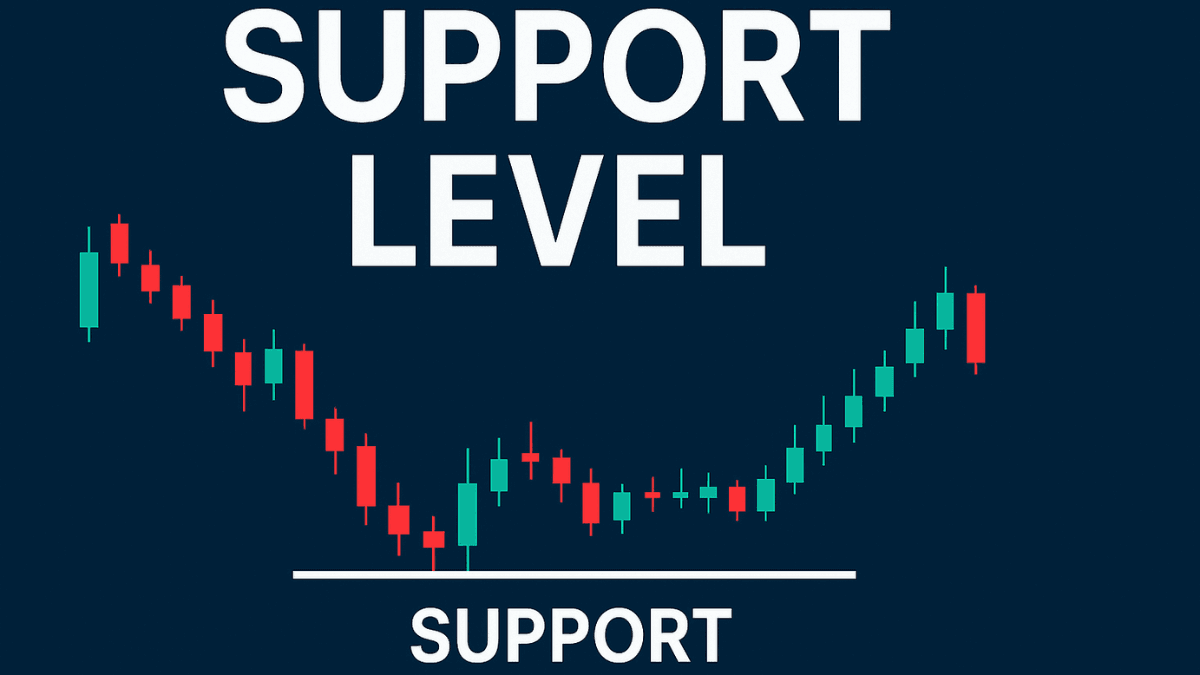
A support level is a price area on a chart where downward price movement tends to pause or reverse because buying interest becomes stronger than selling pressure. This concept is one of the most widely used tools in technical analysis because it reflects real market behavior rather than complex calculations. Traders across forex, stocks, indices, and commodities rely on support levels to understand where demand is likely to appear.
In simple terms, a support level forms when many market participants believe a price is “low enough” to buy. As the price approaches that zone, buyers step in, slowing or stopping the decline. The support level, therefore, acts like a floor, although it is never guaranteed to hold.

Understanding how support levels work helps traders make more informed decisions about entries, exits, and risk management. Instead of guessing where prices might turn, traders use historical price reactions to identify areas where the market has already shown strong interest.
Why Support Levels Matter in Financial Markets
Support levels matter because markets move based on supply and demand rather than random chance. When price repeatedly reacts from a certain area, it signals that buyers consistently see value there. This collective behavior creates a visible structure on the chart.
For traders, support levels offer practical advantages. They help define where risk is lower, where buying pressure may increase, and where invalidation points exist. Without support levels, traders are often forced to rely on emotions instead of structure.
Support levels are also important because many participants monitor them simultaneously. Institutional traders, retail traders, and algorithmic systems often identify similar zones. This shared focus increases the likelihood that prices will react when those levels are reached.
How Support Levels Are Formed
Support levels are formed through repeated interactions between buyers and sellers at similar prices. Each time the price falls to a level and rebounds, it reinforces the idea that buyers are willing to defend that area. Over time, this behavior becomes visible on the chart.
Support can form for several reasons, including previous lows, psychological price points, and areas of high trading volume. These factors combine to create zones where demand outweighs supply.
It is important to understand that support is usually a zone rather than a single exact price. Markets rarely reverse at the same pip or cent every time. Instead, price may dip slightly below or bounce slightly above the perceived level before reacting.
Types of Support Levels
Different types of support levels exist, each offering unique insights into market behavior. Understanding these variations helps traders choose the most relevant level for their strategy.
Horizontal Support Levels
Horizontal support levels are the most common and easiest to identify. They are drawn across areas where price has previously bounced multiple times at roughly the same level. These levels reflect clear historical demand.
Horizontal support is especially useful for beginners because it is visually straightforward. When the price approaches a well-defined horizontal support, traders can anticipate potential reactions without relying on indicators.
Trendline Support
Trendline support forms when price creates higher lows in an uptrend. A line drawn connecting these lows acts as dynamic support, moving upward as the trend continues. This type of support reflects ongoing buying interest rather than static price memory.
Trendline support is commonly used in trending markets. It helps traders enter pullbacks while staying aligned with the overall direction of price.
Moving Average Support
Moving averages can also act as dynamic support levels. Popular moving averages such as the 50-period or 200-period often attract buying interest when the price retraces toward them.
This type of support works because many traders monitor the same moving averages. When price reaches these levels, buying activity may increase simply due to shared expectations.
Psychological Support Levels
Psychological support levels are round numbers, such as 1.2000 in forex or 100 in stocks. These levels attract attention because humans naturally focus on simple, memorable numbers.
Even though psychological support has no mathematical basis, it often works because traders place orders around these prices. The resulting order flow can cause the price to react.
How to Identify Support Levels on a Chart
Identifying support levels requires careful observation of price behavior rather than rushing to draw lines. Traders should start by zooming out to see the broader market structure before focusing on details.
The first step is to mark areas where the price has previously stopped falling and reversed. These points often appear as swing lows or consolidation zones. When multiple reactions occur at a similar price area, that zone qualifies as potential support.
Another useful approach is to look for areas with long lower wicks on candlesticks. These wicks show rejection of lower prices, suggesting strong buying interest. When several such wicks appear around the same level, support is likely present.
Support Levels vs Resistance Levels
Support levels and resistance levels are closely related concepts, but they serve opposite roles. While support represents a price floor where buying pressure emerges, resistance acts as a ceiling where selling pressure increases.
The relationship between support and resistance is dynamic. When a support level breaks, it often turns into resistance on future price retests. This behavior occurs because traders who bought at support may sell when the price returns, attempting to exit at break-even.
Understanding this role reversal is essential for traders. It helps them adapt to changing market conditions rather than holding onto outdated assumptions.
The Psychology Behind Support Levels
Support levels work largely because of market psychology rather than technical rules. Traders remember previous price reactions and base future decisions on those memories. This collective behavior reinforces support zones.
Fear and greed play a major role as well. When the price falls toward support, buyers fear missing out on a potential bounce. At the same time, sellers may take profits, reducing selling pressure.
Institutional traders also influence support levels. Large players often accumulate positions over time, defending certain price zones to manage their entries efficiently. This activity adds further strength to support levels.
Support Levels Across Different Timeframes
Support levels exist on all timeframes, from one-minute charts to monthly charts. However, not all support levels carry the same importance. Higher timeframe support generally has more influence than lower timeframe support.
A support level on a daily or weekly chart reflects broader market consensus. These levels are watched by long-term investors and institutions, making them more reliable. Lower timeframe support may still work, but it is more sensitive to noise.
Traders should align their timeframe with their strategy. A day trader may focus on intraday support, while a swing trader may prioritize daily and weekly levels.
Trading Strategies Using Support Levels
Support levels can be used in several trading strategies, depending on market conditions and risk tolerance. The key is to treat support as a framework rather than a guarantee.
Buying Near Support
One common strategy involves buying near a well-established support level. Traders wait for the price to approach support and look for signs of stabilization, such as smaller candles or rejection wicks.
This approach allows for favorable risk-to-reward ratios because stops can be placed just below support. If the level holds, potential upside often exceeds the downside risk.
Break-and-Retest Strategy
Another strategy focuses on what happens when support breaks. Instead of buying immediately, traders wait for the price to break below support and then retest it from underneath.
If the former supports acts as resistance, traders may enter short positions. This strategy takes advantage of the role reversal principle and often provides clear invalidation points.
Range Trading with Support
In sideways markets, support levels help define the lower boundary of a trading range. Traders buy near support and sell near resistance until the price breaks out of the range.
This strategy works best when the market lacks strong trends and respects established boundaries. Clear range support reduces uncertainty and improves consistency.
Common Mistakes When Using Support Levels
Many traders misuse support levels by treating them as precise lines instead of flexible zones. This leads to premature entries or unnecessary stop-outs when the price briefly dips below support.
Another common mistake is ignoring the broader trend. Buying at support in a strong downtrend carries a higher risk because selling pressure may overwhelm buyers.
Traders also sometimes draw too many support levels, cluttering their charts. This reduces clarity and increases confusion rather than improving decision-making.
Combining Support Levels with Other Tools
Support levels become more effective when combined with complementary analysis tools. This combination improves confirmation without overcomplicating the chart.
Price action signals, such as bullish engulfing candles or pin bars, can confirm buying interest at support. Volume analysis can also help, as increased volume near support suggests strong participation.
Indicators like RSI or MACD may provide additional context, especially when they show divergence near support. However, indicators should support price analysis rather than replace it.
Support Levels in Different Markets
Support levels behave similarly across different financial markets, but each market has unique characteristics. Forex markets tend to respect support levels well due to high liquidity and technical participation.
In stock markets, support levels may be influenced by earnings reports, dividends, and company news. These factors can cause sudden breaks or strong reactions.
Commodity markets often show clear support around production costs or inventory levels. Understanding the underlying market drivers helps traders interpret support more accurately.
Risk Management Around Support Levels
Risk management is essential when trading support levels because no level is guaranteed to hold. Traders should always define their risk before entering a trade.
Stop-loss placement is typically just below the support zone, allowing room for normal price fluctuations. Position sizing should reflect the distance between entry and stop to maintain consistent risk.
Traders should also avoid overexposure by taking multiple trades at the same support level. If support fails, correlated losses can accumulate quickly.
How Support Levels Evolve Over Time
Support levels are not permanent. As market conditions change, levels may weaken or lose relevance. Repeated tests of support can either strengthen it or exhaust buying pressure.
When support finally breaks after many tests, the resulting move is often strong. This happens because trapped buyers exit and new sellers enter, accelerating momentum.
Traders should regularly reassess support levels rather than relying on old markings. Fresh price reactions carry more weight than distant historical ones.
Practical Tips for Using Support Levels Effectively
Consistency and patience are key when working with support levels. Traders should wait for the price to approach support instead of chasing moves in the middle of a range.
It is also helpful to keep charts clean and focus on the most obvious levels. Clear support zones are usually visible without excessive analysis.
Finally, traders should keep records of how the price reacts at support over time. Reviewing past trades helps refine judgment and improve future decision-making.
Final Thoughts
Support level analysis remains one of the most valuable skills a trader can develop. It is simple, adaptable, and grounded in real market behavior rather than a complex form. By understanding how and why support levels form, traders gain a clearer view of market structure.
When used with discipline and proper risk management, support levels can significantly improve trade timing and confidence. They do not predict the future, but they provide a logical framework for responding to price movement.
Mastering support levels takes practice, observation, and patience. Over time, this foundational concept becomes a powerful ally in navigating financial markets with clarity and control.
Trade on the Go. Anywhere, Anytime
If you’re ready to apply what you’ve learned, consider trading with a globally recognized forex and CFD broker like XM .
The platform offers competitive spreads, fast execution, and access to advanced trading tools, including real-time charts and flexible account types, making it suitable for both beginners and experienced traders. Open a trading account for free and start trading today and join millions of traders and investors on the global forex market.
Trading involves risk. Ensure you understand how the markets work before investing.