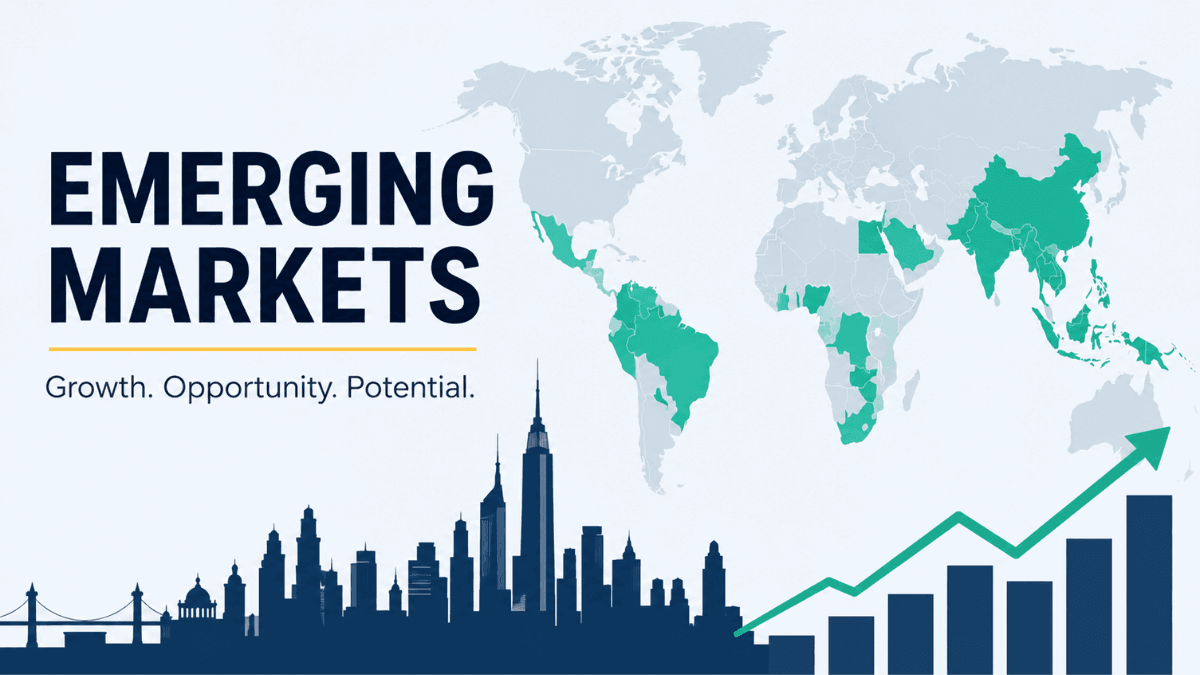
Emerging markets play a major role in the global economy. They are often seen as the growth engines of the future because many developing economies are expanding faster than mature economies like the United States, Japan, or Germany. For investors, traders, and businesses, understanding emerging markets can open the door to new opportunities — but also new risks.
Some of the world’s largest countries, including China, India, Brazil, and South Africa, are classified as emerging markets. These economies are transforming rapidly through industrialization, technology adoption, infrastructure development, and rising consumer demand. At the same time, they can experience political instability, currency volatility, and financial uncertainty, that make them more unpredictable than developed markets.

This guide explains what emerging markets are, how they work, why they matter, and how investors can approach them intelligently.
What Are Emerging Markets?
Emerging markets are countries whose economies are transitioning from developing status toward becoming more advanced and industrialized. These nations typically experience rapid economic growth, improving infrastructure, expanding financial markets, and rising living standards.
The term does not have one universal definition. Different financial institutions and index providers classify countries differently depending on economic development, market accessibility, political stability, and income levels.
A country is generally considered an emerging market when it shows:
- Strong GDP growth
- Expanding middle-class populations
- Increasing industrialization
- Improving stock and financial markets
- Greater integration into the global economy
Emerging economies usually sit between developing economies and fully developed economies. They are not as stable or wealthy as advanced nations, but they often grow much faster.
Characteristics of Emerging Markets
To understand emerging markets properly, you need to look beyond economic growth alone. These economies share several common traits that influence investment opportunities and financial behavior.
Rapid Economic Growth
One of the biggest attractions of emerging markets is growth potential. Many emerging economies expand faster than developed countries because they are still building industries, infrastructure, and consumer markets.
For example, countries like India and Indonesia have experienced strong growth due to rising urbanization, technology adoption, and increasing domestic consumption. A growing population often supports higher demand for housing, transportation, banking, and digital services.
Fast growth can create significant investment opportunities. It can also attract multinational companies looking to expand into new regions.
Expanding Middle Class
Emerging markets often experience a surge in middle-class consumers. As incomes rise, people spend more on education, healthcare, technology, travel, and financial services.
This shift creates new business opportunities across multiple sectors. Companies that target consumer goods, e-commerce, banking, and telecommunications often perform well in rapidly developing economies.
A stronger middle class also tends to increase economic resilience over time because economies become less dependent on exports alone.
Higher Market Volatility
Emerging markets can deliver strong returns, but they are also more volatile than developed markets. Political changes, inflation shocks, currency fluctuations, or global economic uncertainty can trigger sharp market movements.
For traders, this volatility can create opportunities. For long-term investors, it requires patience and proper risk management.
Currency risk is especially important. If an emerging market currency weakens sharply against the US dollar, international investors may lose value even if local stock prices rise.
Infrastructure Development
Many emerging economies invest heavily in roads, railways, airports, energy systems, and digital infrastructure. These projects help improve productivity and attract foreign investment.
Infrastructure growth often supports long-term economic expansion. Countries that modernize transportation and communication networks tend to become more competitive globally.
China’s massive infrastructure growth over the past few decades is one of the clearest examples of how infrastructure investment can accelerate economic transformation.
Examples of Major Emerging Markets
Several countries dominate discussions around emerging markets because of their economic size, population, or regional influence.
China
China is often considered the largest emerging market in the world. Its economy transformed dramatically through manufacturing, exports, technology, and infrastructure development.
Although China has achieved massive economic growth, some analysts debate whether it should still be classified as an emerging market because of its size and influence.
China remains highly important for global trade, commodities, and financial markets. Changes in Chinese economic policy can impact currencies, stocks, and commodities worldwide.
India
India has become one of the fastest-growing major economies globally. Its strengths include a large young population, an expanding technology sector, and a rapidly growing digital economy.
The country has also seen strong growth in fintech, telecommunications, and online services. Many investors view India as a long-term growth opportunity due to rising consumer demand and economic modernization.
Brazil
Brazil is Latin America’s largest economy and a major exporter of commodities such as iron ore, soybeans, oil, and coffee.
Commodity prices strongly influence Brazil’s economy. When global commodity demand rises, Brazil often benefits. During commodity downturns, the country can face slower growth and currency weakness.
Political developments and inflation trends also play a major role in Brazil’s financial markets.
South Africa
South Africa is one of Africa’s most developed financial markets. It serves as an important gateway for investment into the African continent.
The country has strong mining and natural resource industries, particularly in gold, platinum, and minerals. However, it also faces challenges such as unemployment, energy shortages, and political uncertainty.
Indonesia
Indonesia has attracted growing investor attention due to its large population, natural resources, and expanding digital economy.
Its rising middle class and increasing internet adoption have helped fuel growth in e-commerce, banking, and technology sectors.
Why Emerging Markets Matter to Investors
Emerging markets are important because they can provide growth opportunities that are difficult to find in mature economies. Investors often allocate part of their portfolios to emerging markets to diversify risk and increase potential returns.
Higher Growth Potential
Developed economies tend to grow steadily but slowly. Emerging economies can grow much faster because they are still building industries and consumer markets.
This growth can lead to stronger corporate earnings and rising asset prices over time. Investors willing to tolerate volatility may benefit from long-term expansion trends.
Portfolio Diversification
Emerging market investments can help diversify a portfolio because their economic cycles may differ from those of developed countries.
When US or European markets slow down, some emerging economies may continue growing due to local demand or commodity exports.
Diversification does not eliminate risk, but it can reduce dependence on a single region or economy.
Access to New Industries
Many emerging markets are becoming leaders in sectors such as fintech, renewable energy, manufacturing, and digital services.
Investors can gain exposure to industries and consumer trends that are still in early growth stages. This can create opportunities before markets become fully mature.
Risks of Investing in Emerging Markets
While emerging markets offer growth potential, they also carry substantial risks. Understanding these risks is essential before investing or trading.
Emerging Markets and Currency Risk
Currency movements are one of the biggest factors affecting emerging market investments. Many emerging market currencies are more volatile than major currencies like the US dollar or the euro.
A country facing inflation, political instability, or weak exports may see its currency depreciate sharply. This can reduce investment returns for foreign investors.
For forex traders, emerging market currencies can create both opportunity and danger. Pairs involving currencies such as the Turkish lira, South African rand, or Brazilian real can experience large price swings within short periods.
Political and Regulatory Risk
Government decisions can strongly influence emerging markets. Policy changes, elections, corruption scandals, or regulatory shifts can impact investor confidence quickly.
For example, capital controls, tax changes, or trade restrictions may affect stock markets and currency values.
Political instability can also discourage foreign investment, which is often important for economic growth.
Inflation Risk
Inflation tends to be higher and less stable in emerging markets compared to developed economies.
High inflation can reduce purchasing power, weaken currencies, and force central banks to raise interest rates aggressively. Rapid rate hikes may slow economic growth and pressure businesses.
Countries that fail to control inflation often struggle to maintain investor confidence.
Liquidity Risk
Some emerging markets have less developed financial systems. This means fewer buyers and sellers in the market, leading to wider spreads and lower liquidity.
During periods of economic stress, investors may struggle to exit positions quickly without affecting prices significantly.
Liquidity risk becomes especially important during global financial crises or geopolitical tensions.
Emerging Markets vs Developed Markets
Comparing emerging and developed markets helps clarify why investors approach them differently.
| Feature | Emerging Markets | Developed Markets |
|---|---|---|
| Economic Growth | Usually faster | Usually slower |
| Market Stability | Lower | Higher |
| Currency Volatility | Higher | Lower |
| Infrastructure | Developing | Advanced |
| Political Risk | Higher | Lower |
| Investment Risk | Higher | Lower |
| Return Potential | Higher | Moderate |
Emerging markets can outperform developed markets during periods of strong global growth. However, they can also suffer larger declines during economic uncertainty.
How Traders Use Emerging Markets
Traders watch emerging markets closely because these economies influence currencies, commodities, and global sentiment.
Commodity traders monitor emerging economies because countries like China and India consume massive amounts of oil, metals, and agricultural products. Strong economic activity can increase commodity demand and prices.
Forex traders often focus on interest rate differentials, inflation trends, and capital flows. Emerging market currencies can react strongly to US Federal Reserve decisions, commodity prices, or geopolitical developments.
Stock traders also monitor emerging market indices for momentum opportunities during periods of economic expansion or foreign investment inflows.
Emerging Market ETFs and Funds
Many investors gain exposure to emerging markets through ETFs (Exchange-Traded Funds) or mutual funds instead of buying individual stocks directly.
These funds provide diversification across multiple countries and sectors. They can reduce single-country risk while still offering exposure to emerging market growth.
Popular emerging market ETFs often include companies from China, India, Taiwan, Brazil, and South Korea.
Investors should still review:
- Expense ratios
- Country allocations
- Sector exposure
- Currency risk
- Political risk
Not all emerging market funds are structured the same way.
Factors That Influence Emerging Markets
Several global and domestic factors can strongly impact emerging economies.
US Interest Rates
Higher US interest rates often pressure emerging markets because investors move money toward safer US assets offering stronger yields.
This can weaken emerging market currencies and reduce capital inflows.
Commodity Prices
Commodity-exporting countries benefit when prices rise. Oil exporters, mining economies, and agricultural exporters often experience stronger growth during commodity booms.
Commodity downturns can hurt government revenues and weaken currencies.
Global Risk Sentiment
During periods of economic uncertainty, investors often move money into safer assets like US Treasury bonds or the US dollar.
Emerging markets tend to experience outflows during these “risk-off” periods because investors become more cautious.
Domestic Reforms
Countries that improve governance, infrastructure, and financial systems often attract stronger foreign investment over time.
Economic reforms can strengthen investor confidence and support long-term growth.
Are Emerging Markets a Good Investment?
Emerging markets can be attractive investments for people seeking long-term growth potential and diversification. However, they are not suitable for every investor.
If you have a low risk tolerance or need short-term stability, emerging markets may feel too volatile. Sharp corrections and currency swings can happen unexpectedly.
For long-term investors who understand the risks, emerging economies may provide exposure to some of the fastest-growing regions in the world. The key is balancing opportunity with proper risk management and diversification.
Final Thoughts
Emerging markets remain one of the most dynamic areas of the global economy. These countries are transforming through industrialization, technology adoption, infrastructure investment, and rising consumer demand.
Their growth potential attracts investors, traders, and multinational companies searching for expansion opportunities. At the same time, emerging economies face challenges that can create sharp volatility and uncertainty.
Understanding how emerging markets work helps you make better decisions, whether you trade currencies, invest in stocks, or simply want to understand global economic trends. Growth opportunities are real, but success in emerging markets usually rewards those who stay informed, diversified, and patient.
Trade on the Go. Anywhere, Anytime
If you’re ready to apply what you’ve learned, consider trading with a globally recognized forex and CFD broker like XM .
The platform offers competitive spreads, fast execution, and access to advanced trading tools, including real-time charts and flexible account types, making it suitable for both beginners and experienced traders. Open a trading account for free and start trading today and join millions of traders and investors on the global forex market.
Trading involves risk. Ensure you understand how the markets work before investing.