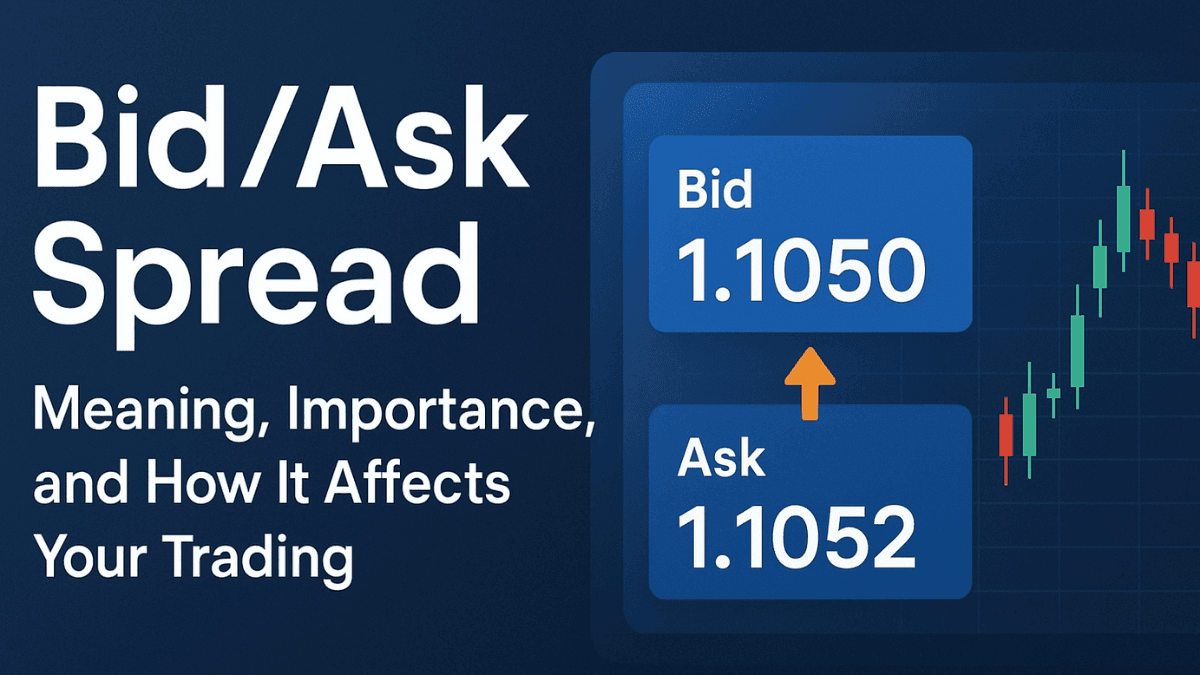
The bid/ask spread is one of the most important concepts every trader should understand. It appears in almost every financial market, yet many beginners overlook how much it affects their trading costs and execution. The bid/ask spread plays a direct role in profits, losses, and overall trading efficiency, making it essential for anyone who wants to improve their results.
Before diving deeper, it helps to understand why this pricing structure exists and how it influences both retail and institutional traders.

What Is the Bid/Ask Spread?
The bid/ask spread is the difference between the price buyers are willing to pay for an asset (the bid) and the price sellers want to receive (the ask). It represents the cost of entering and exiting a trade, even if brokers advertise “zero commission” accounts. This spread compensates market makers and liquidity providers for offering continuous pricing.
In every liquid market forex, stocks, futures, or crypto the spread exists because buyers and sellers never perfectly agree on a single price. Instead, the market finds a balance through two quotes.
Bid Price Explained
The bid price is the highest price a buyer is currently willing to pay for an asset. When you sell an asset instantly using a market order, you receive the bid price. This price shows the demand side of the market and how much buyers value the asset at that moment.
Ask Price Explained
The ask price is the lowest price a seller is willing to accept. When you buy an asset using a market order, you pay the ask price. This price reflects the supply side of the market, and it usually stays slightly above the bid to create the spread.
How the Bid/Ask Spread Works in Real Trading
Before you place any trade, your platform shows two prices. The ask is always a bit higher than the bid. This difference may look small, but it impacts your entry and exit immediately. When you open a trade, you begin slightly negative because you buy at the higher ask and sell at the lower bid.
This small gap is why traders see an instant unrealized loss as soon as their trade executes.
Example of a Bid/Ask Spread
Imagine the EUR/USD pair shows:
- Bid: 1.1050
- Ask: 1.1052
The bid/ask spread is 2 pips (1.1052 – 1.1050). If you buy, you pay 1.1052. If you sell, you receive 1.1050. The difference becomes your initial trading cost.
Why Does the Bid/Ask Spread Exist?
The spread exists for multiple reasons, and understanding them helps traders manage their costs more effectively. It also reveals how market conditions influence spreads throughout the day.
1. Market Liquidity
Highly liquid markets have tighter spreads because there are many buyers and sellers. Forex pairs like EUR/USD or USD/JPY often have very small spreads. Less liquid assets, such as exotic currency pairs or small-cap stocks, typically show wider spreads because fewer participants are trading them.
2. Market Maker Compensation
Market makers take on risk by providing constant buy and sell prices. The spread is their reward. Without them, traders would face delays or unstable pricing. The spread ensures markets remain smooth and active, even during volatile conditions.
3. Volatility Conditions
When markets become highly volatile, spreads widen naturally. This happens because uncertainty increases the risk for market makers. News events, interest rate announcements, or large moves can cause spreads to spike temporarily.
Types of Bid/Ask Spreads
Understanding the types helps traders make smarter decisions based on their trading style and market conditions.
Fixed Spreads
Fixed spreads remain stable regardless of volatility. They are common in certain forex accounts or broker models. While they offer predictability, they can be slightly higher than variable spreads during calm market conditions.
Variable (Floating) Spreads
Variable spreads change based on liquidity and volatility. They tend to be tighter during active trading sessions and wider during low-volume hours. Most ECN and STP brokers use variable spreads for transparency and efficiency.
How the Bid/Ask Spread Affects Your Trading
The spread influences both short-term and long-term trading performance. Even small spreads compound into high costs over time, especially for active traders.
1. Trading Costs
The spread is a hidden transaction fee. Tighter spreads reduce your total cost, while wider spreads make trading more expensive. Scalpers and day traders feel the impact most because they trade frequently.
2. Entry and Exit Timing
Markets with wider spreads require the price to move further in your favor before a trade becomes profitable. This affects strategy performance and can change how aggressively you enter or exit positions.
3. Slippage and Execution Quality
During high volatility, spreads often widen alongside slippage. This impacts traders using market orders or automated strategies that rely on precise pricing.
What Influences the Bid/Ask Spread?
Many factors affect how wide or tight spreads become. Paying attention to these variables helps traders avoid unnecessary costs.
Key influences include:
- Liquidity level
- Trading session (London and New York have tighter spreads)
- Broker type (ECN vs. market maker)
- Economic news releases
- Market conditions and volatility
Understanding these elements helps traders choose the best times to trade for lower spreads.
How to Minimize the Impact of the Bid/Ask Spread
You cannot eliminate the spread, but you can reduce how much it affects your results. Smart traders plan around low-spread conditions and avoid trading when spreads are unpredictable.
1. Trade During High-Liquidity Sessions
Trading during the London or New York sessions generally offers tighter spreads, especially for major forex pairs. Night sessions or holidays usually show wider spreads.
2. Use Limit Orders Instead of Market Orders
Limit orders give you more control over price and help avoid paying unnecessary spread costs. They work especially well when entering during calm market conditions.
3. Choose a Low-Spread Broker
Not all brokers offer the same pricing structure. ECN brokers or brokers with deep liquidity often provide tighter spreads and better execution.
4. Avoid Trading Around Major News Events
Spreads widen sharply during economic releases. Waiting a few minutes after the event reduces cost and improves fill quality.
5. Stick to Liquid Markets
Trading popular assets like major currency pairs or blue-chip stocks helps keep trading costs predictable.
Why the Bid/Ask Spread Matters for Every Trader
The bid/ask spread may look small, but it shapes every entry and exit in the market. It determines your initial cost, affects your profitability, and influences how fast your trades move into profit. Understanding it makes you a more efficient trader, helps you choose better assets, and prevents unnecessary losses.
Mastering the spread is a key step toward consistent and cost-effective trading.
Trade on the Go. Anywhere, Anytime
If you’re ready to apply what you’ve learned, consider trading with a globally recognized forex and CFD broker like XM .
The platform offers competitive spreads, fast execution, and access to advanced trading tools, including real-time charts and flexible account types, making it suitable for both beginners and experienced traders. Open a trading account for free and start trading today and join millions of traders and investors on the global forex market.
Trading involves risk. Ensure you understand how the markets work before investing.