Yield curve control is essential for anyone following financial markets, government policies, or long-term economic trends. It has become an important strategy used by central banks to stabilize borrowing costs, guide market expectations, and support economic recovery. It affects interest rates, inflation, currency strength, and even investment decisions.
This article breaks down how YCC works, why central banks use it, and what risks it carries.

Before diving into the mechanics, it helps to understand why governments and markets pay close attention to the yield curve in the first place.
What Is the Yield Curve and Why they Matter
To understand yield curve control, you must first understand what a yield curve is. A yield curve shows the relationship between short-term and long-term interest rates on government bonds. It reflects how expensive it is for governments to borrow money across different periods.
The shape of the yield curve sends signals about the economy. Investors use it to gauge whether growth is improving, slowing, or heading toward a recession. Central banks also closely monitor it because large shifts in the curve can affect lending, investment, and financial stability.
Common Shapes of the Yield Curve
Before YCC makes sense, let’s briefly look at the three main yield curve shapes:
- Normal yield curve – Long-term rates are higher than short-term rates, showing healthy economic expectations.
- Flat yield curve – Short- and long-term rates are close, often during transitions or uncertainty.
- Inverted yield curve – Short-term rates rise above long-term rates, usually signaling recession risks.
Because the curve influences economic expectations, central banks sometimes choose to intervene and shape it directly. That is where Yield Curve Control comes in.
What Is Yield Curve Control (YCC)?
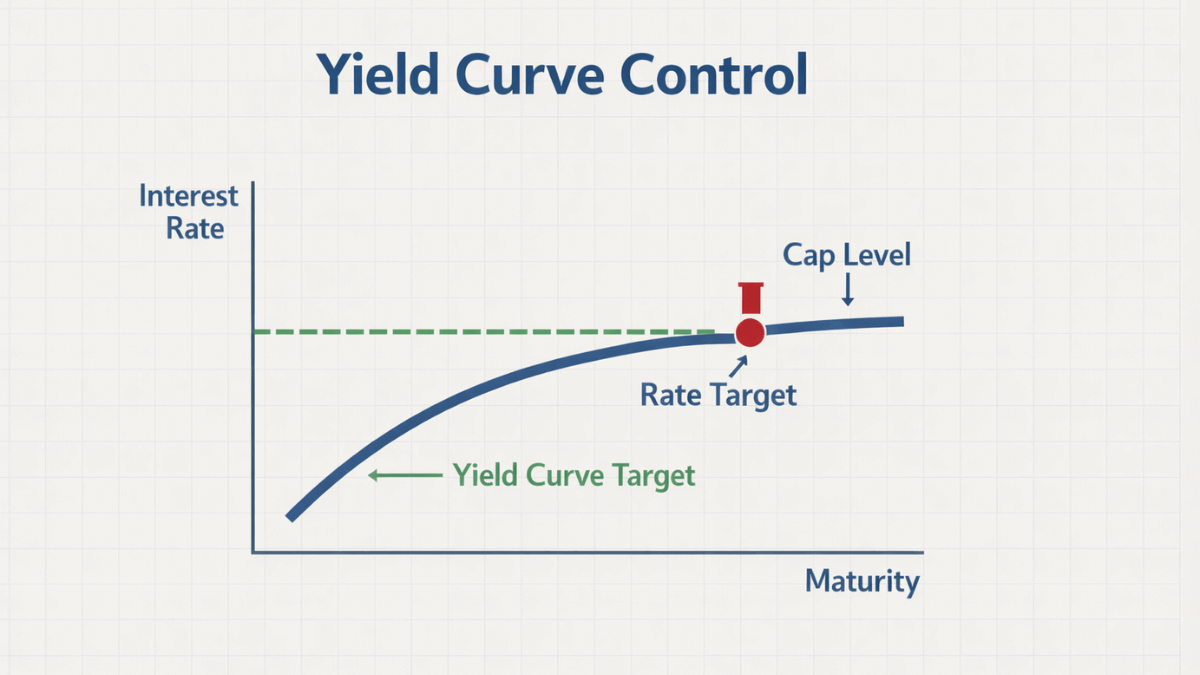
Now that the basics are clear, we can define Yield Curve Control more clearly. Yield Curve Control is a monetary policy strategy where a central bank sets specific targets for certain government bond yields and uses bond buying or selling to maintain those levels. Instead of controlling only short-term interest rates, the bank also manages medium- or long-term rates.
YCC gives central banks a more powerful tool to guide the cost of borrowing. By capping or fixing yields, policymakers can keep financial conditions stable even when markets become volatile.
How Yield Curve Control Works
Understanding how YCC works helps explain why it has become popular among modern central banks. The process is straightforward, but the execution requires discipline.
1. Setting a Target Yield
The central bank chooses a specific maturity for example, the 3-year or 10-year government bond and sets a maximum yield level it does not want to exceed. This target becomes the anchor for the policy.
2. Monitoring Market Movements
If bond yields rise above the target, the central bank immediately intervenes. If yields fall too low, it may reduce its intervention to maintain balance.
3. Buying or Selling Bonds
To keep yields near the target, the bank buys or sells government bonds:
- To push yields down, the bank buys large amounts of bonds, increasing demand.
- To push yields up, the bank sells bonds, increasing supply.
Through these actions, the central bank steers interest rates toward its chosen level.
4. Communicating Policy Clearly
YCC depends heavily on credibility. If investors believe the bank is committed to its target, the market adjusts naturally without requiring constant intervention.
Why Central Banks Use Yield Curve Control
Having seen the mechanism, it’s helpful to explore why a central bank would choose YCC over traditional policy tools. The reasons vary depending on economic conditions, but the goals usually revolve around stability, confidence, and affordability.
Supporting Economic Recovery
YCC helps keep borrowing costs low for businesses, consumers, and governments. This encourages investment, spending, and job creation during slow economic periods.
Managing Long-Term Interest Rates
Traditional interest rate tools mainly affect short-term rates. YCC gives central banks direct influence over longer maturity bonds, which often matter more for mortgages, corporate loans, and infrastructure financing.
Stabilizing Financial Markets
During crises or market panic, bond yields can rise sharply. YCC prevents sudden spikes by assuring investors that yields will remain within a controlled range, reducing uncertainty.
Enhancing the Impact of Quantitative Easing (QE)
YCC can complement Quantitative Easing by making the central bank’s intentions clear. Instead of buying fixed amounts of bonds, the bank buys whatever is necessary to maintain its yield target.
Examples of Countries That Have Used Yield Curve Control
Exploring real-world examples helps illustrate how YCC works in practice and what results it can deliver.
Japan
Japan is the most famous case. The Bank of Japan introduced Yield Curve Control in 2016, targeting the 10-year government bond yield at around 0%. This helped Japan stabilize borrowing costs after years of low inflation and sluggish growth.
Australia
The Reserve Bank of Australia used YCC from 2020 to 2021, targeting the 3-year government bond yield. The policy helped maintain low interest rates during the pandemic recovery phase.
United States (Historical Experiments)
The U.S. Federal Reserve used a form of YCC during and after World War II to keep borrowing costs low. While not currently using YCC, the Fed has discussed it as a possible future tool during major economic downturns.
Benefits of Yield Curve Control
Before looking at risks, it’s important to recognize the advantages YCC can offer. When executed well, it provides stability and predictability in uncertain economic environments.
Key Benefits
- Keeps government borrowing affordable.
- Encourages long-term investment by providing predictable rates.
- Strengthens confidence during economic shocks.
- Helps fight deflation by lowering financing costs.
- Supports recovery without unlimited bond purchases.
These benefits explain why YCC is attractive for central banks facing slow growth or volatile markets.
Risks and Criticisms of Yield Curve Control
Even though YCC can be effective, it also brings significant risks. Understanding these helps policymakers, investors, and citizens see the full picture.
1. Loss of Market Function
If the central bank controls yields too tightly, bond markets may lose their natural pricing ability. This reduces the market’s ability to signal economic conditions.
2. Balance Sheet Expansion
Maintaining yield targets can require massive bond purchases, especially during market stress. This increases the central bank’s balance sheet and creates long-term risks.
3. Inflation Pressures
Over-controlling yields may lead to excessive borrowing and spending. If the economy overheats, inflation can rise faster than expected.
4. Currency Weakness
Low yields may reduce a country’s currency strength because investors seek higher returns elsewhere. A weaker currency can raise import prices and fuel inflation.
5. Difficulty Exiting the Policy
Exiting YCC can be challenging because markets become used to stable yields. Removing the control may cause sudden rate spikes and market turbulence.
How Yield Curve Control Affects Investors
Before concluding, it’s useful to look at how YCC influences investment decisions. Markets respond strongly when central banks adjust yield targets or signal new policies.
Impact on the Bond Market
Bond prices tend to stabilize when YCC is in place because the central bank prevents large yield movements. Investors may earn lower returns, but risk also decreases.
Impact on the Stock Market
Equities often benefit from YCC because lower borrowing costs support corporate growth. However, if YCC leads to inflation fears, stocks may react negatively.
Impact on Real Estate and Loans
Lower long-term yields reduce mortgage rates and loan costs. This can stimulate housing demand and business expansion.
Future Outlook of Yield Curve Control
As global economies face uncertainty, inflation cycles, and shifting monetary policies, YCC may become a more common tool. Central banks must balance the need for stability with the risks of over-intervention. The future of YCC will depend on inflation trends, market expectations, and governments’ fiscal strategies.
Conclusion
Yield Curve Control is a powerful but complex monetary policy tool. It allows central banks to influence long-term interest rates, support economic growth, and maintain market stability. While YCC has clear benefits, it also carries significant risks that require careful management and transparent communication.
As economies continue facing uncertainty, yield curve control will remain an important strategy to watch. Understanding how it works helps investors, policymakers, and the public make informed decisions in an ever-changing financial world.
Trade on the Go. Anywhere, Anytime
If you’re ready to apply what you’ve learned, consider trading with a globally recognized forex and CFD broker like XM .
The platform offers competitive spreads, fast execution, and access to advanced trading tools, including real-time charts and flexible account types, making it suitable for both beginners and experienced traders. Open a trading account for free and start trading today and join millions of traders and investors on the global forex market.
Trading involves risk. Ensure you understand how the markets work before investing.