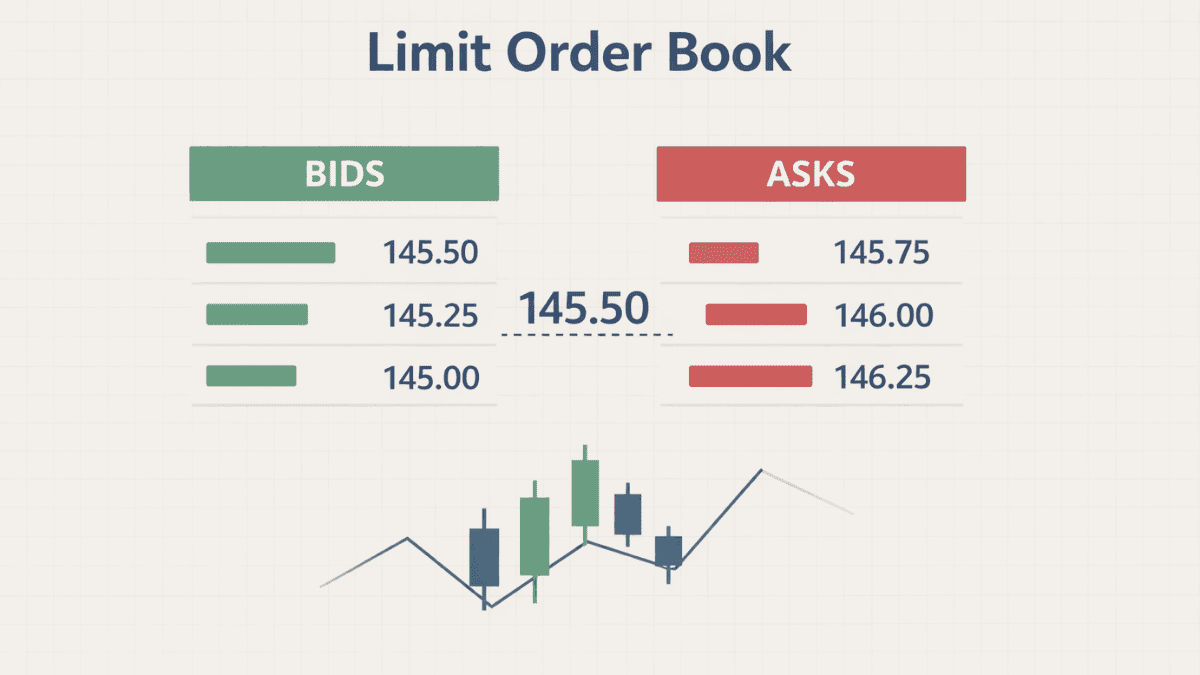
A Limit Order Book is the core system that records all buy and sell orders for a financial asset at different price levels. It is used by stock exchanges, crypto exchanges, and other trading platforms to match buyers and sellers in real time.
At its simplest, the Limit Order Book shows what price traders are willing to buy or sell an asset for, along with how much they want to trade. This transparency allows participants to make informed decisions based on current market demand and supply.

How a Limit Order Book Works
To understand how a Limit Order Book functions, it helps to think of it as a constantly updating list of offers. Each time a trader places an order, it is added to the book until it is matched or canceled.
The book is divided into two main parts:
- Bid side (buy orders): Prices traders are willing to pay
- Ask side (sell orders): Prices traders are willing to accept
When a buy order matches a sell order at the same price, a trade occurs. If there is no match, the order remains in the book, waiting for a suitable counterparty.
Key Components of a Limit Order Book
Every Limit Order Book contains several important elements that help traders interpret market activity. Understanding these components gives you a clearer picture of price movement and liquidity.
Bid and Ask Prices
The bid price represents the highest price a buyer is willing to pay. The ask price represents the lowest price a seller is willing to accept.
The difference between these two is called the spread, and it often reflects market liquidity. A smaller spread usually indicates a more active and competitive market.
Order Size (Volume)
Each order includes a quantity, which shows how many units of the asset are being bought or sold. Larger volumes at certain price levels can act as support or resistance in the market.
Price Levels
Orders are grouped by price levels, creating a layered view of the market. These levels help traders see where significant buying or selling interest exists.
Types of Orders in the Limit Order Book
Different order types determine how trades are executed and how they appear in the Limit Order Book. Each serves a specific purpose depending on a trader’s strategy.
Limit Orders
A limit order allows a trader to specify the exact price at which they want to buy or sell. These orders sit in the book until they are matched.
They provide control over price but do not guarantee execution if the market does not reach the desired level.
Market Orders
A market order is executed immediately at the best available price. It does not appear in the book for long because it is matched instantly with existing orders.
This type prioritizes speed over price precision.
Stop Orders
Stop orders are triggered when the price reaches a certain level. Once triggered, they usually become market or limit orders and enter the book accordingly.
Why the Limit Order Book Matters
The Limit Order Book plays a central role in price discovery and market efficiency. It provides real-time insights into how supply and demand interact.
For traders, it offers valuable information such as:
- Where large orders are placed
- How strong is the buying or selling pressure
- Potential price movement based on order flow
This makes it a powerful tool for both short-term traders and long-term investors.
Understanding Market Depth
Market depth refers to the volume of orders available at different price levels within the Limit Order Book. It shows how much liquidity exists in the market.
A deep market has many buy and sell orders across various price levels, making it easier to execute large trades without significantly affecting the price. A shallow market, on the other hand, can lead to sharp price movements with relatively small trades.
The Role of Liquidity in the Limit Order Book
Liquidity is a key concept tied closely to the Limit Order Book. It determines how easily an asset can be bought or sold without causing large price changes.
High liquidity means:
- Tight spreads
- Faster execution
- Lower trading costs
Low liquidity often leads to wider spreads and more volatility, making trading riskier.
How Traders Use the Limit Order Book
Professional and retail traders use the Limit Order Book to guide their strategies. By analyzing order flow, they attempt to predict short-term price movements.
Some common uses include:
- Identifying support and resistance levels: Large clusters of orders can signal strong price barriers
- Spotting momentum shifts: Changes in order volume may indicate trend reversals
- Timing entries and exits: Traders look for favorable conditions before placing orders
While useful, the Limit Order Book should be combined with other tools for better decision-making.
Limit Order Book vs Order Matching Engine
It is important to distinguish between the Limit Order Book and the matching engine. While they work together, they serve different roles.
The Limit Order Book stores all active orders, showing market participants what is available. The matching engine processes these orders and executes trades when conditions are met.
In simple terms, the book displays the data, and the engine acts on it.
Common Misconceptions About the Limit Order Book
Many beginners misunderstand how the Limit Order Book works. Clearing up these misconceptions can help avoid costly mistakes.
One common belief is that visible orders guarantee price movement. In reality, large orders can be canceled before execution, making them unreliable signals on their own.
Another misconception is that the book reflects all market activity. Some orders, such as hidden or dark pool trades, may not appear, which means the view is not always complete.
Advantages and Limitations
The Limit Order Book offers valuable insights, but it also has its limitations. Understanding both sides helps you use it more effectively.
Advantages
- Provides real-time transparency
- Helps identify market trends
- Supports better price discovery
Limitations
- Can be manipulated through fake orders
- Does not show hidden liquidity
- Requires experience to interpret correctly
Final Thoughts
The Limit Order Book is one of the most important tools in modern trading. It reveals how buyers and sellers interact, offering a real-time snapshot of market dynamics.
By learning how to read and interpret it properly, traders can gain a deeper understanding of price movements and make more informed decisions. While it is not a standalone solution, it becomes highly effective when combined with broader market analysis.
Trade on the Go. Anywhere, Anytime
If you’re ready to apply what you’ve learned, consider trading with a globally recognized forex and CFD broker like XM .
The platform offers competitive spreads, fast execution, and access to advanced trading tools, including real-time charts and flexible account types, making it suitable for both beginners and experienced traders. Open a trading account for free and start trading today and join millions of traders and investors on the global forex market.
Trading involves risk. Ensure you understand how the markets work before investing.