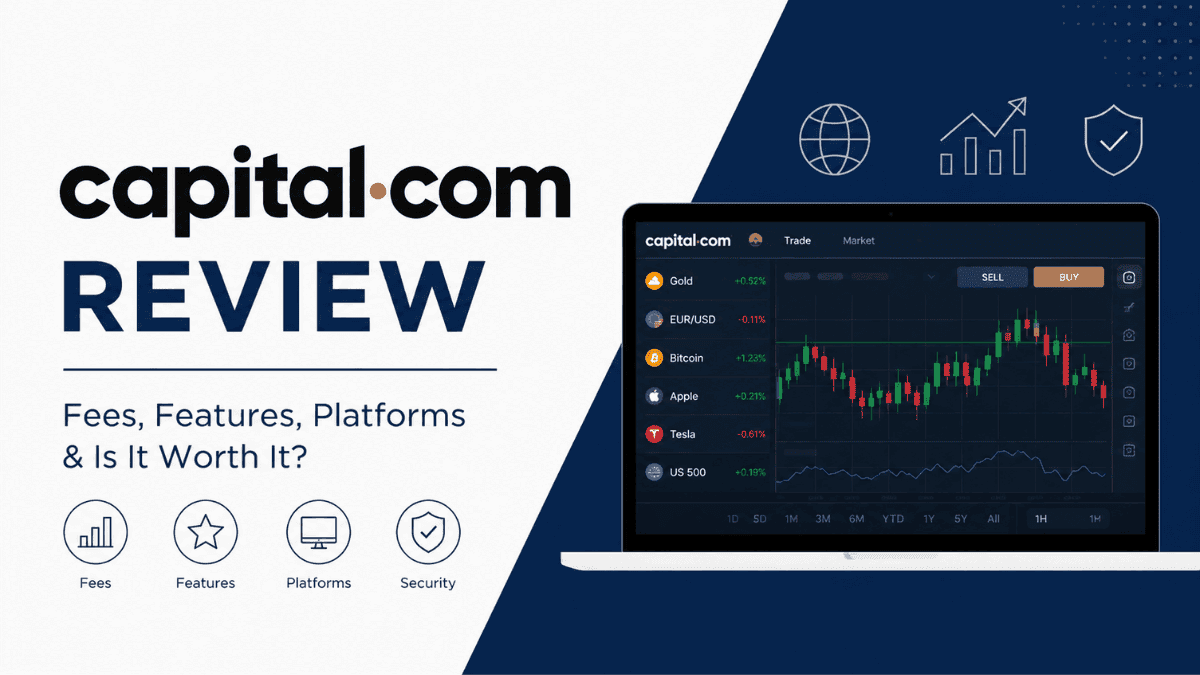
Choosing the right forex and CFD broker can make a major difference in your trading experience. This Capital.com Review takes a close look at one of the fastest-growing online trading platforms in the industry, covering everything from regulation and trading fees to platforms, assets, customer support, and overall usability.
Capital.com has built a strong reputation for offering a beginner-friendly trading environment while still providing enough advanced tools for experienced traders. The broker combines modern technology, competitive spreads, and a clean trading interface that appeals to traders who want simplicity without sacrificing functionality.

But is Capital.com actually worth using in 2026 and beyond? Let’s break it down in detail.
What Is Capital.com?
Capital.com is a global online broker that provides access to forex, stocks, commodities, indices, cryptocurrencies, and CFDs. Since launching in 2016, the broker has expanded rapidly and now serves traders in multiple regions around the world.
One of the reasons Capital.com gained popularity so quickly is its focus on technology and user experience. The platform feels modern compared to many traditional brokers that still rely heavily on outdated interfaces.
The broker is especially known for:
- Tight spreads
- Zero commission trading on many CFD products
- Fast account opening
- User-friendly mobile trading
- Educational content for beginners
- AI-powered trading insights
Unlike some brokers that target only professional traders, Capital.com tries to balance simplicity with advanced functionality. That makes it appealing to both new and experienced traders.
Is Capital.com Regulated?
Regulation is one of the first things traders should check before opening an account. A regulated broker must follow strict financial rules designed to protect client funds and ensure fair trading practices.
Capital.com operates through multiple regulated entities worldwide.
Capital.com Regulatory Licenses
The broker is regulated by several major authorities, including:
- Financial Conduct Authority (FCA)
- Cyprus Securities and Exchange Commission (CySEC)
- Australian Securities and Investments Commission (ASIC)
- Securities Commission of The Bahamas (SCB)
Having multiple regulatory licenses is a positive sign because it shows the company operates under internationally recognized compliance standards.
Client funds are typically kept in segregated bank accounts, meaning broker operating funds are separated from customer money.
Capital.com Account Types
This section explains the different account options available and who they are best suited for.
Capital.com keeps its account structure relatively simple compared to brokers that overwhelm traders with dozens of account types.
Retail Trading Account
The standard retail account is designed for most traders. It offers access to all supported markets with competitive spreads and no deposit fees.
Retail clients also receive negative balance protection in regulated regions. This means you cannot lose more money than you deposit.
Professional Account
Experienced traders may qualify for a professional account if they meet certain eligibility requirements.
Professional traders can access:
- Higher leverage
- Advanced trading conditions
- Reduced regulatory restrictions
However, some protections available to retail clients may no longer apply.
Demo Account
Capital.com offers a free demo account with virtual funds.
This is one of the platform’s strongest features for beginners because you can test strategies and explore the trading interface without risking real money. The demo account closely mirrors live market conditions, making it useful for practice.
Tradable Markets on Capital.com
A broker’s asset selection matters because it determines how flexible your trading opportunities are.
Capital.com provides access to thousands of instruments across several asset classes.
Forex Trading
Forex traders can access major, minor, and exotic currency pairs.
Popular pairs include:
- EUR/USD
- GBP/USD
- USD/JPY
- AUD/USD
- USD/CAD
Spreads on major pairs are generally competitive, especially during peak market hours.
Stocks and Shares CFDs
The broker offers CFDs on shares from major exchanges worldwide.
You can trade companies listed in regions such as:
- United States
- United Kingdom
- Europe
- Asia
This allows traders to speculate on stock price movements without owning the underlying shares.
Commodities
Commodity traders can access instruments such as:
- Gold
- Silver
- Oil
- Natural Gas
- Coffee
Gold trading is particularly popular on Capital.com due to competitive spreads and fast execution.
Indices
Capital.com also supports index trading, including:
- S&P 500
- NASDAQ 100
- FTSE 100
- Germany 40
- US Wall Street 30
Indices are often favored by traders looking for broader market exposure instead of individual stocks.
Cryptocurrency CFDs
Crypto CFD trading is available in supported regions.
Traders can speculate on popular cryptocurrencies like:
- Bitcoin
- Ethereum
- Ripple
Availability may depend on local regulations.
Capital.com Trading Platforms
The trading platform can heavily influence your overall experience. A slow or outdated platform can create unnecessary frustration.
Capital.com performs well in this area by offering multiple platform choices.
Capital.com Web Platform
The proprietary web platform is clean, modern, and beginner-friendly.
Navigation feels intuitive, and traders can quickly:
- Open charts
- Place trades
- Set stop losses
- Monitor positions
- Analyze markets
The platform also includes integrated trading analytics and educational tools.
Mobile Trading App
Capital.com’s mobile app is one of its strongest features.
The app is available for both Android and iOS devices and includes most desktop features. Traders can manage positions, analyze charts, and receive price alerts directly from their phones.
The interface remains smooth even during active market sessions.
MetaTrader 4 Integration
For traders who prefer traditional trading platforms, Capital.com supports MetaTrader 4.
MT4 remains popular because of:
- Expert Advisors (EAs)
- Custom indicators
- Automated trading
- Advanced charting tools
This flexibility makes Capital.com attractive to both casual traders and technical analysts.
Capital.com Spreads and Fees
Understanding trading costs is essential before opening an account.
Capital.com mainly operates using spread-based pricing rather than charging commissions on standard CFD trades.
Spreads
Spreads vary depending on market conditions and asset volatility.
Forex spreads on major pairs are generally competitive compared to industry averages. During normal market conditions, EUR/USD spreads can remain relatively tight.
Commission Fees
Most retail CFD products on Capital.com are commission-free.
That structure is appealing to beginners because costs are easier to understand upfront.
Overnight Fees
Like most CFD brokers, Capital.com charges overnight financing fees for leveraged positions held beyond the trading day.
These fees can add up over time, especially for swing traders holding positions for several days or weeks.
Deposit and Withdrawal Fees
Capital.com does not usually charge deposit or withdrawal fees.
However, third-party banking or payment provider charges may still apply depending on your payment method.
Capital.com Leverage
Leverage allows traders to control larger positions using smaller amounts of capital.
Capital.com offers leverage based on local regulations and account type.
Retail clients in regulated regions often receive leverage limits such as:
- 30:1 for major forex pairs
- 20:1 for minor forex pairs and gold
- Lower leverage for crypto CFDs
Professional traders may qualify for significantly higher leverage.
While leverage can increase profits, it also increases risk. Beginners should approach high leverage carefully.
Capital.com Deposit and Withdrawal Methods
Funding and withdrawing from an account are usually straightforward.
Supported payment methods often include:
- Bank transfer
- Debit cards
- Credit cards
- Apple Pay
- E-wallets in supported regions
Processing times vary depending on the payment method used.
Card deposits are often processed quickly, while bank withdrawals may take several business days.
Capital.com Educational Resources
Education is one area where Capital.com stands out.
The broker offers educational materials designed for beginners who are still learning how markets work.
Trading Guides
The platform includes guides covering topics such as:
- Forex basics
- Risk management
- Technical analysis
- Trading psychology
- CFD trading
The explanations are generally easy to understand without oversimplifying complex topics.
Webinars and Videos
Capital.com also provides webinars and video lessons.
These resources can help traders understand market conditions, trading strategies, and platform functionality more effectively.
Demo Trading for Learning
The demo account doubles as a valuable educational tool.
Instead of simply reading about trading, users can apply concepts in simulated live market conditions.
Customer Support Experience
Good customer support becomes extremely important when account or withdrawal issues arise.
Capital.com provides customer support through:
- Live chat
- Email support
- Help center resources
Response times are usually reasonable, especially through live chat.
The support team generally handles account verification and platform questions efficiently.
Capital.com Pros and Cons
Every broker has strengths and weaknesses. Here’s a balanced overview.
Pros
- Regulated by multiple respected authorities
- User-friendly trading platform
- Strong mobile trading app
- Commission-free CFD trading
- Free demo account
- Competitive spreads
- Large range of tradable markets
- Educational content for beginners
Cons
- CFD trading carries high risk
- Overnight fees may affect long-term traders
- Professional tools on MT4 may feel limited compared to specialized brokers
- Cryptocurrency availability depends on the region
Who Should Use Capital.com?
Capital.com works particularly well for:
- Beginner traders
- Mobile traders
- CFD traders
- Traders seeking a clean interface
- Users wanting educational support
The platform may be less suitable for traders looking for ultra-specialized institutional trading tools or very deep custom platform integrations.
Still, for most retail traders, the broker provides a balanced trading experience with strong usability.
Is Capital.com Safe?
Safety depends on several factors, including regulation, company transparency, and fund protection measures.
Capital.com scores relatively well in these areas because it operates under recognized financial regulators and uses standard client fund segregation procedures.
No broker is completely risk-free, especially in leveraged CFD trading, but Capital.com appears to meet the safety standards expected from a modern regulated broker.
Final Verdict
Capital.com has positioned itself as a modern, beginner-friendly broker that still offers enough functionality for experienced traders. The platform combines strong regulation, competitive spreads, intuitive trading software, and accessible educational tools into one polished experience.
Its biggest strength is usability. Many brokers overwhelm users with cluttered platforms and confusing pricing structures, but Capital.com keeps the experience clean and approachable.
That said, traders should still remember that CFD trading involves significant risk, particularly when leverage is used aggressively. A broker can provide excellent tools, but risk management ultimately remains your responsibility.
For traders looking for a regulated broker with a modern platform, solid market coverage, and commission-free CFD trading, Capital.com is certainly worth considering.
Frequently Asked Questions About Capital.com
Is Capital.com good for beginners?
Yes. Capital.com is considered beginner-friendly due to its clean platform design, educational content, and free demo account.
Does Capital.com support MetaTrader 4?
Yes. Capital.com supports MetaTrader 4 for traders who prefer advanced charting and automated trading.
Is Capital.com regulated?
Yes. Capital.com is regulated by authorities including the Financial Conduct Authority, Australian Securities and Investments Commission, and Cyprus Securities and Exchange Commission.
Does Capital.com charge commissions?
Most CFD trades on Capital.com are commission-free. The broker mainly earns through spreads and overnight financing fees.
Can you trade cryptocurrencies on Capital.com?
Yes, cryptocurrency CFDs are available in supported regions, including assets like Bitcoin and Ethereum.
Is Capital.com available worldwide?
Capital.com operates in many countries, but availability depends on local regulations and regional restrictions.
Capital.com vs Other Brokers
Compare Capital.com with any other broker by selecting the other broker below.
The most popular FP Markets comparisons:
- Exness vs Capital.com
- Blueberry Markets vs Capital.com
- FP Markets vs Capital.com
- Capital.com vs IC Markets
- XM vs Capital.com
- HFM vs Capital.com
- ActivTrades vs Capital.com
Trade on the Go. Anywhere, Anytime
If you’re ready to apply what you’ve learned, consider trading with a globally recognized forex and CFD broker like XM .
The platform offers competitive spreads, fast execution, and access to advanced trading tools, including real-time charts and flexible account types, making it suitable for both beginners and experienced traders. Open a trading account for free and start trading today and join millions of traders and investors on the global forex market.
Trading involves risk. Ensure you understand how the markets work before investing.

Our financial editorial team covers global markets, economic policy, and investment trends. We combine real-time research with AI-powered writing assistants to deliver accurate, timely, and easy-to-read articles. Our editors review all content to ensure quality, neutrality, and clarity for our readers.