Understanding small changes in interest rates and financial percentages can be confusing, especially when the numbers are very close. This is why financial professionals use precise units to avoid mistakes.
One of the most commonly used terms is the basis point, and understanding it can help you interpret rate changes more accurately.
What Is a Basis Point?
Before going deeper into how it is used, it’s important to understand the basic meaning of the term.
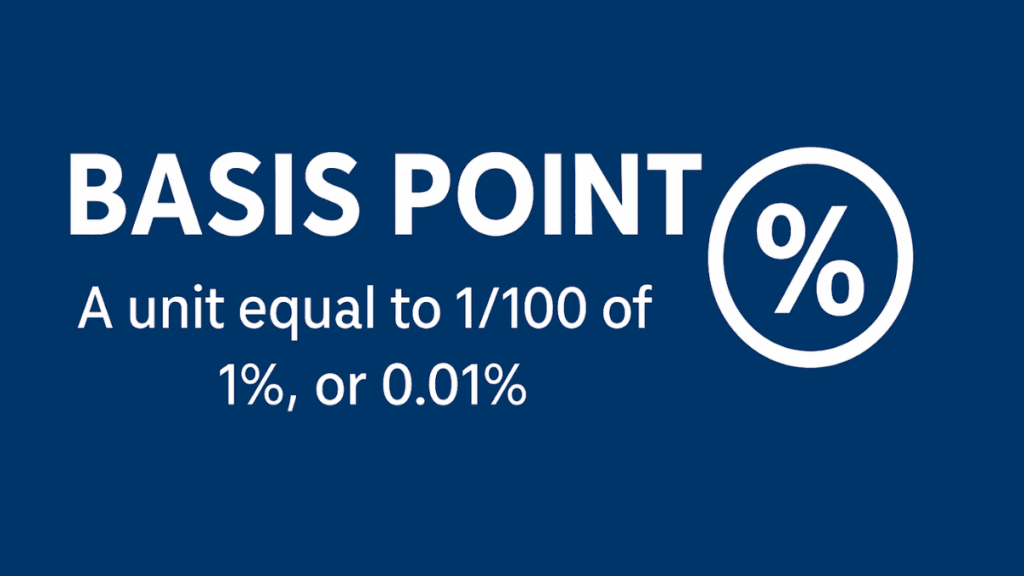
A basis point (bps) is a unit equal to 1/100 of 1%, or 0.01%. This means that:
- 100 basis points = 1%
- 1 basis point = 0.01%
Because many financial instruments move in tiny increments, using basis points helps avoid confusion between “percentage points” and “percent.” For example, an interest rate moving from 5% to 6% is an increase of 1 percentage point, but an interest rate moving from 5% to 5.05% is an increase of 5 basis points.
Why Do Financial Professionals Use Basis Points?
To understand the real value of basis points, it helps to look at the challenges they solve.
In finance, even small changes can have huge consequences, especially in loans, bonds, and investments. Percentages alone can sometimes make changes sound larger or smaller than they truly are. Basis points remove this confusion by expressing changes in a precise numerical format.
Professionals use basis points to avoid misunderstandings when discussing:
- Interest rates
- Bond yields
- Loan pricing
- Investor fees
- Central bank rate decisions
This clarity is essential because a simple misinterpretation can cost millions of dollars in large transactions.
How to Calculate Basis Points
Before using basis points in real situations, it’s good to understand how they are calculated.
The calculation is simple, and it works both ways—converting from basis points to percentages and from percentages to basis points.
Conversion Formulas
To convert basis points to percent:
Percentage = Basis Points ÷ 100
Example:
50 basis points = 50 ÷ 100 = 0.50%
To convert percent to basis points:
Basis Points = Percentage × 100
Example:
0.25% × 100 = 25 basis points
These formulas help ensure accuracy when analyzing financial changes.
Examples of Basis Points in Real Life
To fully understand how basis points work, it helps to look at situations where they are commonly used.
Below are simple examples that show how basis points make financial communication clearer.
1. Central Bank Interest Rate Changes
When a central bank raises the policy rate from 10% to 10.25%, it is easier to say the rate increased by 25 basis points instead of 0.25%.
2. Loan Pricing
A bank may lower a mortgage rate by 15 basis points, meaning the customer gets a 0.15% reduction on the interest rate.
3. Bond Market Movements
If a bond yield moves from 7.10% to 7.40%, this is an increase of 30 basis points, helping traders measure movements accurately.
4. Investment Fees
A fund manager may charge a fee of 75 basis points, which is another way of saying 0.75%.
These examples show how basis points help remove ambiguity in common financial conversations.
Why Basis Points Matter in Finance
Understanding the importance of basis points becomes easier when considering the role they play in financial decision-making.
Because financial markets rely heavily on precision, basis points help individuals and institutions understand small changes that can affect returns, risk levels, and loan costs.
Key reasons why basis points matter:
- They prevent confusion between small percentage changes.
- They make comparing financial products more accurate.
- They help investors evaluate risks with precision.
- They offer a standardized way to measure rate changes globally.
- They provide clarity in government and central bank communication.
This consistency is one reason why basis points are universally used in banking, investing, and economic reports.
Basis Point vs Percentage Point: Key Difference
Before concluding, it’s useful to understand the important difference between the two similar terms.
A percentage point refers to the absolute difference between percentages, while a basis point is used to measure small percentage movements with precision.
Example:
- Increase from 4% to 5% = 1 percentage point
- Increase from 4% to 4.10% = 10 basis points
This distinction helps avoid costly misunderstandings in finance.
Final Thoughts
A basis point is a simple but powerful tool that brings clarity to financial communication. It helps professionals, investors, and everyday individuals understand small but important changes in interest rates, yields, and fees. By using basis points, financial discussions become clearer, more precise, and easier to interpret.
This makes the basis point an essential term for anyone who wants to understand the financial world with confidence.
 Join Our Telegram Channel