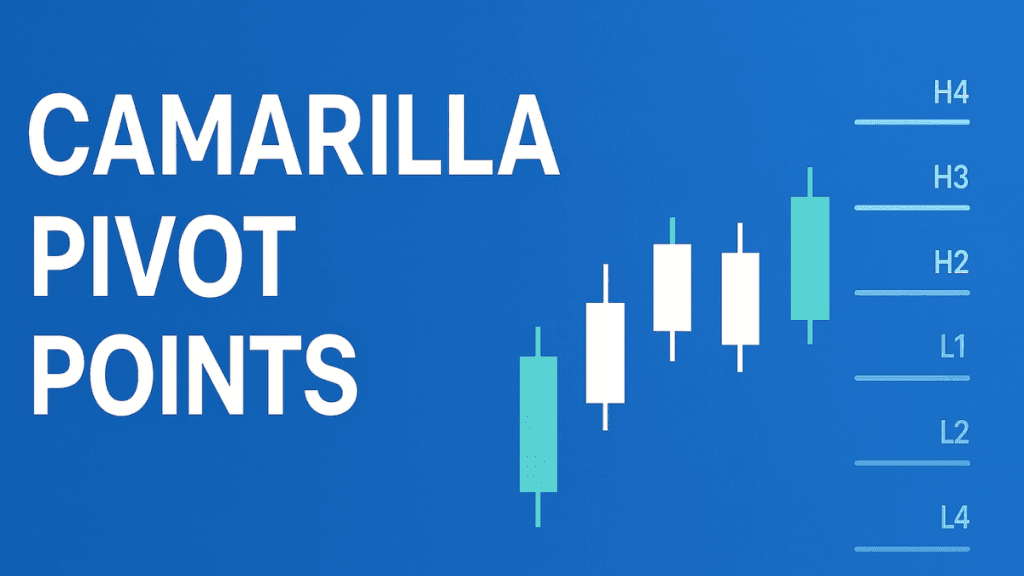
Camarilla Pivot Points are a set of advanced support and resistance levels used by traders to identify potential price turning points during intraday trading. Developed in the late 1980s by trader Nick Scott, this method expands on the classic pivot point system by adding tighter, more price-responsive levels. Because of this design, many day traders use Camarilla levels to predict reversals with high accuracy, especially in volatile markets.
Camarilla Pivot Points rely on a mathematical formula that uses the previous day’s high, low, and close prices to calculate eight intraday levels (L1–L4 and H1–H4). These levels help traders find areas whether the price may bounce, reverse, or break out.
Why Camarilla Pivot Points Matter
Camarilla levels are popular among futures, forex, crypto, and stock traders due to their ability to react quickly to price action. They create a systematic way to track market structure, especially during fast trading sessions.
Key Advantages
- Tight leveare ls ideal for scalpers and day traders
- Early signals for potential reversals
- Clear breakout and breakdown entry zones
- Works well in volatile markets
- Easy to combine with indicators like RSI, MACD, and VWAP
How Camarilla Pivot Points Work
Camarilla Pivot Points divide the market into predictable zones. These zones act as psychological and technical boundaries that help traders interpret market momentum.
The Key Levels
Camarilla Pivot Points produce four support levels and four resistance levels:
- H1, H2, H3, H4 — resistance layers
- L1, L2, L3, L4 — support layers
The H3 and L3 levels are commonly used to identify potential reversals.
The H4 and L4 levels signal possible breakouts or breakdowns.
Camarilla Pivot Point Formula
Although the full formula includes eight levels, the two most widely used calculations are:
H3 = Close + (High – Low) × 1.1 / 12
L3 = Close – (High – Low) × 1.1 / 12
These levels aim to forecast the natural high-low range of the next trading session.
H4 and L4 are more aggressive levels:
H4 = Close + (High – Low) × 1.1 / 2
L4 = Close – (High – Low) × 1.1 / 2
Traders often watch H4 and L4 to determine whether the market will perform a strong breakout.
How Traders Use Camarilla Pivot Points
The Camarilla system can support several trading styles. Most traders use it for reversal trades, breakout setups, and intraday price structure mapping.
1. Reversal Trading
Reversal traders focus heavily on the L3 and H3 levels.
- When price tests H3, traders watch for signs of weakness to short.
- When price tests L3, traders look for bullish signals to buy.
This method works best in range-bound or sideways markets.
2. Breakout Trading
Breakout traders monitor the H4 and L4 levels.
- A strong move above H4 suggests bullish continuation.
- A clean break below L4 suggests bearish continuation.
These breakouts are considered high-momentum setups that may follow strong news or volatility.
3. Trend Confirmation
Some traders use Camarilla levels as trend filters.
- Price staying above the central zone indicates bullish bias.
- Price staying below suggests bearish sentiment.
4. Mapping Market Structure
Camarilla levels act like a roadmap for daily trading sessions. They help identify:
- Intraday sentiment
- High-value reversal zones
- Potential scalping points
- Strong barriers that may cause price stalls
Best Markets for Camarilla Pivot Points
Camarilla Pivot Points can be applied to almost any asset class, but they work especially well in:
- Forex pairs (because they are highly liquid)
- Index futures (SP500, NASDAQ, DAX)
- Cryptocurrencies like BTC and ETH
- Stocks with strong intraday volatility
Their responsiveness makes them ideal for fast-moving markets.
Camarilla Pivot Points vs. Classic Pivot Points
| Feature | Camarilla Pivot Points | Classic Pivot Points |
| Sensitivity | High | Medium |
| Ideal For | Reversal traders, scalpers | Trend and breakout traders |
| Number of Levels | 8 | 7 |
| Key Focus Levels | H3, L3, H4, L4 | R1, R2, R3, S1, S2, S3 |
| Reaction to Volatility | Strong | Moderate |
Camarilla levels are tighter, more reactive, and better suited for intraday decision-making.
Tips for Using Camarilla Pivot Points Effectively
To get more accurate entries, many experienced traders combine Camarilla levels with:
- Candlestick patterns
- RSI or stochastic signals
- Trendlines
- Market sentiment tools
- Volume analysis
Simple Best Practices
- Use H3 and L3 for reversals.
- Use H4 and L4 for breakouts.
- Avoid trading every touch—wait for confirmation.
- Combine pivot zones with price action for better accuracy.
Common Mistakes Traders Make
Avoid these traps to improve trading results:
- Trading every level blindly without confirmation
- Ignoring the overall trend or market sentiment
- Using Camarilla levels alone without context
- Overusing leverage during tight, choppy sessions
Camarilla Pivot Points are a guide—not a standalone system.
Are Camarilla Pivot Points Reliable?
Camarilla levels have remained popular for decades because they adapt well to real intraday price movement. They are not perfect, but when used with clear rules and proper risk management, they provide strong insight into momentum shifts and reversal probabilities.
Their reliability depends on:
- Market conditions
- Volume
- Volatility
- Confirmation tools used alongside them
Conclusion
Camarilla Pivot Points offer a precise and dynamic way to understand intraday market behavior. Their tight structure makes them powerful tools for reversal and breakout strategies, especially in volatile markets. When combined with solid risk management and price action confirmation, they can provide a strong edge for day traders and scalpers.
Whether you trade forex, stocks, futures, or crypto, Camarilla levels can help you stay ahead of price movements and make more informed trading decisions.
FAQs About Camarilla Pivot Points
1. What makes Camarilla Pivot Points different from other pivot systems?
They provide more sensitive and tighter levels, making them ideal for short-term trading and fast market environments.
2. Are Camarilla Pivot Points good for beginners?
Yes. They are simple to use and help beginners understand intraday support and resistance zones.
3. Which levels are the most important?
H3, L3, H4, and L4 are the core levels used for reversals and breakouts.
4. Can Camarilla Pivot Points be used with other indicators?
Absolutely. Many traders combine them with RSI, MACD, VWAP, or simple candlestick patterns.
5. Do Camarilla Pivot Points work in trending markets?
They work best in ranging markets for reversals, but the H4/L4 levels can help confirm trend continuation.
 Join Our Telegram Channel