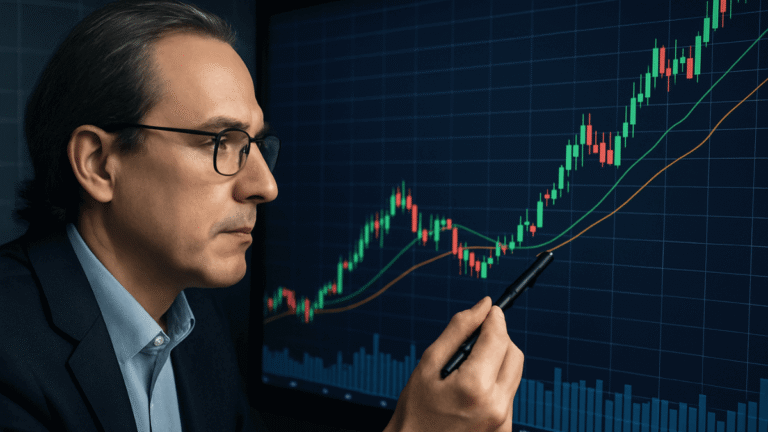
A chartist is a market participant who studies price charts to understand market behavior and make trading or investment decisions. Instead of focusing mainly on economic news or company reports, a chartist believes that price movements and patterns already reflect all available information.
In modern financial markets, chartists play an important role across stocks, forex, commodities, and cryptocurrencies. Their approach is widely used by traders who want to identify trends, key price levels, and possible market turning points.
Click here to connect with us on Telegram
To understand how chartists work and why their methods remain popular, it is important to explore their philosophy, tools, and strengths in detail.
What Is a Chartist?
A chartist is a trader or analyst who uses technical analysis as the primary method to study financial markets. This approach focuses on historical price data, volume, and chart patterns rather than company fundamentals or macroeconomic indicators.
The core belief of a chartist is that price action tells a story. By reading that story correctly, a chartist aims to anticipate future price movements with reasonable probability, not certainty.
Chartists operate in both short-term and long-term markets. Some trade within minutes or hours, while others analyze weekly or monthly charts for broader trends.
How Chartists View the Market
Before using tools or indicators, chartists rely on a specific way of thinking about price behavior. This mindset shapes every trading decision they make.
Price Discounts Everything
Chartists believe that all known information, including news, earnings, and expectations, is already reflected in the market price. Because of this, they focus more on what price is doing than why it is moving.
This does not mean chartists ignore news completely. Instead, they watch how price reacts to news, which often provides clearer signals than headlines alone.
Market Movements Are Not Random
Another key belief is that markets move in trends and cycles. Chartists study these movements to find repeating patterns that can offer trading opportunities.
Although no pattern works all the time, chartists believe that disciplined analysis improves decision-making over random guessing.
Tools Commonly Used by a Chartist
To analyze charts effectively, chartists rely on a set of well-established tools. Each tool serves a specific purpose and helps confirm market signals.
Price Charts
Price charts are the foundation of chartist analysis. Common chart types include line charts, bar charts, and candlestick charts.
Candlestick charts are especially popular because they clearly show opening, closing, high, and low prices within a given period. This visual clarity helps chartists interpret market psychology.
Trendlines and Channels
Trendlines help chartists identify the direction of the market. By connecting higher lows in an uptrend or lower highs in a downtrend, chartists can spot potential entry and exit points.
Channels are formed when price moves between two parallel trendlines. These structures help chartists anticipate support and resistance levels.
Technical Indicators
Indicators are mathematical calculations based on price or volume. Chartists use them to confirm trends, measure momentum, or identify overbought and oversold conditions.
Common indicators include moving averages, relative strength index (RSI), and moving average convergence divergence (MACD). These tools do not predict the future but help chartists manage risk and timing.
Chart Patterns Chartists Look For
Beyond indicators, chartists spend significant time studying chart patterns. These patterns reflect crowd behavior and often repeat over time.
Continuation Patterns
Continuation patterns suggest that the current trend is likely to continue after a brief pause. Examples include flags, pennants, and rectangles.
Chartists use these patterns to re-enter trends rather than chase price movements late.
Reversal Patterns
Reversal patterns indicate that a trend may be losing strength. Head and shoulders, double tops, and double bottoms are common examples.
While these patterns are useful, chartists always wait for confirmation before acting. False signals can occur in fast-moving markets.
Difference Between a Chartist and a Fundamental Analyst
Understanding this difference helps clarify where chartists fit within the broader investing world.
A chartist focuses on price behavior and market psychology. A fundamental analyst studies financial statements, economic data, and business performance.
Many experienced traders combine both approaches. However, pure chartists believe that charts provide faster and clearer signals, especially in volatile markets.
Advantages of Being a Chartist
Chartist analysis offers several practical benefits that explain its widespread use.
- It can be applied to any market with price data
- It works across different timeframes
- It supports clear risk management through stop-loss levels
Because of these advantages, chartist methods are popular among active traders and institutional professionals alike.
Limitations of Chartist Analysis
Despite its strengths, chartist analysis is not perfect. Recognizing its limits helps traders avoid unrealistic expectations.
Charts do not guarantee outcomes, and patterns can fail. Market manipulation, unexpected news, and low liquidity can distort price behavior.
For this reason, disciplined chartists combine technical analysis with proper risk control and emotional discipline.
Is Chartist Trading Still Relevant Today?
With the rise of algorithms and high-frequency trading, some question whether chartist methods still work. In reality, charts remain relevant because they reflect human behavior, which has not changed.
Even automated systems often rely on technical signals derived from price charts. This confirms that chartist principles continue to influence modern markets.
Final Thoughts
A chartist is not someone who predicts the market with certainty. Instead, a chartist is a disciplined observer of price behavior who makes decisions based on probability and structure.
By focusing on trends, patterns, and risk management, chartists aim to stay aligned with the market rather than fight it. When used correctly, chartist analysis remains a powerful tool for understanding and navigating financial markets.
 Join Our Telegram Channel