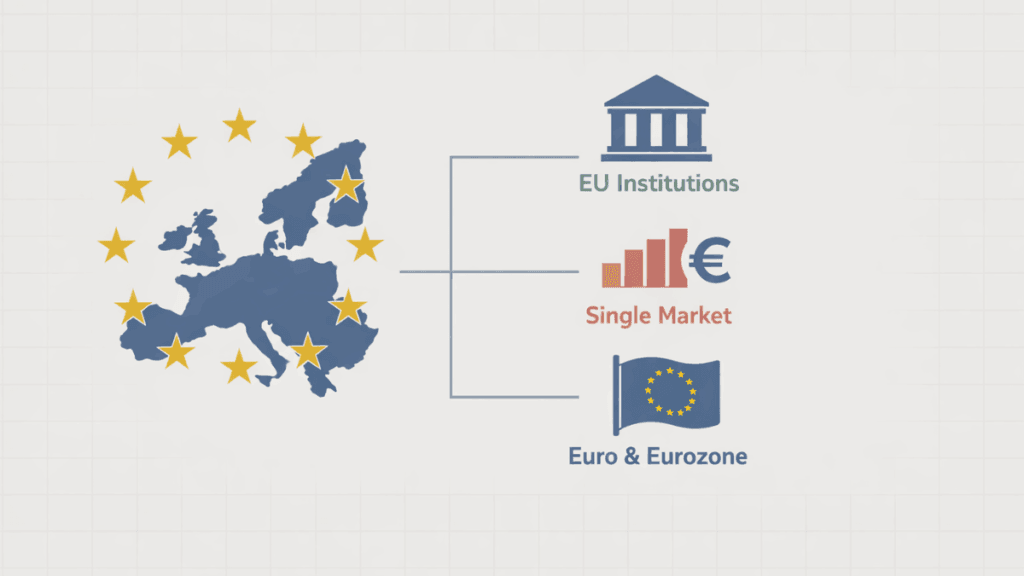
The European Union (EU) is a political and economic union of European countries that work together to promote peace, stability, and shared prosperity. It brings member states under a common framework that supports cooperation in areas such as trade, law, human rights, and regional development.
In practical terms, the European Union allows its members to coordinate policies, remove trade barriers, and give citizens certain shared rights, including the freedom to live, work, and study across member countries. While the EU is not a single country, it operates through common institutions that make decisions binding on its members in agreed areas.
Click Here To Join our Telegram Community
Purpose and Core Objectives of the European Union
The European Union was created with a clear mission centered on unity and cooperation among European nations. Its objectives are defined in EU treaties and guide how policies and laws are developed.
At its core, the EU aims to maintain peace, encourage economic growth, and improve living standards across Europe. It also works to strengthen democracy, protect human rights, and ensure the rule of law within its borders.
Key objectives include:
- Promoting peace and political stability among member states
- Creating a single market with free movement of goods, services, capital, and people
- Supporting sustainable economic and social development
- Protecting consumer rights, workers’ rights, and the environment
History and Formation of the European Union
The European Union grew out of efforts to prevent future conflict in Europe after World War II. European leaders believed that economic cooperation would make war between neighboring countries less likely.
The earliest step was the European Coal and Steel Community in 1951, which linked the key industries of six countries. Over time, cooperation expanded through new treaties, eventually leading to the formal establishment of the European Union in 1993 under the Maastricht Treaty.
EU Member States and Enlargement
The European Union is made up of sovereign countries that voluntarily choose to join and accept shared rules and obligations. Membership requires meeting strict political, legal, and economic criteria.
Since its early beginnings with six members, the EU has expanded several times, especially after the Cold War. Enlargement has helped integrate Central and Eastern European countries into a shared political and economic framework.
Key Institutions of the European Union
The European Union operates through several core institutions, each with a distinct role. Together, these bodies ensure that EU laws are proposed, debated, adopted, and enforced.
These institutions balance national interests with collective European goals, creating a system that combines intergovernmental cooperation with supranational decision-making.
European Commission
The European Commission serves as the EU’s executive body and is responsible for proposing new laws. It also ensures that EU rules are applied fairly across all member states.
Commissioners act in the interest of the entire Union rather than their home countries. This structure is designed to maintain neutrality and consistency in policy enforcement.
European Parliament
The European Parliament represents EU citizens directly and is elected by voters across member states. It plays a key role in debating, amending, and approving EU legislation.
Parliament also oversees the work of other institutions, adding a democratic check to the EU’s decision-making process.
Council of the European Union
The Council of the European Union represents the governments of member states. It works alongside the European Parliament to adopt laws and coordinate national policies.
Council decisions reflect national interests while still contributing to shared European outcomes.
Court of Justice of the European Union
The Court of Justice of the European Union ensures that EU law is interpreted and applied consistently. It resolves legal disputes between member states, institutions, businesses, and individuals.
This court plays a crucial role in upholding the rule of law across the Union.
The Single Market and Economic Integration
One of the European Union’s most significant achievements is the creation of the single market. This system allows goods, services, people, and capital to move freely between member states.
By reducing barriers and harmonizing standards, the single market encourages competition, innovation, and economic efficiency. It benefits consumers through wider choice and often lower prices.
The Euro and the Eurozone
Not all EU countries use the same currency, but many have adopted the euro. The group of countries that use the euro is known as the eurozone.
The euro simplifies trade and travel within participating countries and reduces currency exchange risks. Monetary policy for the eurozone is managed by the European Central Bank.
Laws, Regulations, and Decision-Making
European Union law has direct effects in many areas of daily life, from consumer protection to environmental standards. EU laws are created through a structured process involving multiple institutions.
Some EU laws apply automatically across member states, while others require national governments to adapt their own laws. This system balances shared rules with national flexibility.
Benefits of the European Union
The European Union delivers a wide range of benefits to its citizens and businesses. These advantages extend beyond economics to social, legal, and political areas.
EU membership supports:
- Easier travel, work, and study across borders
- Stronger consumer and environmental protections
- Greater economic opportunities through a large unified market
- Collective influence in global trade and diplomacy
Criticisms and Challenges Facing the EU
Despite its achievements, the European Union faces ongoing challenges and criticism. Some concerns focus on democratic accountability, national sovereignty, and bureaucratic complexity.
Other challenges include managing economic differences between member states, responding to migration pressures, and addressing geopolitical tensions. These issues continue to shape debates about the EU’s future direction.
European Union vs. Other International Organizations
The European Union differs from most international organizations because it can pass laws that directly affect citizens and businesses. This sets it apart from bodies that rely mainly on voluntary cooperation.
Unlike a traditional alliance, the EU combines economic integration with political coordination, making it one of the most advanced forms of regional cooperation in the world.
Why the European Union Matters Today
The European Union plays a major role in shaping global trade, environmental policy, and international standards. Acting collectively, member states have greater influence than they would individually.
In an increasingly interconnected world, the EU provides a framework for cooperation that helps address shared challenges while promoting stability and long-term growth.
Key Takeaways
The European Union is a unique political and economic union built on cooperation, shared rules, and common values. It connects sovereign nations while respecting national identities.
Understanding how the EU works helps clarify its impact on everyday life, global affairs, and the future of regional integration in Europe.
 Join Our Telegram Channel