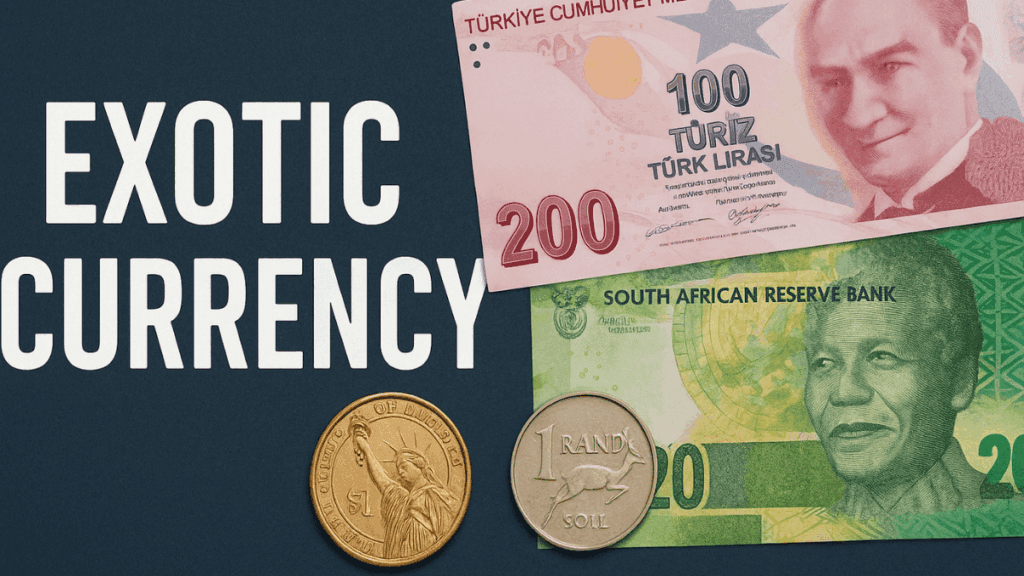
In the vast world of foreign exchange (forex), traders deal with three categories of currency pairs: major, minor, and exotic. An exotic currency represents a currency from a developing or emerging market economy, such as the Turkish Lira (TRY), South African Rand (ZAR), or Thai Baht (THB). These currencies are paired with a major one, usually the U.S. dollar (USD) or the Euro (EUR), and attract traders seeking higher volatility and potential profit.
What Is an Exotic Currency?
An exotic currency is typically issued by a smaller or less developed economy. It is traded less frequently in global markets than major currencies such as the USD, EUR, or JPY. Examples include:
- USD/TRY – U.S. Dollar vs Turkish Lira
- USD/ZAR – U.S. Dollar vs South African Rand
- USD/THB – U.S. Dollar vs Thai Baht
- EUR/SEK – Euro vs Swedish Krona
These pairs are called “exotic pairs” because they are less liquid, meaning there are fewer buyers and sellers in the market. As a result, they often come with wider spreads and greater price swings.
Characteristics of Exotic Currencies
Before trading or investing in exotic currencies, it’s essential to understand what sets them apart:
1. Low Liquidity
Exotic currencies have lower trading volumes. This makes it harder to enter or exit trades at desired prices, especially during off-peak hours.
2. High Volatility
They can experience large price movements due to political instability, economic changes, or limited market participation. For traders, this can mean high profit potential — or high losses.
3. Wider Spreads
Because these currencies are traded less frequently, brokers often charge higher transaction costs (spreads). This increases the cost of trading.
4. Economic Dependence
Many exotic currencies rely heavily on exports, commodities, or tourism. Any global disruption affecting these sectors can quickly impact the currency’s value.
Examples of Exotic Currencies and Their Regions
To give context, here are a few commonly recognized exotic currencies grouped by region:
Asia
- Thai Baht (THB)
- Malaysian Ringgit (MYR)
- Indonesian Rupiah (IDR)
- Philippine Peso (PHP)
Africa
- South African Rand (ZAR)
- Egyptian Pound (EGP)
- Kenyan Shilling (KES)
- Nigerian Naira (NGN)
Middle East and Eastern Europe
- Turkish Lira (TRY)
- Saudi Riyal (SAR)
- Hungarian Forint (HUF)
- Polish Zloty (PLN)
These currencies often represent economies that are growing but still developing, making them appealing for investors seeking diversification and potential high returns.
Why Traders Choose Exotic Currencies
Despite their risks, exotic currencies hold a certain appeal for adventurous traders. Here’s why:
1. Higher Profit Potential
Because exotic pairs move more dramatically than major pairs, even small investments can yield substantial returns if timed correctly.
2. Portfolio Diversification
Traders and investors often include exotic currencies to spread their risk across different economies and regions.
3. Economic Trends and Arbitrage Opportunities
Sharp changes in inflation, interest rates, or government policies in emerging markets can create short-term trading opportunities.
The Risks of Trading Exotic Currencies
While the rewards may seem tempting, the risks are equally significant. Understanding these challenges helps traders make informed decisions.
1. Political and Economic Instability
Emerging markets often experience political uncertainty, inconsistent monetary policies, and limited central bank transparency, all of which can drive sudden price swings.
2. High Transaction Costs
Because liquidity is low, brokers often set wider spreads. A 50-pip spread on a pair like USD/TRY is common, compared to just 1–2 pips for EUR/USD.
3. Limited Market Information
Data transparency can be a problem. Many exotic markets lack timely economic reports, which can make fundamental analysis more challenging.
4. Currency Controls and Restrictions
Some governments impose restrictions on currency exchange or capital flow to stabilize their economies. These controls can limit trading flexibility.
How to Trade Exotic Currencies Wisely
Trading exotic currencies requires a thoughtful strategy and risk management. Here’s how to approach it safely:
1. Start Small
Because volatility can be extreme, new traders should begin with small positions until they understand how the pair behaves.
2. Monitor Economic News
Stay updated with the latest economic and political developments from the country behind the exotic currency. Central bank announcements, elections, or trade data can move markets instantly.
3. Use Stop-Loss Orders
Always protect your capital with stop-loss orders to limit potential losses from unexpected volatility.
4. Choose a Reliable Broker
Work only with regulated brokers that offer fair spreads and strong liquidity even for less-traded pairs.
5. Combine Technical and Fundamental Analysis
Using tools like Moving Averages, RSI, and MACD alongside macroeconomic data can improve entry and exit timing.
The Future of Exotic Currencies
The global economy is evolving, and so is the forex market. As more developing nations open their markets and adopt digital trading infrastructure, exotic currencies are expected to gain more attention. Some, like the Chinese Yuan (CNY) or the Indian Rupee (INR), may transition from being considered exotic to becoming semi-major pairs as global trade participation increases.
However, volatility, political risk, and market transparency will continue to play a big role in determining their long-term appeal.
Click Here To Join our Telegram Community
Final Thoughts
Exotic currencies offer a mix of excitement, risk, and opportunity in the forex world. Experienced traders can provide higher profit margins and portfolio diversity. But for beginners, the unpredictability can be overwhelming without a proper strategy and risk control.
Understanding how exotic currencies behave and why they differ from major pairs is the first step to navigating them wisely. Approach with patience, stay informed, and always trade with a plan.
 Join Our Telegram Channel