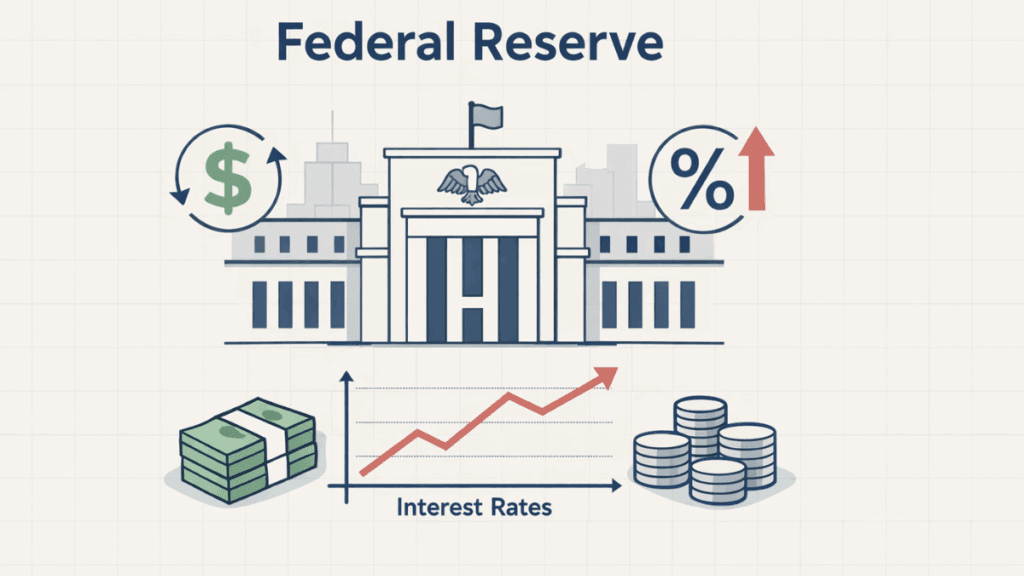
The Federal Reserve is the central bank of the United States, and it plays a decisive role in how the American and global economies function. From setting interest rates to keeping banks stable, the Federal Reserve influences inflation, employment, borrowing costs, and financial confidence in ways that affect everyday life.
This guide explains the Federal Reserve in clear, simple terms. It is designed for readers who want a solid understanding without an advanced financial background, while still offering depth and accuracy for informed readers.
Click Here To Join our Telegram Community
What Is the Federal Reserve?
The Federal Reserve is the institution responsible for managing the U.S. monetary system and ensuring financial stability. It acts as the country’s central bank, which means it oversees money supply, credit conditions, and the banking system.
Although it works closely with the U.S. government, the Federal Reserve operates independently. This independence allows it to make long-term economic decisions without political pressure, which is essential for maintaining trust in the financial system.
Why the Federal Reserve Was Created
The Federal Reserve was created in response to repeated financial crises that exposed weaknesses in the U.S. banking system. Before its establishment, bank failures and economic panics were common and difficult to control.
In 1913, Congress passed the Federal Reserve Act to create a central authority that could provide stability. The goal was to prevent bank runs, manage liquidity during crises, and create a safer financial environment for businesses and households.
How the Federal Reserve Is Structured
The Federal Reserve is not a single bank but a system made up of several connected parts. Each part has a specific role that supports the overall mission of economic stability.
The Board of Governors
The Board of Governors is the main decision-making body at the national level. Its members are appointed by the U.S. President and confirmed by the Senate, serving long terms to protect independence.
This board sets key policies, supervises major banks, and provides leadership for the entire Federal Reserve System.
The Federal Reserve Banks
There are 12 regional Federal Reserve Banks across the United States. These banks represent different parts of the country and ensure that regional economic conditions are considered in national policy decisions.
They also provide banking services to commercial banks, process payments, and conduct economic research.
The Federal Open Market Committee (FOMC)
The Federal Open Market Committee is the group that decides monetary policy, including interest rates. It meets regularly to assess economic conditions and determine whether policy adjustments are needed.
Because its decisions directly affect borrowing costs and financial markets, the FOMC is closely watched by investors, businesses, and governments around the world.
What the Federal Reserve Does
The Federal Reserve has several core responsibilities that support a stable and growing economy. Each responsibility connects directly to everyday financial activity.
Managing Monetary Policy
Monetary policy refers to how the Federal Reserve controls money and credit conditions. Its main goals are stable prices, maximum employment, and moderate long-term interest rates.
By adjusting policy tools, the Federal Reserve influences how easy or expensive it is to borrow money.
Supervising and Regulating Banks
The Federal Reserve monitors banks to ensure they operate safely and fairly. This oversight helps protect consumers, prevent excessive risk-taking, and maintain confidence in the banking system.
Strong supervision also reduces the likelihood that problems at individual banks will spread to the broader economy.
Maintaining Financial Stability
During periods of economic stress, the Federal Reserve acts as a stabilizing force. It can provide emergency liquidity to financial institutions to prevent panic and systemic collapse.
This role became especially important during major crises, when confidence in financial markets was at risk.
How the Federal Reserve Sets Interest Rates
Interest rates are one of the most powerful tools the Federal Reserve uses. Rather than setting all rates directly, it targets short-term rates that influence the entire financial system.
The most important of these is the federal funds rate, which affects loans, mortgages, credit cards, and savings accounts. When this rate changes, borrowing and spending behavior across the economy tends to change as well.
Tools the Federal Reserve Uses
The Federal Reserve relies on several policy tools to guide the economy. Each tool affects financial conditions in a different way.
- Open market operations, which involve buying or selling government securities to control liquidity
- Interest on reserve balances, which influences how much banks lend or hold
- Discount window lending, which provides short-term loans to banks in need
These tools allow the Federal Reserve to respond flexibly to changing economic conditions.
The Federal Reserve and Inflation
Inflation is one of the main concerns of the Federal Reserve because rising prices reduce purchasing power. When inflation is too high, everyday goods and services become harder to afford.
To control inflation, the Federal Reserve may raise interest rates to slow spending and borrowing. When inflation is too low, it may lower rates to encourage economic activity.
The Federal Reserve and Employment
Supporting employment is a key part of the Federal Reserve’s mandate. While it does not create jobs directly, its policies influence how businesses invest and hire.
Lower interest rates often encourage expansion and job creation, while higher rates can slow the economy when it is overheating. The challenge is balancing job growth with price stability.
Independence of the Federal Reserve
The Federal Reserve is designed to operate independently from day-to-day political influence. This structure helps ensure decisions are based on economic data rather than short-term political goals.
Even so, the Federal Reserve remains accountable to Congress and regularly reports on its actions and policies.
How Federal Reserve Decisions Affect Everyday Life
The actions of the Federal Reserve extend far beyond financial markets. Its decisions shape the cost of living, access to credit, and overall economic confidence.
Changes in interest rates can affect mortgage payments, student loans, car financing, and savings returns. For this reason, Federal Reserve policy touches nearly every household.
The Federal Reserve’s Global Influence
Because the U.S. dollar is the world’s primary reserve currency, the Federal Reserve has global influence. Its policy decisions often affect exchange rates, capital flows, and financial stability in other countries.
Central banks around the world closely monitor the Federal Reserve, especially during periods of economic uncertainty.
Common Misunderstandings About the Federal Reserve
Many people believe the Federal Reserve is a private institution or is directly controlled by politicians. In reality, it has a unique public-private structure with strong government oversight.
Another common misunderstanding is that it controls all economic outcomes. While powerful, the Federal Reserve cannot prevent every recession or crisis, and its tools have limits.
Why Understanding the Federal Reserve Matters
Understanding the Federal Reserve helps people make better financial decisions and interpret economic news more accurately. Interest rate changes, inflation reports, and policy statements all become clearer with basic knowledge.
For investors, business owners, and everyday consumers, knowing how the Federal Reserve works provides valuable insight into where the economy may be heading.
Final Thoughts
The Federal Reserve is one of the most influential institutions in the global financial system. Its role in managing money, credit, and stability makes it central to economic life in the United States and beyond.
By understanding its structure, tools, and goals, readers can better appreciate how major economic decisions are made and how those decisions affect their daily lives.
 Join Our Telegram Channel