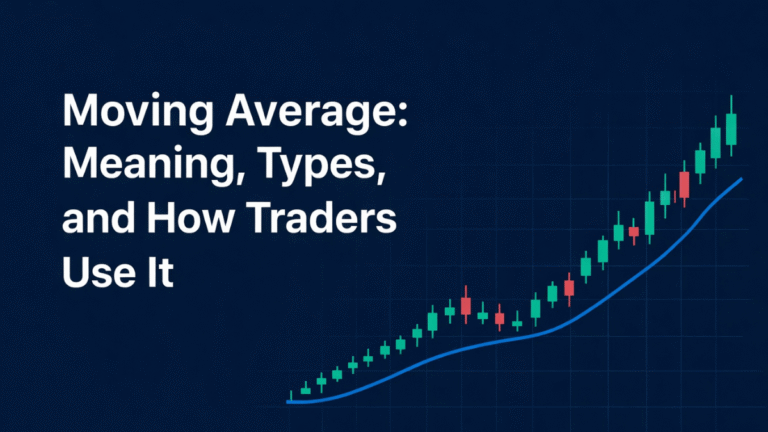
Understanding trends is one of the biggest challenges in trading, which is why the Moving Average remains one of the most trusted tools across Forex, crypto, stocks, and commodities. A moving average helps smooth out price data so traders can see the market direction more clearly, reducing the “noise” that comes with daily price spikes. In this guide, you will learn what a moving average is, how it works, its main types, and how professional traders use it in real trading environments.
Before diving into the different forms of moving averages, it is helpful to understand why traders rely on them and what problems they solve.
Click here to connect with us on Telegram
What Is a Moving Average?
A moving average (MA) is a technical indicator that calculates the average price of an asset over a specific period. As new price data comes in, the old data is removed, and the average “moves” forward, hence the name moving average. It smooths the price chart and helps traders identify whether the market is trending up, trending down, or consolidating.
The moving average does not predict the future. Instead, it reflects the current market direction by filtering out short-term price fluctuations that can confuse traders.
Why Moving Averages Are Useful in Trading
Before looking at the variations of moving averages, it is important to understand why traders use them. Moving averages offer several advantages:
- They help confirm trends and reduce emotional trading.
- They act as dynamic support and resistance levels.
- They simplify complex price movements into clear signals.
- They help traders avoid entering trades during uncertain market conditions.
These benefits make moving averages popular among day traders, swing traders, and long-term investors.
Types of Moving Averages
Now that the purpose of moving averages is clearer, we can examine the main types used in trading. Each type reacts differently to price changes and is suitable for different strategies.
Simple Moving Average (SMA)
A Simple Moving Average is the most basic form of moving average. It calculates the average closing price of an asset over a chosen period, such as 20, 50, or 200 days.
An SMA gives equal weight to all prices within the selected period. This makes it smooth and reliable, but slower to react when prices change quickly. Traders often use the SMA to determine long-term trends, especially the 50-day and 200-day SMAs.
Exponential Moving Average (EMA)
The Exponential Moving Average gives more weight to recent prices. Unlike the SMA, the EMA reacts faster to changes in price, making it more suitable for short-term and fast-moving markets such as Forex and crypto.
Because it responds quickly, traders use the EMA to spot early reversals or momentum shifts. Common EMAs include the 20 EMA and 50 EMA, often used together to confirm trends or signal entries.
Weighted Moving Average (WMA)
A Weighted Moving Average also assigns more importance to recent price data, but the weighting is linear rather than exponential. This means the newest price gets the highest weight, and the importance decreases for older prices in a predictable way.
The WMA reacts faster than the SMA but is less sensitive than the EMA. Traders usually use it when they want a balanced representation of recent price action without too much noise.
How Moving Averages Work in Real Trading
Understanding the mechanics of moving averages is helpful, but what matters most to traders is how to use them effectively. Before exploring specific strategies, it is important to understand the two main ways moving averages provide insights.
1. Identifying the Market Trend
Moving averages help traders understand whether the market is bullish, bearish, or ranging.
- If the price stays above the moving average, the trend is likely upward.
- If the price stays below the moving average, the trend is likely downward.
- If the price crosses back and forth, the market may be consolidating.
This simple interpretation supports traders in avoiding trades that go against the trend.
2. Using Moving Averages as Dynamic Support and Resistance
Moving averages tend to act as barriers that price reacts to. When the market is trending, the moving average often behaves like a support level in uptrends or a resistance level in downtrends. Traders watch for price touches or bounces near these levels to time their entries or exits.
Popular Moving Average Strategies
Before applying strategies, traders must remember that moving averages work better in trending markets and may give false signals in sideways conditions.
Moving Average Crossovers
A crossover happens when a short-term moving average crosses above or below a long-term one.
- A bullish crossover occurs when the short-term MA crosses above the long-term MA.
- A bearish crossover occurs when the short-term MA crosses below the long-term MA.
The most popular example is the Golden Cross (50 SMA crossing above 200 SMA) and the Death Cross (50 SMA crossing below 200 SMA).
Pullback Entries Using the Moving Average
Another strategy is entering a trade when the price pulls back to a moving average during a strong trend. Traders prefer EMAs for this strategy because they align more closely with real-time price action.
This method helps traders avoid chasing prices and ensures they enter in line with the market direction.
MA + Price Action Combination
Many professionals combine moving averages with price action patterns such as:
- Rejections or wicks near the MA
- Break and retest formations
- Trendline confirmations
This combination reduces false signals and improves decision-making.
Advantages and Limitations of Moving Averages
Before relying heavily on moving averages, traders should understand their strengths and weaknesses.
Advantages
- They simplify market analysis and reduce confusion.
- They help traders stay aligned with the trend.
- They can act as reliable dynamic support and resistance levels.
- They are useful for timing entries and exits.
Limitations
- They lag behind current prices because they are based on past data.
- They give false signals in ranging or choppy markets.
- They must be combined with other tools for greater accuracy.
Conclusion
The moving average is one of the most important and versatile indicators in trading. It helps simplify price movements, identify trends, and support decision-making in both short-term and long-term strategies. Whether you are trading Forex, crypto, indices, or stocks, mastering the moving average gives you a stronger foundation for analyzing the market with clarity and confidence.
By understanding its types, behavior, and practical uses, traders can apply moving averages more effectively and avoid common mistakes.
 Join Our Telegram Channel