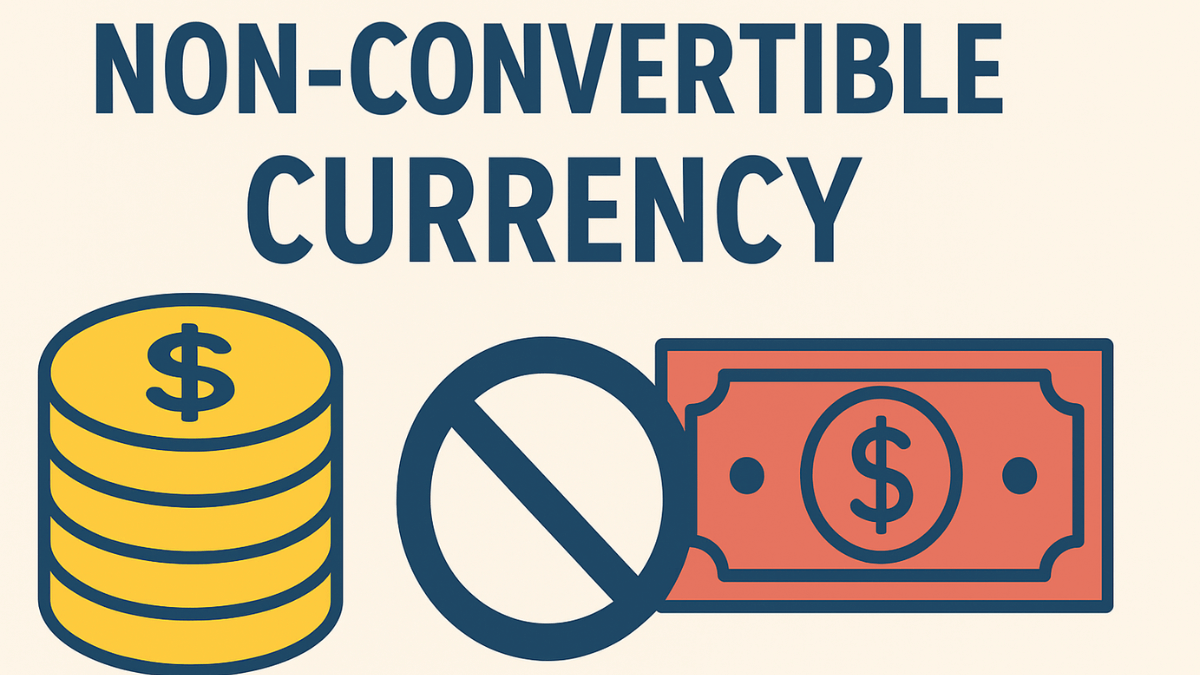
A non-convertible currency is a vital concept in international finance, especially for investors, travelers, and global businesses. The term non-convertible currency refers to money that cannot be freely exchanged in the global foreign exchange market. Understanding how it works helps you make informed financial decisions and recognize the economic policies behind it.
What Is a Non-Convertible Currency?
Before diving deeper, it is important to understand why some currencies are fully convertible while others are restricted. A non-convertible currency (also known as an inconvertible or restricted currency) is money that cannot be exchanged freely for another currency without government approval. This means individuals or businesses cannot directly buy or sell it on the international forex market.
Countries use currency restrictions to protect their economies, regulate capital flows, and maintain stability during periods of uncertainty.
Click here to connect with us on Telegram
Why Do Some Countries Use Non-Convertible Currencies?
To better understand this concept, we must first look at the reasons behind restricted convertibility. Governments usually limit currency movement due to economic, political, or financial concerns. These restrictions help them maintain control over domestic money flows.
1. Protecting the Local Economy
Some countries fear sudden capital flight—when large amounts of money leave the country quickly. Restricting currency convertibility reduces this risk and promotes economic stability.
2. Controlling Inflation
Unrestricted exchange can increase demand for foreign currency, weakening the local currency. By limiting convertibility, governments try to manage inflation and protect purchasing power.
3. Maintaining Exchange Rate Stability
A freely floating currency can be volatile. Countries with fragile economies may restrict forex activities to keep exchange rates predictable.
4. Conserving Foreign Reserves
Governments need foreign currency reserves for imports, debt payments, and emergency stabilization. Non-convertibility ensures that reserves are not drained by uncontrolled exchange.
How Non-Convertible Currencies Work
Before exploring examples, it helps to understand how these currencies operate in practice. You cannot simply walk into a forex bureau or bank and convert a non-convertible currency into USD, EUR, or GBP. Instead, conversions require:
- Government authorization
- A central bank permit
- An official exchange channel
- A specific purpose (such as trade or foreign investment)
These controls mean that tourists, international investors, and foreign companies must follow strict procedures.
Examples of Non-Convertible Currencies
Now that the concept is clearer, let’s look at real-world examples. Many countries restrict currency convertibility to varying degrees. Common examples include:
- North Korean Won (KPW)
- Cuban Peso (CUP)
- Ethiopian Birr (ETB)
- Zimbabwean Dollar (ZWL)
- Iranian Rial (IRR)
These currencies are not freely traded in global forex markets. In most cases, only the government or authorized institutions are allowed to exchange them.
Non-Convertible Currency vs. Convertible Currency
To understand non-convertibility better, it helps to compare it with fully convertible currencies. Here is a simple distinction that shows the difference:
Convertible Currency
- Freely traded on global forex markets
- No major government restrictions
- Example: USD, EUR, GBP, JPY
Non-Convertible Currency
- Strict exchange restrictions
- Requires government approval for conversion
- Not traded openly on international markets
This comparison highlights how restricted currencies limit financial flexibility but can strengthen government control.
Advantages of Non-Convertible Currencies
Even though restrictions may seem limiting, they serve several economic purposes. Countries with fragile financial systems often benefit from such policies.
1. Economic Stability
Limiting currency movement helps governments avoid dangerous fluctuations in exchange rates.
2. Protection Against Speculation
Speculative attacks can damage a weak currency. Non-convertibility prevents this by blocking open-market trading.
3. Better Control of Capital Flows
Governments can regulate the direction and volume of money entering or leaving the country.
Disadvantages of Non-Convertible Currencies
While non-convertibility may stabilize the economy in the short term, it also creates challenges.
1. Reduced Foreign Investment
Global investors prefer currencies they can easily exchange. Restrictions discourage investment.
2. Limited International Trade
Importers and exporters must deal with extra bureaucracy, making trade more expensive.
3. Difficulty for Travelers
Tourists cannot freely exchange the currency abroad, which leads to inconvenience and extra costs.
4. Parallel or Black Markets
Strict controls often lead to unofficial exchange markets, where rates differ significantly from official ones.
Impact on Businesses and Investors
Before closing, it is important to understand how non-convertible currencies affect global business operations. Companies working in such countries often face:
- Complex approval processes
- Delays in profit repatriation
- Higher transaction costs
- Exchange rate uncertainties
Foreign investors may hesitate to enter markets with restricted currency rules, slowing economic growth.
Is a Non-Convertible Currency Good or Bad?
There is no simple answer. It depends on the economic goals and stability of a country. For nations facing financial risks, restricting convertibility may be a temporary protective measure. However, long-term growth typically requires more openness, transparency, and currency flexibility.
Final Thoughts
A non-convertible currency plays a key role in shaping how a country interacts with the global economy. While restrictions can stabilize weak economies, they may also slow trade, investment, and economic development. By understanding how these currencies work, investors, travelers, and businesses can navigate complex markets more confidently.
 Join Our Telegram Channel