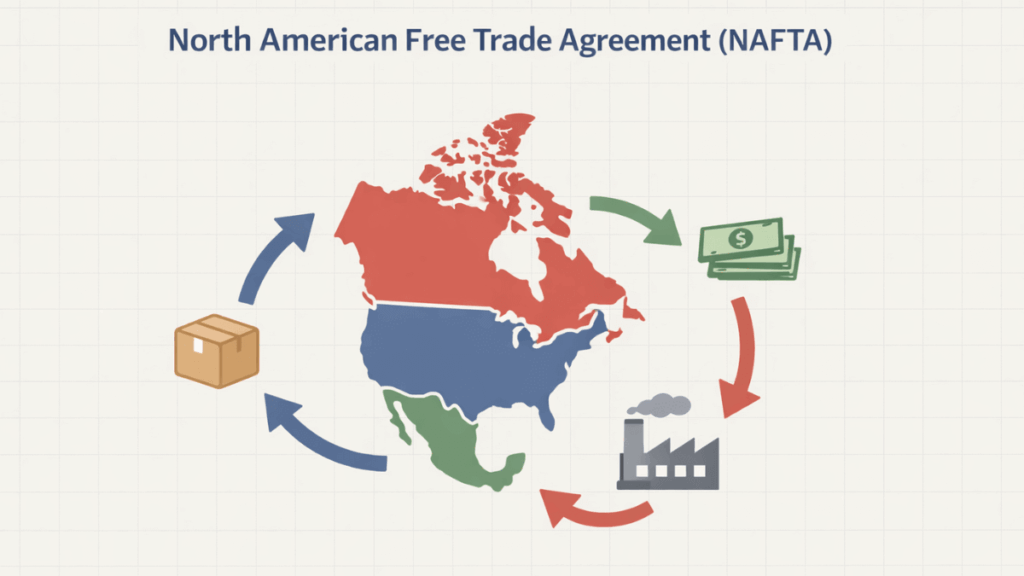
The North American Free Trade Agreement (NAFTA) was a landmark trade pact that reshaped economic relations between the United States, Canada, and Mexico for more than two decades. From its launch in the mid-1990s to its eventual replacement, NAFTA influenced how goods were produced, traded, and priced across North America.
This guide explains NAFTA in clear, practical terms, covering why it was created, how it worked, what it achieved, and why it ultimately changed. It is written for readers who want a solid understanding without needing a background in economics or international law.
Click Here To Join our Telegram Community
What Was NAFTA?
The North American Free Trade Agreement was a trilateral trade agreement designed to reduce barriers to trade between the United States, Canada, and Mexico. Its central goal was to make cross-border trade easier and cheaper by removing tariffs and aligning trade rules.
NAFTA officially came into force on January 1, 1994. At the time, it created one of the world’s largest free trade areas, linking economies at very different stages of development under a shared set of trade rules.
Why NAFTA Was Created
NAFTA was created to deepen economic cooperation across North America. Policymakers believed that freer trade would strengthen competitiveness, lower consumer prices, and encourage long-term economic growth.
Another motivation was to provide stable, predictable trade rules. By locking in commitments through a formal agreement, governments aimed to give businesses confidence to invest and build supply chains across borders.
Countries Involved in NAFTA
NAFTA brought together three neighboring economies with close geographic and economic ties. Each country entered the agreement with different priorities and expectations.
United States
The United States viewed NAFTA as a way to expand export markets and reinforce its economic leadership in the region. Supporters also argued that stronger trade ties with Mexico would support political and economic stability.
Canada
Canada already had a free trade agreement with the United States before NAFTA. Joining the trilateral pact helped Canada preserve access to the U.S. market while gaining improved trade terms with Mexico.
Mexico
For Mexico, NAFTA represented a major step toward economic integration with advanced economies. The agreement was seen as a way to attract foreign investment, modernize industry, and support economic reforms.
Core Objectives of NAFTA
NAFTA was built around several clear objectives that shaped its structure and rules. These goals guided how the agreement was negotiated and implemented.
The main objectives included:
- Eliminating tariffs and reducing non-tariff barriers on most goods
- Promoting fair competition across member countries
- Encouraging investment and protecting intellectual property
- Establishing procedures to resolve trade disputes
Together, these aims were intended to create a more open and predictable trading environment across North America.
How NAFTA Worked in Practice
NAFTA did more than cut tariffs. It set detailed rules that affected how goods were made, how services were delivered, and how disputes were handled.
Tariff Elimination
One of NAFTA’s most visible effects was the gradual removal of tariffs on thousands of products. Some tariffs disappeared immediately, while others were phased out over periods of up to 15 years.
This process made cross-border trade cheaper and encouraged companies to source materials and components from within North America rather than from outside the region.
Rules of Origin
NAFTA included “rules of origin” to define which goods qualified for tariff-free treatment. These rules ensured that benefits applied mainly to products genuinely made in North America.
The rules were especially important in industries such as automobiles, where parts often crossed borders multiple times during production.
Services and Investment
Beyond goods, NAFTA opened many service sectors to foreign providers. It also offered protections to investors, including safeguards against unfair treatment by host governments.
These provisions played a major role in shaping cross-border investment, particularly in manufacturing and energy.
Economic Impact of NAFTA
NAFTA had wide-ranging economic effects, some clearly positive and others more contested. Its impact varied across industries, regions, and social groups.
Trade between the three countries increased significantly after NAFTA took effect. Supply chains became more integrated, especially in sectors such as automotive manufacturing, agriculture, and electronics.
Benefits Often Attributed to NAFTA
Supporters of NAFTA point to several long-term benefits that emerged from the agreement. These outcomes were not evenly distributed, but they reshaped the regional economy.
Lower tariffs helped reduce costs for consumers and businesses. Companies gained access to larger markets, which supported growth and efficiency.
NAFTA also encouraged investment, particularly in Mexico, where manufacturing hubs expanded rapidly along the U.S. border.
Criticisms and Controversies
Despite its benefits, NAFTA faced strong criticism from various groups. Concerns focused on jobs, wages, and environmental standards.
Some critics argued that NAFTA contributed to job losses in certain industries, especially in regions where factories moved production to lower-cost areas. Others raised concerns about labor protections and environmental enforcement.
These debates played a major role in shaping public opinion about trade agreements more broadly.
NAFTA and Labor Issues
Labor standards were a sensitive topic throughout NAFTA’s history. While the agreement included side agreements on labor cooperation, critics argued they lacked strong enforcement.
Supporters countered that economic growth and investment would gradually improve labor conditions. In practice, results varied widely by industry and location.
Environmental Considerations Under NAFTA
Environmental protection was addressed through a separate agreement alongside NAFTA. This arrangement aimed to prevent countries from lowering environmental standards to attract investment.
Although the framework encouraged cooperation, enforcement depended heavily on national governments. This led to ongoing debate about whether environmental protections were sufficient.
Dispute Resolution Under NAFTA
NAFTA established formal mechanisms to resolve trade disputes between member countries. These procedures were designed to prevent conflicts from escalating into trade wars.
One of the most debated elements was the investor-state dispute settlement system. Critics argued it gave corporations too much power, while supporters saw it as essential for protecting cross-border investment.
Replacement of NAFTA
Over time, political and economic conditions changed, leading to calls for a revised agreement. These pressures eventually resulted in NAFTA being replaced.
In 2020, NAFTA was formally replaced by the United States–Mexico–Canada Agreement (USMCA). The new agreement updated rules on labor, digital trade, and intellectual property while preserving many core features of NAFTA.
NAFTA’s Long-Term Legacy
NAFTA’s legacy is complex and deeply influential. It demonstrated how closely integrated modern economies can become through trade agreements.
The agreement also shaped future trade negotiations by highlighting both the opportunities and challenges of economic integration. Many lessons from NAFTA informed later trade deals around the world.
Key Takeaways for Readers
The North American Free Trade Agreement was more than a trade policy it was a defining economic framework for an entire region. Its successes and shortcomings continue to influence how governments, businesses, and citizens think about globalization.
Understanding NAFTA provides valuable context for current trade debates and helps explain how North American economies became so closely connected. Even after its replacement, NAFTA remains a crucial chapter in the history of international trade.
 Join Our Telegram Channel