In foreign exchange trading, understanding how currency pairs work is essential for making informed decisions. One of the most important concepts is the quote currency, which tells traders the value of one currency relative to another. Without a clear understanding of the quote currency, it becomes difficult to read prices, calculate profits, or manage risk properly.
This guide explains what a quote currency is, how it works in real trading situations, and why it plays a critical role in forex, CFDs, and global financial markets.
Click here to connect with us on Telegram
What Is a Quote Currency?
To understand the quote currency clearly, it helps to first look at how currency pairs are structured. In the forex market, currencies are always traded in pairs, not individually.
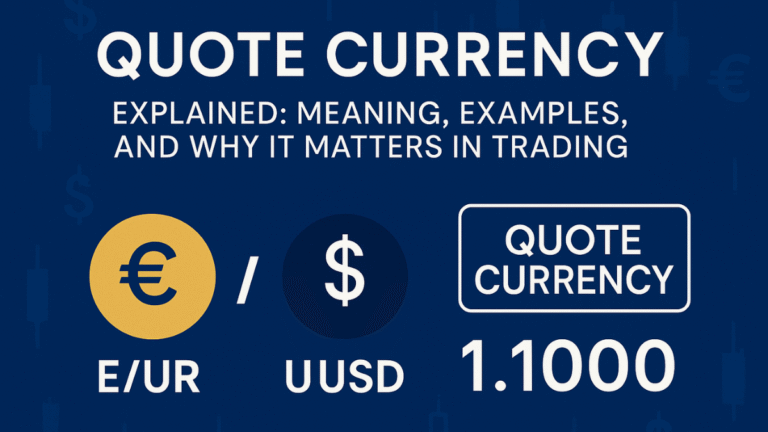
The quote currency is the second currency listed in a currency pair. It shows how much of that currency is needed to buy one unit of the base currency.
For example, in the pair EUR/USD = 1.1000, the U.S. dollar (USD) is the quote currency. This means one euro costs 1.10 U.S. dollars.
How Quote Currency Works in a Currency Pair
Now that the basic definition is clear, it is important to understand how the quote currency functions in real market pricing. Every currency pair has two sides, and each side has a specific role.
Base Currency vs Quote Currency
Before focusing deeper on the quote currency, here is a simple comparison for clarity:
- Base currency: The first currency in the pair and the one being bought or sold.
- Quote currency: The second currency and the one used to express value.
When the exchange rate moves, it is the quote currency that changes in value relative to the base currency.
Example of Quote Currency
To make the concept easier, consider a common forex pair that most traders recognize. Seeing how prices move helps explain the role of the quote currency more clearly.
If GBP/USD = 1.2500, then:
- GBP is the base currency.
- USD is the quote currency.
- One British pound costs 1.25 U.S. dollars.
If the price rises to 1.2700, the quote currency (USD) has weakened against the base currency (GBP). If the price falls, the quote currency has strengthened.
Why Quote Currency Is Important in Forex Trading
The importance of the quote currency goes beyond basic price reading. It directly affects profits, losses, and risk management decisions.
Profit and Loss Are Measured in the Quote Currency
When trading forex, gains and losses are calculated in the quote currency of the pair. This is a critical detail many beginners overlook.
For example, if you trade EUR/USD:
- Your profit or loss is measured in U.S. dollars.
- Even if your account is in another currency, conversions are based on the quote currency first.
Impact on Pip Value Calculation
Understanding pip value becomes much easier when you know the role of the quote currency. For most major pairs, one pip is equal to 0.0001 units of the quote currency.
This means:
- In EUR/USD, one pip equals 0.0001 USD per unit traded.
- Larger trade sizes increase exposure to movements in the quote currency.
Quote Currency in Major, Minor, and Exotic Pairs
As traders explore different markets, they will encounter many types of currency pairs. The quote currency behaves the same way across all categories, but the risk profile may change.
Major Currency Pairs
In major pairs, the quote currency is usually a highly liquid and stable currency. Examples include:
- EUR/USD (USD is the quote currency)
- USD/JPY (JPY is the quote currency)
These pairs typically have lower spreads and higher trading volume.
Minor and Exotic Pairs
In minor and exotic pairs, the quote currency may belong to an emerging or less liquid economy. This can lead to higher volatility and wider spreads.
Examples include:
- EUR/TRY (Turkish lira as quote currency)
- USD/ZAR (South African rand as quote currency)
In such cases, movements in the quote currency can be sharp and unpredictable.
Quote Currency and Trading Psychology
Beyond technical calculations, the quote currency also influences how traders think about price movements. Many traders naturally focus on familiar currencies, such as the U.S. dollar.
When the quote currency is familiar:
- Price interpretation feels more intuitive.
- Risk assessment becomes easier.
- Emotional decision-making may be reduced.
This is one reason why USD-based quote currencies are popular among beginners.
Common Mistakes Traders Make With Quote Currency
Even experienced traders can misunderstand the role of the quote currency if they are not careful. Recognizing these mistakes helps improve accuracy and confidence.
Some common errors include:
- Assuming profits are always in the account currency.
- Misreading price direction by focusing on the wrong currency.
- Ignoring quote currency volatility in exotic pairs.
Avoiding these mistakes starts with a solid understanding of how quote currency works.
Quote Currency vs Account Currency
Many traders confuse quote currency with account currency, but the two are different. Clarifying this distinction helps prevent calculation errors.
The account currency is the currency your trading account is funded in. The quote currency is the currency used to price the trade.
If they are different:
- Your broker converts profits and losses.
- Exchange rates may affect final results slightly.
Why Every Trader Should Understand Quote Currency
Understanding the quote currency is not optional for serious traders. It affects pricing, risk, and overall trading performance.
When traders fully understand the quote currency:
- They read charts more accurately.
- They calculate risk more precisely.
- They make more confident trading decisions.
This knowledge forms a foundation for advanced strategies and long-term consistency.
Final Thoughts
The quote currency may seem like a small detail, but it plays a major role in forex trading and global financial markets. It defines price, measures profit and loss, and influences trading psychology.
By mastering the concept of quote currency, traders gain clarity and control. This understanding supports better decision-making, stronger risk management, and a more professional approach to trading.
 Join Our Telegram Channel