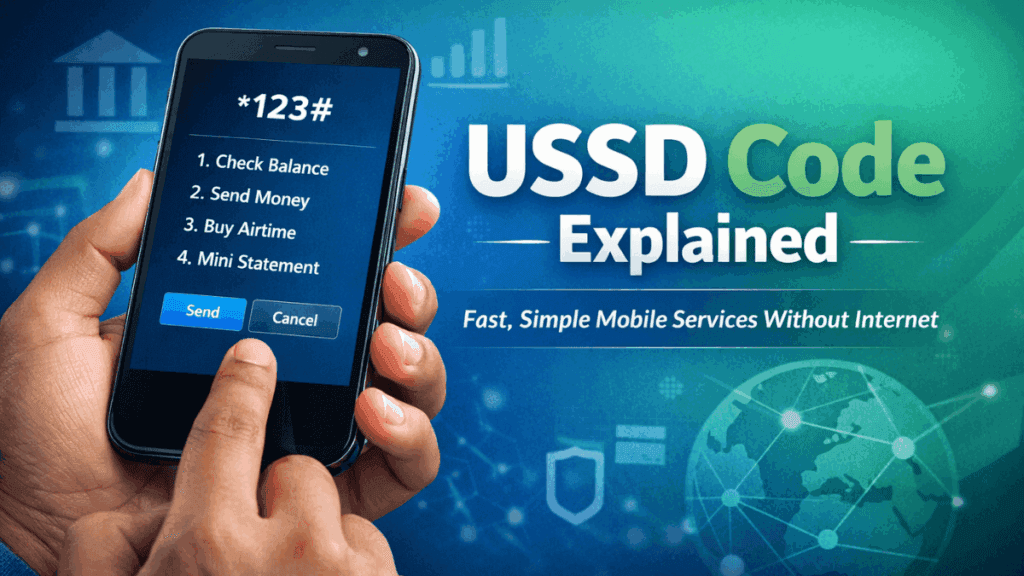
A USSD Code is one of the simplest yet most powerful tools in mobile communication. Even in a world dominated by smartphones and mobile apps, USSD remains essential. It allows users to access services instantly using short codes, without internet access or advanced devices.
USSD, which stands for Unstructured Supplementary Service Data, is widely used for mobile banking, airtime purchase, checking balances, and accessing essential services. This article explains what USSD is, how it works, and why it continues to be relevant today.
What Is a USSD Code?
To understand its importance, it helps to start with the basics. A USSD Code is a short command that starts with an asterisk (*) and ends with a hash (#). When dialed on a mobile phone, it connects directly to a service provider’s system.
Unlike mobile apps or websites, USSD does not require internet access. The interaction happens in real time through the mobile network, making it fast and reliable even on basic phones.
What Does USSD Mean?
USSD stands for Unstructured Supplementary Service Data. It is a communication protocol used by GSM mobile networks to send messages between a phone and a service provider.
These messages are session-based, meaning the connection stays open while the user responds to menu options. This is different from SMS, which is stored and forwarded.
How USSD Works Step by Step
Now that the concept is clear, it is important to understand how USSD actually works behind the scenes. The process is simple, yet highly efficient.
When a user dials a USSD Code, the mobile network sends the request to the service provider’s application server. The server responds instantly with a menu or message, and the session continues until the user exits or completes the action.
A Simple Example of a USSD Session
Here is a typical USSD flow:
- You dial a USSD Code such as *123#
- A menu appears on your phone screen
- You select an option by typing a number
- The system responds immediately
- The session ends once the task is complete
This real-time interaction is what makes USSD fast and dependable.
Common Uses of USSD Codes
USSD technology is widely adopted because it solves real-world problems. It works on any phone and does not depend on data connectivity, which makes it accessible to millions of users globally.
USSD in Mobile Banking
One of the most important applications of USSD is mobile banking. Many banks and mobile money services rely on USSD to reach customers without smartphones.
With USSD, users can:
- Check account balances
- Send and receive money
- Pay bills and merchants
- Buy airtime or data
- Access mini statements
These services are especially valuable in regions where internet access is limited or expensive.
USSD for Telecom Services
Telecom operators also rely heavily on USSD. It allows customers to manage their mobile services quickly.
Common telecom USSD functions include:
- Checking airtime balance
- Activating data bundles
- Viewing promotional offers
- Managing subscriptions
These services are instant and do not require app installation.
USSD vs SMS vs Mobile Apps
To fully appreciate USSD, it helps to compare it with other communication methods. Each option has strengths, but USSD stands out in several key areas.
Key Differences Explained
USSD is faster than SMS because it works in real time. SMS messages may be delayed, while USSD responses are immediate. Compared to mobile apps, USSD does not need internet access, updates, or storage space.
Mobile apps offer richer experiences, but they exclude users with basic phones or poor connectivity. USSD fills this gap by providing essential services to everyone.
Advantages of Using USSD Codes
USSD remains relevant because it offers clear advantages that modern technologies still struggle to replace completely.
Why USSD Is Still Popular
USSD Codes are:
- Fast and responsive
- Accessible on all mobile phones
- Independent of internet connectivity
- Easy to use and understand
- Cost-effective for service providers
These benefits make USSD ideal for mass services such as banking, healthcare, and public utilities.
Limitations of USSD Technology
Although USSD is powerful, it is not perfect. Understanding its limitations helps set realistic expectations.
USSD sessions are temporary and time-sensitive. If a user takes too long to respond, the session may expire. Additionally, USSD interfaces are text-based and limited in design, which restricts complex interactions.
Security can also be a concern if users are not careful, especially when entering PINs in public places.
Security and Privacy in USSD Services
Security is a critical topic when discussing USSD, especially for financial transactions. While USSD is generally secure, it depends heavily on the systems implemented by service providers.
Most mobile money and banking services use encryption and session controls to protect users. However, users must also play their part by keeping PINs private and avoiding suspicious codes.
The Role of USSD in Financial Inclusion
USSD has played a major role in expanding financial access across the world. It enables people without smartphones or internet access to participate in the digital economy.
By offering banking and payment services through simple codes, USSD reduces barriers and supports financial inclusion. This impact is especially visible in developing markets, where mobile phones are more common than bank branches.
Is USSD Still Relevant in the Smartphone Era?
With the rise of mobile apps and digital wallets, some people question whether USSD is still necessary. The answer is yes, and for good reasons.
USSD continues to serve users who value speed, simplicity, and reliability. Even smartphone users often prefer USSD for quick tasks like checking balances or buying airtime when data is unavailable.
The Future of USSD Technology
Looking ahead, USSD is likely to coexist with modern digital platforms rather than disappear. Many service providers now integrate USSD with mobile apps and APIs to create hybrid solutions.
As long as there is a need for universal access, USSD will remain a trusted and essential communication channel.
Final Thoughts
A USSD Code may look simple, but its impact is significant. It connects millions of people to essential services every day, without requiring internet access or advanced technology.
USSD proves that innovation does not always mean complexity. Sometimes, the most effective solutions are the simplest ones.