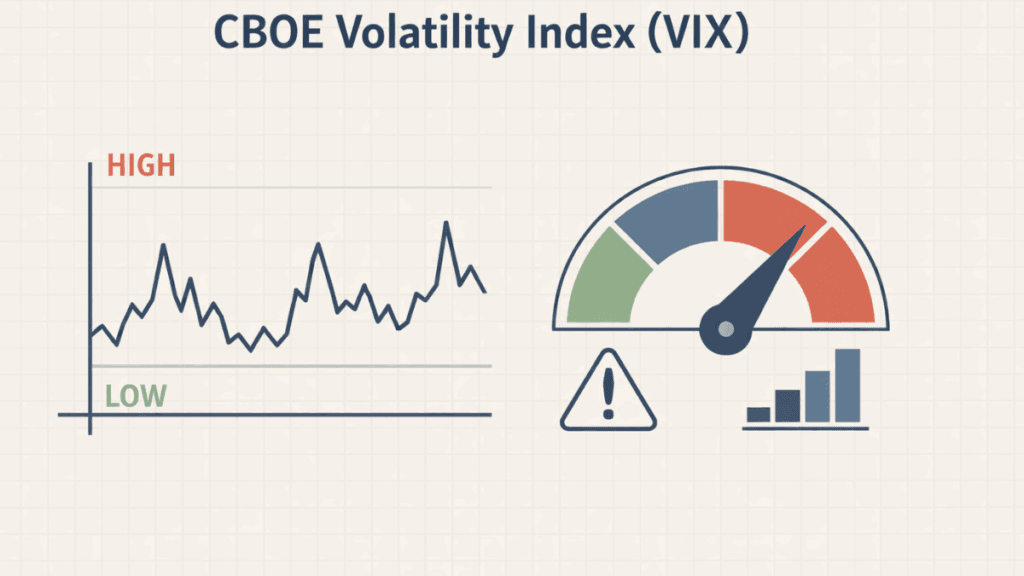
The CBOE Volatility Index (VIX) is one of the most closely watched indicators in global financial markets because it reflects how investors feel about near-term market risk. Often called the market’s “fear gauge,” the VIX helps traders, investors, and analysts understand expectations for stock market volatility over the next 30 days.
Unlike traditional indicators that track prices or returns, the VIX focuses on expectations. It is derived from S&P 500 index options, making it a forward-looking rather than a backward-looking measure.
Click Here To Join our Telegram Community
What the CBOE Volatility Index (VIX) Represents
To understand the VIX properly, it helps to begin with what it is designed to measure. At its core, the VIX reflects expected volatility, not whether markets will rise or fall.
When the VIX is low, investors generally expect calm and stable market conditions. When it rises sharply, it signals growing uncertainty, fear, or risk aversion among market participants.
Why the VIX Is Often Called the “Fear Index”
The VIX earned its nickname because it tends to spike during periods of market stress. Events such as financial crises, geopolitical shocks, or sudden economic surprises often cause investors to rush for protection.
This demand for protection shows up in options prices, which, in turn, drive the VIX higher. As a result, the index acts as a real-time reflection of collective investor anxiety.
How the VIX Is Calculated
The calculation of the VIX is complex, but the idea behind it is straightforward. It uses prices of a wide range of S&P 500 index options to estimate expected volatility over the next month.
Rather than relying on historical price swings, the VIX looks at what options traders are willing to pay today. This approach makes it a forward-looking indicator grounded in real market behavior.
The Role of S&P 500 Options
Options prices rise when investors expect larger future price movements. The VIX aggregates these prices across different strike levels to capture a broad view of expected volatility.
By using both call and put options, the index avoids directional bias. It focuses on the size of price moves, not whether they will be upward or downward.
Interpreting VIX Levels in Real Markets
Reading the VIX correctly requires context rather than rigid rules. While there is no fixed “good” or “bad” level, certain ranges are commonly associated with specific market conditions.
A lower VIX usually points to confidence and stability, while a higher VIX suggests uncertainty and stress. Sudden changes in the index can be just as important as the absolute level.
Common VIX Ranges and Their Meaning
Although markets change over time, these broad interpretations are widely used:
- Below 15: Calm markets with low expected volatility
- 15 to 25: Normal or mildly uncertain conditions
- Above 25: Elevated fear and increased risk perception
- Above 40: Severe stress or crisis-like conditions
These ranges should be treated as guidelines rather than precise signals.
The Relationship Between the VIX and Stock Markets
One of the most important features of the VIX is its typical inverse relationship with stock prices. When equity markets fall sharply, the VIX often rises, reflecting increased demand for protection.
This relationship exists because investors buy more options during downturns. However, it is not a perfect mirror, and there are times when both stocks and the VIX move in unexpected ways.
Why the VIX Can Rise Even When Markets Are Up
Markets can climb even as uncertainty continues to increase. For example, during earnings seasons or ahead of major policy announcements, investors may hedge their positions despite rising prices.
In such cases, the VIX may increase even as stock indexes move higher. This behavior highlights why the VIX should be used alongside other indicators rather than in isolation.
How Traders and Investors Use the VIX
Different market participants use the VIX for different purposes. Some view it as a sentiment indicator, while others actively trade products linked to it.
Understanding these use cases helps avoid common misunderstandings about what the VIX can and cannot do.
Using the VIX as a Market Sentiment Tool
Long-term investors often monitor the VIX to gauge overall market mood. Extremely high readings can signal panic, while very low readings may suggest complacency.
In some strategies, unusually high fear is seen as a potential contrarian signal. This does not guarantee market reversals, but it can highlight periods when emotions dominate decision-making.
Trading VIX-Based Products
The VIX itself cannot be bought or sold directly. Instead, traders use futures, options, and exchange-traded products linked to VIX movements.
These instruments are complex and can behave very differently from the index itself. Because of this, they are generally better suited for experienced traders with a clear understanding of risk.
Common Misconceptions About the VIX
Despite its popularity, the VIX is often misunderstood. Clearing up these misconceptions is essential for using it responsibly.
One common mistake is assuming the VIX predicts market direction. In reality, it measures expected volatility, not future prices.
The VIX Is Not a Timing Tool
A high VIX does not automatically mean markets will rebound, and a low VIX does not guarantee a downturn. It simply reflects current expectations embedded in options prices.
Relying on the VIX alone for entry or exit decisions can lead to poor outcomes. It works best as part of a broader analytical framework.
Limitations of the CBOE Volatility Index (VIX)
Like all indicators, the VIX has limits that users should respect. It focuses on short-term expectations and may not reflect longer-term risks.
The index is also influenced by technical factors in the options market, such as supply and demand imbalances. These factors can sometimes distort readings without a clear economic cause.
Why the VIX Still Matters in Modern Markets
Despite its limitations, the VIX remains a valuable tool for understanding market psychology. It provides insight into expectations that are not visible from price charts alone.
For beginners, it offers a simple way to observe how fear and uncertainty fluctuate over time. For experienced participants, it adds depth to risk management and market analysis.
Final Thoughts
The CBOE Volatility Index (VIX) plays a unique role in financial markets by translating investor expectations into a single, widely followed number. While it should not be treated as a crystal ball, it offers meaningful clues about sentiment and risk.
Used thoughtfully and in context, the VIX can help investors make more informed decisions. Its true value lies not in prediction, but in understanding how markets feel when uncertainty rises or falls.
 Join Our Telegram Channel