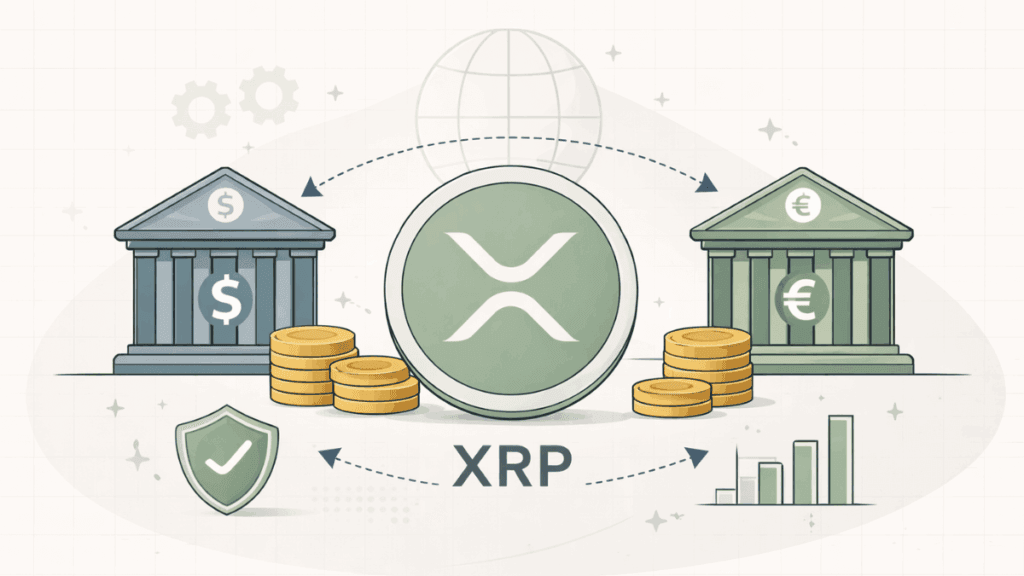
XRP is a digital asset designed to move value quickly and cheaply across borders, making it one of the most established cryptocurrencies in the global payments space. From the very first moment XRP was introduced, its goal has been clear: to improve how money moves between banks, businesses, and individuals worldwide.
Unlike many cryptocurrencies created mainly for speculation, XRP was built with real-world financial infrastructure in mind. It aims to solve inefficiencies in traditional cross-border payments, such as high fees, long settlement times, and limited transparency.
The Origins and Purpose of XRP
XRP was created to support a payment network that could operate faster and more efficiently than legacy banking systems. Its development is closely linked to Ripple, a technology company focused on financial messaging and settlement solutions.
The core purpose of XRP is to act as a bridge currency. This means it can help convert one currency into another instantly, reducing the need for banks to hold large amounts of foreign currency in advance.
How XRP Works
XRP operates on the XRP Ledger, a decentralized and open-source blockchain designed for speed and scalability. Transactions on the network typically settle within seconds, making it one of the fastest major digital assets.
Instead of using mining like Bitcoin, the XRP Ledger relies on a consensus mechanism. Trusted validators confirm transactions, which allows the network to remain energy-efficient while processing a high volume of transfers.
XRP Ledger Explained
The XRP Ledger is the foundation that powers XRP transactions. It records all transfers permanently and transparently while maintaining low transaction costs.
Because the ledger is not dependent on mining, it avoids congestion and high fees during periods of heavy network activity. This design choice makes it particularly attractive for payment-focused use cases.
XRP vs Traditional Banking Systems
Traditional international transfers often take several days and involve multiple intermediaries. Each step adds cost and increases the risk of delays or errors.
XRP reduces these frictions by enabling near-instant settlement. Financial institutions can send value directly, improving cash flow and reducing operational complexity.
Key Use Cases of XRP
XRP is mainly used for payments, liquidity management, and currency exchange. Its design allows it to serve as a practical tool rather than just a store of value.
Common use cases include:
- Cross-border payments for banks and payment providers
- On-demand liquidity for currency exchange
- Fast peer-to-peer transfers with minimal fees
XRP in Cross-Border Payments
Cross-border payments are where XRP shows its strongest advantage. Banks can use XRP to bridge currencies without pre-funding accounts in foreign countries.
This approach lowers capital requirements and allows smaller institutions to compete globally. As a result, XRP is often discussed in conversations about modernizing international finance.
XRP and Financial Institutions
Many financial institutions explore XRP because it integrates easily with existing systems. It does not require banks to replace their entire infrastructure.
Instead, XRP can act as a settlement layer, improving speed and reducing costs while maintaining regulatory compliance.
XRP Token Supply and Economics
XRP has a fixed maximum supply of 100 billion tokens. Unlike mined cryptocurrencies, all XRP tokens were created at launch.
A large portion of XRP was placed in escrow to manage supply release responsibly. This structure helps reduce uncertainty and adds predictability to the asset’s circulation.
Is XRP Centralized or Decentralized?
XRP is often debated in terms of decentralization. While Ripple played a major role in its early development, the XRP Ledger itself is open and maintained by independent validators.
No single entity controls the ledger. This distributed validation model supports resilience while still allowing efficient governance.
XRP and Regulation
Regulation has been one of the most discussed topics around XRP. Its classification has been examined closely by regulators, especially in the United States.
Clearer regulatory guidance has helped increase confidence among investors and institutions. As global crypto regulations mature, XRP’s compliance-focused design may become an advantage.
Risks and Challenges of XRP
Like all digital assets, XRP carries risks that investors should understand. Price volatility remains a reality, even for established cryptocurrencies.
Additional challenges include regulatory changes, competition from other payment-focused blockchains, and shifts in institutional adoption. Careful research is essential before making any financial decisions.
XRP Compared to Other Cryptocurrencies
XRP differs significantly from Bitcoin and Ethereum in both purpose and design. While Bitcoin focuses on decentralization and scarcity, XRP prioritizes speed and utility.
Ethereum supports smart contracts and decentralized applications, whereas XRP concentrates on payments. These differences mean XRP serves a distinct role in the crypto ecosystem.
Long-Term Outlook for XRP
The long-term outlook for XRP depends largely on global payment adoption and regulatory clarity. If financial institutions continue seeking faster settlement solutions, XRP may remain relevant.
Its success will also depend on competition and technological innovation. Continued development of the XRP Ledger is critical to maintaining its position.
Is XRP Suitable for Beginners?
XRP is often considered beginner-friendly due to its clear use case and established presence. Its fast transactions and low fees make it easy to understand from a practical perspective.
However, beginners should still learn basic crypto concepts and risk management. Understanding how XRP fits into the broader market helps build realistic expectations.
How to Store and Use XRP Safely
Storing XRP securely is an important part of ownership. Users can choose between hardware wallets, software wallets, or trusted exchanges.
Security best practices include using strong passwords, enabling two-factor authentication, and keeping private keys offline whenever possible.
Final Thoughts
XRP stands out as a cryptocurrency designed for real-world financial efficiency rather than hype. Its focus on speed, cost reduction, and institutional use gives it a unique identity in the crypto market.
While challenges remain, XRP continues to play a significant role in discussions about the future of global payments. For anyone interested in how blockchain can improve financial systems, XRP is an asset worth understanding.