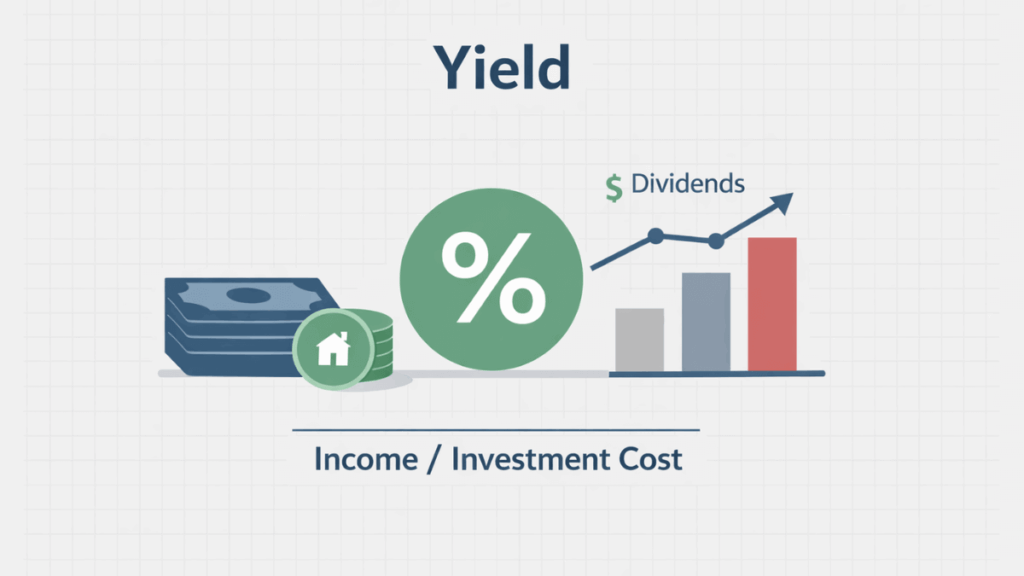
Yield is one of the most important concepts in finance because it shows how much income an investment produces relative to its cost. Whether you are earning interest on a savings account, dividends from shares, or rent from property, yield helps you understand how efficiently your money is working for you. Instead of focusing only on price changes, yield highlights the income side of investing, which is often more stable and predictable.
This guide explains yield in clear, practical terms. You will learn what yield means, how it is calculated, the main types of yield, and how to use it wisely when comparing investments.
What Yield Means in Finance
Yield refers to the income generated by an investment over a specific period, expressed as a percentage of its price or value. This income may come from interest, dividends, or other regular payments. The idea is simple: yield measures what you earn, not what the asset might sell for later.
Unlike profit, yield focuses on ongoing returns rather than one-time gains. An investment can have a high yield even if its price does not change, which is why income-focused investors pay close attention to it.
Why Yield Matters to Investors
Yield matters because it shows how much cash flow an investment can provide. For many people, especially retirees and conservative investors, regular income is just as important as long-term growth.
A clear understanding of yield helps investors:
- Compare income potential across different assets
- Plan a predictable cash flow
- Balance risk and return
- Avoid being misled by price movements alone
When used correctly, yield adds depth to investment analysis and supports better financial decisions.
How Yield Is Calculated
Yield is calculated by dividing the annual income from an investment by its current price or initial cost, then multiplying by 100 to get a percentage. While the formula is straightforward, the meaning depends on the type of investment.
For example, if an investment pays KES 5,000 per year and costs KES 100,000, the yield is 5%. This percentage makes it easier to compare investments of different sizes and prices.
Common Types of Yield
Different investments generate income in different ways, which is why several types of yield are commonly used. Each type highlights a specific source of return.
Dividend Yield
Dividend yield applies to shares that pay dividends. It shows how much a company pays shareholders each year relative to its share price. Investors who prefer steady income often focus on dividend yield rather than short-term price changes.
A high dividend yield may look attractive, but it should always be assessed alongside the company’s financial health and payout sustainability.
Interest Yield
Interest yield is common in fixed-income investments such as bonds, treasury bills, and savings accounts. It reflects the interest paid over a year as a percentage of the invested amount.
This type of yield is usually more predictable, making it popular among low-risk investors. However, interest yield can be affected by inflation and changes in interest rates.
Rental Yield
Rental yield applies to real estate investments. It measures the annual rental income as a percentage of the property’s purchase price or current value. Property investors often use rental yield to judge whether a property is worth buying.
Expenses such as maintenance, taxes, and vacancies should be considered alongside rental yield to get a realistic picture of returns.
Yield to Maturity
Yield to maturity is used for bonds held until they expire. It considers interest payments, purchase price, face value, and time remaining until maturity. This makes it a more complete measure than simple interest yield.
Because it involves several assumptions, yield to maturity is best used when comparing bonds with similar risk profiles.
Yield vs Return: Understanding the Difference
Yield and return are related but not identical. Yield focuses on income, while return includes both income and price changes. An investment may have a low yield but a high total return if its price rises significantly.
Understanding this difference prevents confusion and unrealistic expectations. Yield suits income analysis, while total return gives a full picture of investment performance.
High Yield: Opportunity or Warning?
High-yield investments can be tempting, but they often come with higher risk. A very high yield may indicate financial stress, declining prices, or unstable income sources.
Before choosing a high-yield investment, it is important to understand why the yield is high. Sustainable income usually matters more than headline percentages.
Factors That Influence Yield
Several factors affect yield, and understanding them helps investors make better comparisons.
Market Price Changes
Yield changes when prices move. If the price of an asset falls while income stays the same, the yield increases. If the price rises, the yield decreases even if the income remains unchanged.
This relationship explains why yield should never be viewed in isolation.
Interest Rate Environment
Interest rates have a direct impact on yield, especially for bonds and savings products. When rates rise, newly issued instruments often offer higher yields, making older ones less attractive.
Monitoring interest rate trends helps investors time income-focused decisions more effectively.
Inflation
Inflation reduces the real value of income. A yield that looks attractive today may lose purchasing power over time if inflation rises faster than income.
For long-term planning, real yield, which accounts for inflation, provides more meaningful insight.
Using Yield to Compare Investments
Yield is a powerful comparison tool when used correctly. It allows investors to evaluate income potential across assets such as shares, bonds, property, and savings products.
For fair comparison, investments should be similar in risk, duration, and tax treatment. Yield works best when combined with qualitative analysis and broader financial goals.
Yield in Agriculture and Business Contexts
While yield is commonly associated with finance, it is also used in agriculture and production. In these contexts, yield measures output relative to input, such as crop yield per acre.
The shared idea is efficiency. Whether in farming or investing, yield shows how effectively resources generate results.
Common Mistakes People Make When Evaluating Yield
Many investors misunderstand yield, leading to poor decisions. One common mistake is chasing high yield without considering risk. Another is ignoring expenses, taxes, or inflation.
Yield should always be part of a broader evaluation rather than a single deciding factor.
How Beginners Can Use Yield Wisely
For beginners, yield provides a simple entry point into understanding investments. Starting with familiar income sources such as savings accounts or dividend-paying shares makes the concept easier to grasp.
Over time, combining yield analysis with basic risk assessment builds confidence and financial literacy.
Yield and Long-Term Financial Planning
Yield plays a key role in long-term planning, especially for income-focused goals. Regular income can support living expenses, reinvestment, or debt reduction.
When aligned with realistic expectations and diversified assets, yield becomes a stable foundation for sustainable wealth building.
Frequently Asked Questions About Yield
Yield is the income an investment generates over time, shown as a percentage of its price or value. It helps you understand how much you earn regularly, not how much the investment might grow in price.
Yield focuses only on the income an investment produces, such as interest or dividends. Return includes both income and any increase or decrease in the investment’s price.
Not always. A high yield can signal higher risk or financial problems with the investment. It is important to check whether the income is stable and sustainable before relying on a high yield.
Yield is commonly found in investments that pay regular income, such as bonds, dividend-paying shares, fixed deposits, and rental property. These investments are popular with people seeking a steady cash flow.
Yes, yield can change when the price of an investment changes or when the income it pays changes. Interest rate movements and market conditions often affect yield levels.
Yield provides regular income that can be reinvested or used for expenses. Over the long term, a consistent yield can contribute significantly to overall wealth and financial stability.
Final Thoughts
Yield is more than just a percentage on a chart. It represents real income, real cash flow, and real financial choices. When understood properly, it helps investors move beyond speculation and focus on dependable value.
By learning how yield works, comparing it carefully, and respecting its limits, you gain a clearer view of how money grows and supports long-term goals.
 Join Our Telegram Channel