Every trader eventually faces the same question: when should I take a profit? TP1, TP2, and TP3 offer a structured answer by breaking profit-taking into stages instead of relying on a single exit.
In simple terms, TP stands for “Take Profit.” TP1, TP2, and TP3 are multiple profit targets placed at different price levels. Instead of closing your entire trade at once, you scale out gradually as the market moves in your favor.

This approach helps you secure profits early while still allowing part of your position to ride larger trends. It also reduces emotional decision-making because your exit plan is already defined before entering the trade.
Why TP1, TP2, and TP3 Matter in Trading
A clear exit strategy is what separates consistent traders from those who rely on luck. Using multiple take-profit levels gives you more control over outcomes.
When markets are unpredictable, closing everything at one level can either leave money on the table or cut profits too early. Splitting exits solves this problem by balancing safety and opportunity.
Traders who use TP1, TP2, and TP3 tend to experience smoother equity growth because they are not dependent on hitting a single perfect target.
How TP1, TP2, and TP3 Work
Understanding how these levels function will make it easier to apply them effectively in your trades.
TP1: The First Profit Target
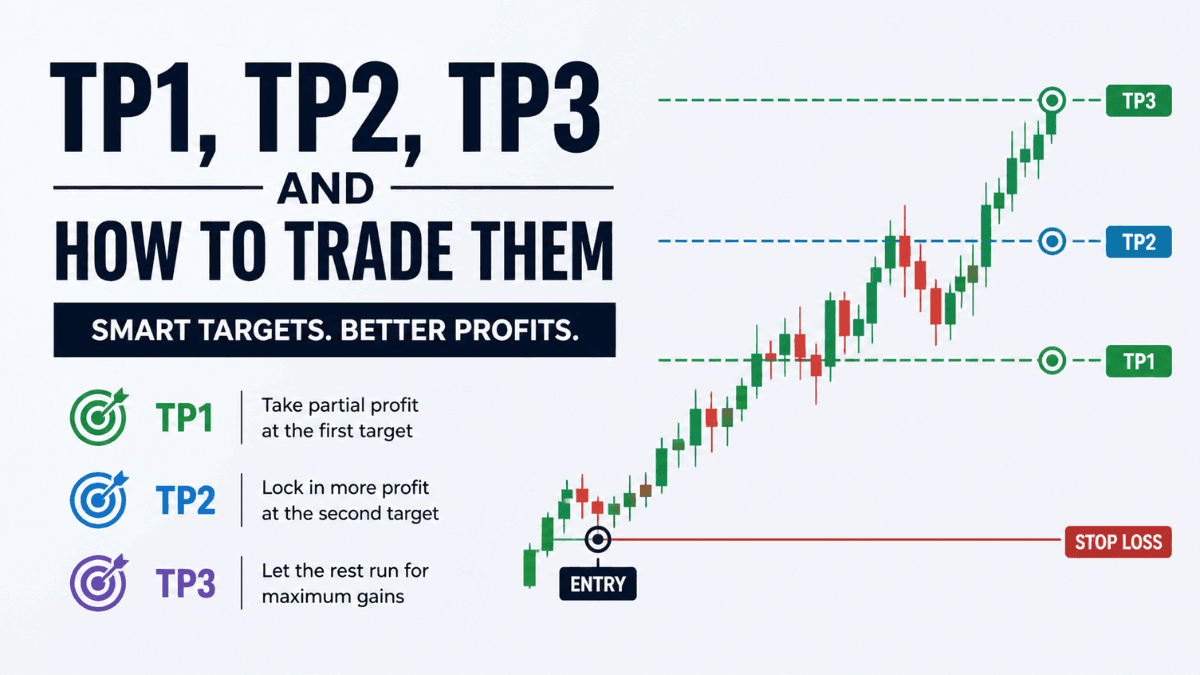
TP1 is your conservative exit point. It is typically placed at a nearby support or resistance level where the price is likely to react.
This level is designed to secure quick profits and reduce risk. Many traders close a portion of their position here and move their stop loss to break-even, ensuring the trade becomes risk-free.
TP2: The Intermediate Target
TP2 sits further away and captures a more substantial portion of the trend. By the time the price reaches TP2, the trade is usually well-established.
At this level, traders often close another portion of the position. This locks in more profit while still keeping a remaining position open for bigger moves.
TP3: The Final Target
TP3 is your most ambitious target. It is placed at a major support or resistance zone or based on a higher timeframe analysis.
This level allows you to maximize gains when the market trends strongly. Not every trade will reach TP3, but when it does, it significantly boosts your overall profitability.
How to Set TP1, TP2, and TP3 Correctly
Setting these levels is not random. It requires a combination of technical analysis and logical planning.
Use Support and Resistance
Prices tend to react at key levels, making them ideal zones for placing take-profit targets. TP1 can be near minor levels, while TP2 and TP3 align with stronger zones.
This method ensures your targets are based on real market behavior rather than guesswork.
Apply Risk-to-Reward Ratios
A good structure often follows a logical ratio, such as 1:1 for TP1, 1:2 for TP2, and 1:3 or higher for TP3.
This setup ensures that even if only TP1 is hit frequently, your overall strategy can remain profitable.
Consider Market Conditions
Different market conditions require different approaches. In a trending market, TP3 is more likely to be reached, while in a ranging market, TP1 and TP2 become more important.
Adapting your targets based on market structure improves consistency.
Position Sizing for TP1, TP2, and TP3
How you split your trade is just as important as where you place your targets. Proper position sizing ensures balanced risk and reward.
A common approach includes:
- Closing 50% of the position at TP1
- Closing 30% at TP2
- Leaving 20% for TP3
This structure gives you early security while still allowing for larger profits. Some traders adjust these percentages depending on their risk tolerance and trading style.
Example of TP1, TP2, and TP3 in Action
Seeing how this works in a real scenario makes it easier to understand.
Imagine you enter a buy trade on a currency pair:
- Entry: 1.1000
- Stop Loss: 1.0950
- TP1: 1.1050
- TP2: 1.1100
- TP3: 1.1200
As the price moves up:
- At TP1, you close part of the trade and secure profit
- At TP2, you take more profit and reduce exposure
- At TP3, you exit the remaining position for maximum gain
Even if the price reverses after TP1 or TP2, you still walk away with profits.
Advantages of Using TP1, TP2, and TP3
Scaling out of trades offers several key benefits that improve long-term performance.
It reduces emotional pressure because decisions are pre-planned. It also increases consistency since profits are locked in gradually rather than relying on a single outcome.
Another advantage is flexibility. You can adapt your targets based on market behavior without completely changing your strategy.
Common Mistakes Traders Make
Even though the concept is simple, many traders misuse TP levels and lose their edge.
One common mistake is placing targets too close together. This limits profit potential and defeats the purpose of scaling out.
Another issue is ignoring market structure. Setting TP levels without considering support and resistance often leads to missed opportunities or premature exits.
Some traders also close trades manually before targets are reached due to fear or impatience. This breaks the system and leads to inconsistent results.
Tips to Master TP1, TP2, and TP3 Trading
Improving your use of multiple take profit levels requires discipline and practice.
Focus on planning your trade before entering. Define your entry, stop loss, and all TP levels in advance so you are not reacting emotionally.
Backtest your strategy to see how TP1, TP2, and TP3 perform over time. This builds confidence and helps refine your approach.
Stick to consistency. Changing your TP structure frequently will make it difficult to measure results or improve your strategy.
When to Use TP1, TP2, and TP3
This strategy works best in certain trading environments.
It is highly effective in trending markets where price moves in clear directions. In such cases, TP3 becomes especially valuable.
It also works well for swing trading and intraday trading, where the price often moves in stages. However, in highly volatile or news-driven markets, targets may need to be adjusted or tightened.
Final Thoughts
A strong exit strategy is what turns good trades into consistent profits. TP1, TP2, and TP3 give you a structured way to manage trades without relying on guesswork.
By combining smart target placement, proper position sizing, and disciplined execution, you can improve both your confidence and your results. The key is not just knowing these levels, but applying them consistently over time.
If you treat TP1, TP2, and TP3 as part of a complete trading plan rather than a simple concept, they can become one of the most powerful tools in your trading strategy.
Frequently Asked Questions (FAQs) About TP1, TP2, and TP3
What are TP1, TP2, and TP3 in trading?
TP1, TP2, and TP3 are multiple take-profit levels used to close parts of a trade at different price points. Instead of exiting a trade all at once, traders secure profits gradually as the market moves in their favor.
How do I set TP1, TP2, and TP3 correctly?
You can set TP1, TP2, and TP3 using support and resistance levels, trend analysis, or risk-to-reward ratios. A common approach is placing TP1 at 1:1, TP2 at 1:2, and TP3 at 1:3 or higher relative to your stop loss.
What is the best percentage split for TP1, TP2, and TP3?
A popular method is closing 50% of your trade at TP1, 30% at TP2, and leaving 20% for TP3. This balance helps secure early profits while still allowing part of the trade to capture larger market moves.
Can beginners use TP1, TP2, and TP3 strategies?
Yes, beginners can use TP1, TP2, and TP3 as long as they understand basic trading concepts like stop loss and risk management. This strategy can actually make trading easier by providing a clear exit plan.
Do all trades reach TP3?
No, not all trades will reach TP3 because markets do not always trend strongly. That is why TP1 and TP2 are important, as they ensure you still make profits even if the market reverses early.
Are TP1, TP2, and TP3 better than a single take profit?
Using TP1, TP2, and TP3 is generally more flexible than a single take profit. It allows you to reduce risk, lock in gains, and still benefit from extended price movements without relying on one exact target.
Trade on the Go. Anywhere, Anytime
If you’re ready to apply what you’ve learned, consider trading with a globally recognized forex and CFD broker like XM .
The platform offers competitive spreads, fast execution, and access to advanced trading tools, including real-time charts and flexible account types, making it suitable for both beginners and experienced traders. Open a trading account for free and start trading today and join millions of traders and investors on the global forex market.
Trading involves risk. Ensure you understand how the markets work before investing.

Our financial editorial team covers global markets, economic policy, and investment trends. We combine real-time research with AI-powered writing assistants to deliver accurate, timely, and easy-to-read articles. Our editors review all content to ensure quality, neutrality, and clarity for our readers.