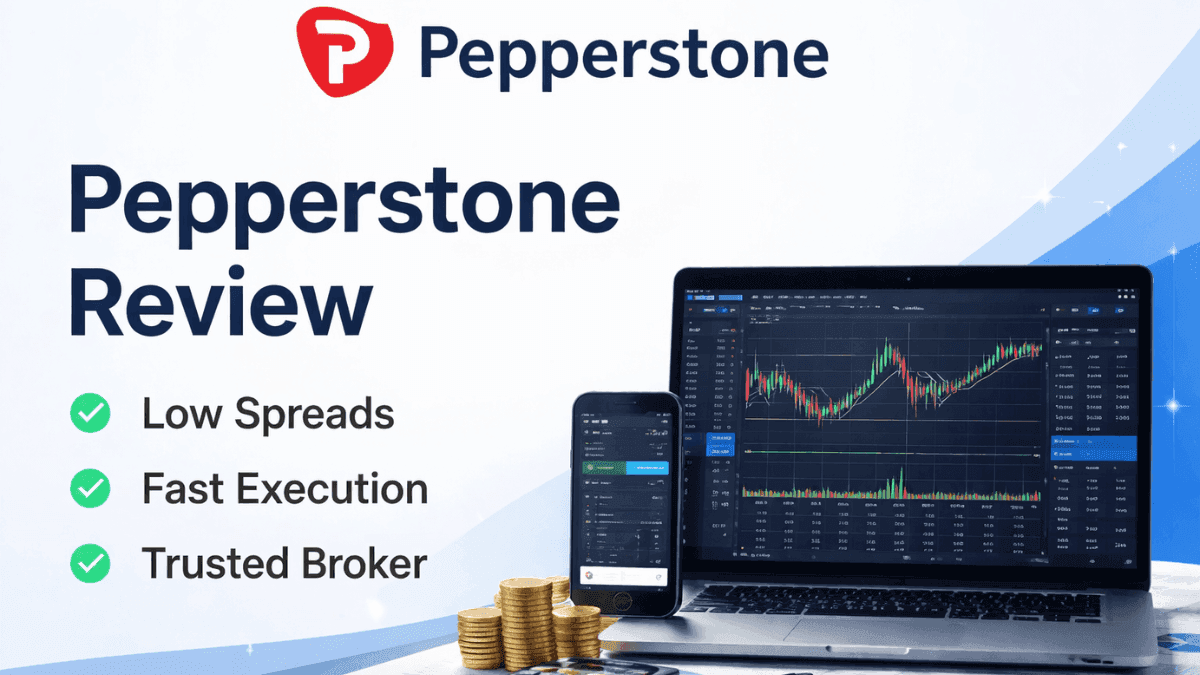
The Pepperstone review you’re about to read goes beyond surface-level features. If you’re serious about trading, whether you’re scalping, swing trading, or building a long-term strategy, you need a broker that executes fast, keeps costs low, and stays reliable under pressure.
Pepperstone has built a strong reputation globally, but reputation alone doesn’t make a broker right for you. Let’s break down exactly what it offers, where it excels, and where it falls short so you can decide with clarity.

Pepperstone Overview
Pepperstone is a globally recognized forex and CFD broker known for low spreads, fast execution, and a trader-focused environment. Founded in 2010, it has grown into one of the most trusted names among retail and professional traders.
What sets Pepperstone apart isn’t flashy marketing—it’s the infrastructure behind the scenes. The broker is designed for performance, particularly for traders who rely on precision entries and exits.
You’re not just getting access to markets, you’re getting a trading environment built for speed and efficiency.
Pepperstone Regulation and Safety
Trust is non-negotiable when choosing a broker, and Pepperstone performs strongly in this area.
Pepperstone is regulated by multiple top-tier authorities, including:
- Financial Conduct Authority (FCA) – UK
- Australian Securities and Investments Commission (ASIC)
- Cyprus Securities and Exchange Commission (CySEC)
- Dubai Financial Services Authority (DFSA)
This multi-jurisdiction regulation means client funds are handled with strict compliance standards. Segregation of funds (keeping your money separate from company funds) adds another layer of protection.
While no broker is completely risk-free, Pepperstone sits comfortably in the “low-risk” category compared to many offshore alternatives.
Trading Platforms
A broker is only as good as the platform you trade on. Pepperstone gives you flexibility without compromise.
MetaTrader 4 (MT4)
MT4 remains a favorite for forex traders who value simplicity and speed. It’s ideal for:
- Scalpers
- Algorithmic traders (Expert Advisors)
- Traders focused purely on forex pairs
Execution is fast, charts are clean, and customization is easy.
MetaTrader 5 (MT5)
MT5 builds on MT4 with more timeframes, order types, and asset coverage. If you trade indices, commodities, or stocks alongside forex, MT5 gives you that extra depth.
cTrader
cTrader is where Pepperstone really stands out. It’s designed for transparency and precision.
You get:
- Level II pricing (market depth)
- Advanced order execution
- Clean, modern interface
For traders who rely on order flow or tight entries, cTrader often feels like an upgrade over MT4/MT5.
TradingView Integration
Pepperstone also integrates with TradingView, which many traders already use for charting.
This allows you to:
- Analyze and execute trades in one place
- Use advanced charting tools
- Access community-driven ideas
If you already use TradingView daily, this integration alone can improve your workflow.
Account Types
Pepperstone keeps things simple with two main account types, that is, razor and standard, but the differences matter.
Razor Account
This is the go-to for serious traders.
You get:
- Raw spreads starting from 0.0 pips
- Commission per trade
- Ultra-fast execution
It’s ideal for scalping, day trading, and strategies where every pip counts.
Standard Account
This account bundles costs into the spread.
You get:
- No commission
- Slightly higher spreads
It’s better suited for beginners or casual traders who prefer simplicity over tight pricing.
Spreads, Fees, and Trading Costs
Costs are where many brokers quietly eat into your profits. Pepperstone keeps things transparent.
On the Razor account, spreads on major pairs like EUR/USD can go as low as 0.0–0.3 pips during liquid sessions, with a small commission added.
On the Standard account, spreads are wider but commission-free.
There are no hidden fees for deposits or withdrawals in most cases, though third-party charges may apply depending on your payment method.
If you’re an active trader, the Razor account typically offers better long-term value.
Leverage
Leverage depends on your region due to regulations.
Retail traders typically get:
- Up to 1:30 in highly regulated regions (UK, EU)
- Higher leverage (up to 1:500) in offshore jurisdictions
Higher leverage can amplify profits but it also increases risk. If you’re newer to trading, using lower leverage is usually the smarter move.
Markets Available
Pepperstone offers a wide range of instruments, giving you flexibility across markets.
You can trade:
- Forex (major, minor, and exotic pairs)
- Indices (like NASDAQ, S&P 500)
- Commodities (gold, oil, etc.)
- Cryptocurrencies
- Shares (CFDs)
This variety makes it easy to diversify your strategy without switching brokers.
Execution Speed and Liquidity
Execution is where Pepperstone truly shines—and this is something experienced traders notice immediately.
Orders are filled quickly with minimal slippage, especially during high liquidity periods. The broker uses a no-dealing-desk (NDD) model, meaning your trades go directly to liquidity providers.
For scalpers and intraday traders, this can make a measurable difference in results over time.
Deposits and Withdrawals
Funding your account is straightforward, with multiple options available.
Common methods include:
- Bank transfer
- Credit/debit cards
- E-wallets (depending on region)
Deposits are usually instant or processed quickly, while withdrawals are typically handled within 1–3 business days.
There’s no unnecessary friction here, which is exactly what you want.
Customer Support
Support quality can make or break your experience, especially when issues arise mid-trade.
Pepperstone offers:
- 24/5 customer support
- Live chat, email, and phone options
Response times are generally fast, and support agents tend to understand trading-related issues not just basic account questions.
That’s a subtle but important difference.
Education and Tools for Traders
Pepperstone doesn’t overwhelm you with basic tutorials but it provides solid resources where it matters.
You’ll find:
- Market analysis and insights
- Webinars and trading guides
- Smart Trader Tools (MT4/MT5 add-ons)
These tools can improve decision-making, especially if you’re still refining your strategy.
Pepperstone Pros and Cons
Every broker has strengths and weaknesses. Here’s a clear breakdown.
Pros
- Extremely tight spreads (Razor account)
- Fast execution with deep liquidity
- Multiple high-quality platforms
- Strong global regulation
- No deposit/withdrawal fees (in most cases)
Cons
- No proprietary trading platform
- Limited educational depth for beginners
- High leverage is not available in all regions
Who Should Use Pepperstone?
Pepperstone isn’t trying to be everything to everyone—and that’s actually a strength.
It’s best suited for:
- Scalpers who need tight spreads and fast execution
- Day traders who rely on precision entries
- Experienced traders who want flexibility across platforms
Beginners can still use it, but they may need to rely on external learning resources.
Final Verdict
Pepperstone delivers where it matters most: execution speed, pricing, and platform flexibility.
It doesn’t rely on gimmicks or overcomplicated features. Instead, it focuses on giving traders a clean, efficient environment to operate in.
If your priority is performance over hype, Pepperstone is one of the better choices available right now.
FAQs About Pepperstone
Is Pepperstone good for beginners?
Yes, but with a caveat. The platform is easy to use, but beginners may need additional education from external sources to fully understand trading concepts.
What is the minimum deposit for Pepperstone?
There’s no strict minimum deposit requirement, but starting with at least $100–$200 is generally recommended for practical trading.
Does Pepperstone charge commissions?
Yes, on Razor accounts. Standard accounts are commission-free but include higher spreads.
Can you use Pepperstone for scalping?
Absolutely. Pepperstone is one of the more popular brokers among scalpers due to its low spreads and fast execution.
Is Pepperstone safe?
Yes. It is regulated by multiple top-tier authorities and follows strict compliance standards, making it a trustworthy broker overall.
Pepperstone vs Other Brokers
Compare Pepperstone with any other broker by selecting the other broker below.
The most popular Pepperstone comparisons:
- Interactive Brokers vs Pepperstone
- Exness vs Pepperstone
- Pepperstone vs Eightcap
- Pepperstone vs FBS
- Pepperstone vs Deriv
- Pepperstone vs FXOpen
- XM vs Pepperstone
- RoboForex vs Pepperstone
- OctaFX vs Pepperstone
- Pepperstone vs IC Markets
- Fusion Markets vs Pepperstone
- IC Markets vs Pepperstone
- Templer FX vs Pepperstone
- FXPro vs Pepperstone
- Pepperstone vs AvaTrade
- Pepperstone vs FXTM
- Pepperstone vs FOREX.com
- XTB vs Pepperstone
Trade on the Go. Anywhere, Anytime
If you’re ready to apply what you’ve learned, consider trading with a globally recognized forex and CFD broker like XM .
The platform offers competitive spreads, fast execution, and access to advanced trading tools, including real-time charts and flexible account types, making it suitable for both beginners and experienced traders. Open a trading account for free and start trading today and join millions of traders and investors on the global forex market.
Trading involves risk. Ensure you understand how the markets work before investing.

Vincent Nyagaka is the founder of Chweya, where he breaks down complex financial topics into simple insights. A trader since 2015, he uses his market experience to help readers better understand investing, trading, and personal finance.