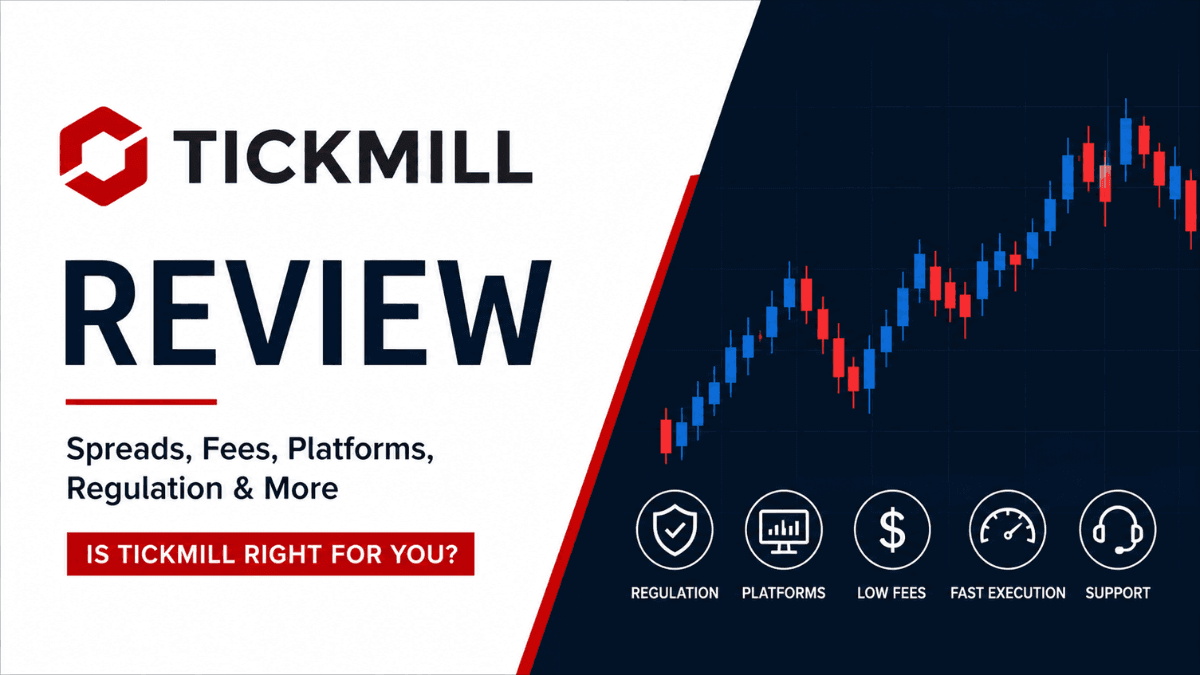
Choosing the right forex broker can make a major difference in your trading experience. In this Tickmill Review, we’ll break down everything you need to know about the broker — from spreads and trading platforms to regulation, execution quality, and account types.
Tickmill has built a strong reputation among forex and CFD traders for its low trading costs, fast execution speeds, and institutional-grade trading environment. But does it still compete well in 2026 as the industry becomes more crowded and competitive? Let’s take a closer look.
Click Here To Join our Telegram Community
Tickmill Overview
Tickmill is an online forex and CFD broker that provides trading services to retail and professional traders worldwide. The broker is known for offering tight spreads, low commissions, and access to popular trading platforms like MetaTrader 4 and MetaTrader 5.
It was founded in 2014, Tickmill has steadily expanded its global presence and now serves traders across multiple regions. The company focuses heavily on transparency and execution quality, which has helped it gain popularity among scalpers, day traders, and algorithmic traders.
The broker offers trading across several asset classes, including:
- Forex
- Stock indices
- Commodities
- Bonds
- Cryptocurrencies
- CFDs on stocks
One of Tickmill’s strongest selling points is its institutional-style pricing model. Instead of widening spreads excessively, the broker keeps spreads low and charges a transparent commission on certain account types.
Tickmill Regulation and Safety
Regulation is one of the first things traders should evaluate before opening an account. A broker may offer attractive trading conditions, but without strong oversight, your funds and trading experience could be at risk.
Tickmill operates through several regulated entities across different jurisdictions. Depending on your region, you may fall under a specific regulatory body.
Tickmill Regulatory Licenses
Tickmill is regulated by multiple authorities, including:
- Financial Conduct Authority (FCA) in the UK
- Cyprus Securities and Exchange Commission (CySEC)
- Financial Sector Conduct Authority (FSCA) in South Africa
- Financial Services Authority (FSA) in Seychelles
- Labuan Financial Services Authority (Labuan FSA)
Having multiple regulatory licenses helps increase the broker’s credibility. Tier-1 regulators such as the FCA are generally considered among the strictest in the financial industry.
Is Tickmill Safe?
For most retail traders, Tickmill is considered a relatively safe broker due to its regulatory structure and long operational history.
Client funds are typically held in segregated accounts, meaning company funds are kept separate from client deposits. This reduces the risk of misuse of client money.
Tickmill also provides negative balance protection for eligible retail clients in certain jurisdictions. This means you cannot lose more money than you deposit during extreme market volatility.
Still, no broker is completely risk-free. Trading leveraged products like forex and CFDs always carries significant financial risk.
Tickmill Trading Platforms
A broker’s platform can heavily affect execution speed, analysis quality, and overall trading efficiency. Tickmill keeps things straightforward by focusing on widely trusted trading platforms instead of building complicated proprietary software.
MetaTrader 4 (MT4)
MetaTrader 4 remains one of the most popular forex trading platforms in the world. Tickmill’s MT4 offering includes advanced charting tools, custom indicators, Expert Advisors (EAs), and one-click trading functionality.
MT4 is especially popular among:
- Scalpers
- Algorithmic traders
- Day traders
- Traders using custom indicators
The platform supports automated trading through Expert Advisors, making it attractive for traders running forex robots.
MetaTrader 5 (MT5)
MT5 is the upgraded version of MT4 and includes additional features such as:
- More timeframes
- More order types
- Economic calendar integration
- Faster backtesting
- Depth of market functionality
Traders who want broader market access and improved analytical tools may prefer MT5 over MT4.
Tickmill Mobile Trading
Tickmill also supports mobile trading through the MetaTrader mobile apps for Android and iOS devices.
The apps allow traders to:
- Open and close trades
- Analyze charts
- Manage risk
- Monitor positions
- Deposit and withdraw funds
While mobile platforms are convenient, charting is naturally more limited compared to desktop trading.
Tickmill Account Types
Tickmill offers several account types designed for different trader profiles. This flexibility helps beginners and experienced traders choose an account that matches their strategy and trading volume.
Classic Account
The Classic Account is designed for traders who prefer commission-free pricing.
Spreads are slightly wider compared to raw spread accounts, but there are no separate commissions charged per trade. This can simplify cost calculations for beginners.
The Classic Account may suit:
- New traders
- Swing traders
- Traders are placing fewer trades
Raw Account
The Raw Account is Tickmill’s most popular option among active traders.
This account offers extremely low spreads starting from 0.0 pips, combined with a fixed commission per lot traded. The pricing structure is attractive for scalpers and high-frequency traders who prioritize low trading costs.
The Raw Account is generally better for:
- Scalping
- Intraday trading
- Algorithmic trading
- High-volume traders
Demo Account
Tickmill also provides a free demo account, allowing traders to practice strategies without risking real money.
A demo account is especially useful for:
- Testing Expert Advisors
- Learning platform functionality
- Practicing risk management
- Trying new strategies
Tickmill Spreads and Fees
Trading costs directly impact long-term profitability. Even small differences in spreads and commissions can add up significantly over hundreds of trades.
Tickmill is widely known for competitive pricing, especially on forex pairs.
Forex Spreads
On the Raw Account, spreads can start from 0.0 pips during highly liquid market conditions.
Major pairs like EUR/USD often maintain very tight spreads, which benefits traders using short-term strategies.
The Classic Account has wider spreads since commissions are included within the spread itself.
Commissions
The Raw Account charges a fixed commission per lot traded. While exact commission structures may vary slightly depending on region and account currency, Tickmill generally remains competitive against other low-cost brokers.
Transparent commissions are often preferred by professional traders because they make trading costs easier to calculate.
Non-Trading Fees
Tickmill keeps non-trading fees relatively low.
The broker generally does not charge:
- Deposit fees
- Withdrawal fees
- Inactivity fees in many regions
Still, third-party payment processors or banks may apply charges depending on your payment method.
Markets Available on Tickmill
Market variety matters because many traders eventually expand beyond forex into other instruments.
Tickmill offers access to multiple CFD markets.
Forex Trading
Forex remains Tickmill’s core offering. Traders can access major, minor, and exotic currency pairs with competitive spreads and leverage.
Popular pairs include:
- EUR/USD
- GBP/USD
- USD/JPY
- AUD/USD
- USD/CAD
Indices
Tickmill offers CFD trading on global stock indices such as:
- NASDAQ 100
- S&P 500
- DAX 40
- FTSE 100
Indices are popular among traders looking to speculate on broader market sentiment.
Commodities
Commodity traders can access instruments like:
- Gold
- Silver
- Crude oil
- Natural gas
Gold trading is particularly popular on Tickmill due to tight spreads and strong execution speeds.
Cryptocurrency CFDs
Tickmill also offers cryptocurrency CFDs, allowing traders to speculate on price movements without owning the underlying coins.
Available crypto instruments may vary by region.
Tickmill Execution Speed and Trading Conditions
Execution quality is one of the areas where Tickmill performs particularly well.
The broker emphasizes low-latency execution and minimal requotes, which can matter significantly during volatile market conditions.
Why Execution Matters
Imagine entering a trade during a major news release. If your broker executes slowly, you could receive a worse price than expected — a phenomenon known as slippage.
Tickmill’s infrastructure is designed to reduce this problem as much as possible.
This makes the broker attractive for:
- News traders
- Scalpers
- EA users
- High-frequency traders
VPS Hosting
Tickmill supports VPS (Virtual Private Server) hosting solutions for eligible traders.
A VPS allows automated trading systems to run continuously with stable internet connectivity and reduced latency.
For traders running Expert Advisors 24/7, VPS hosting can improve execution consistency.
Tickmill Deposit and Withdrawal Methods
Funding and withdrawing from your trading account should be fast and straightforward. Tickmill supports several common payment methods depending on your location.
Deposit Options
Tickmill commonly supports:
- Bank transfer
- Visa/Mastercard
- Skrill
- Neteller
- Cryptocurrency payments in some regions
Deposits are often processed quickly, especially through e-wallet methods.
Withdrawals
Withdrawal processing times can vary based on the payment provider, but Tickmill generally processes requests efficiently.
Many traders report relatively smooth withdrawal experiences, which is always an important factor when evaluating broker reliability.
Tickmill Education and Research Tools
A strong educational section can help traders improve their skills over time.
Tickmill offers educational resources, including webinars, market analysis, trading guides, and economic insights.
Educational Content
The broker provides materials suitable for both beginners and intermediate traders.
Topics often include:
- Forex basics
- Technical analysis
- Risk management
- Trading psychology
- Market news
Market Research
Tickmill publishes regular market analysis and trading insights covering forex, commodities, and indices.
While research tools are useful, traders should still develop independent analytical skills rather than relying entirely on broker commentary.
Tickmill Pros and Cons
Every broker has strengths and weaknesses. Understanding both sides helps traders make realistic decisions.
Pros
- Very competitive spreads
- Strong regulation
- Fast execution speeds
- MT4 and MT5 support
- Good environment for scalping and EAs
- Low non-trading fees
- Multiple account types
Cons
- Limited proprietary platform features
- The product range is smaller than that of some multi-asset brokers
- Educational content may feel basic for advanced traders
- Cryptocurrency offerings vary by region
Who Should Use Tickmill?
Tickmill is particularly well-suited for traders who prioritize low trading costs and reliable execution.
The broker can work well for:
- Forex scalpers
- Day traders
- Swing traders
- EA users
- Cost-conscious traders
Beginners can also benefit from the simple platform structure and demo account availability, though they may need additional third-party educational resources as they advance.
Final Verdict
Tickmill continues to stand out in 2026 as a serious broker focused on trading efficiency rather than flashy marketing.
Its biggest strengths are low spreads, transparent commissions, strong execution quality, and solid regulatory oversight. These factors make it especially attractive for active forex traders and algorithmic trading strategies.
The broker may not offer the largest range of assets or the most advanced proprietary platform, but it delivers where many traders care most — pricing, execution, and reliability.
If your priority is finding a broker with institutional-style trading conditions and competitive costs, Tickmill remains one of the stronger options in the forex and CFD industry.
Frequently Asked Questions About Tickmill
Yes. Tickmill operates under several regulatory authorities, including the FCA, CySEC, FSCA, and FSA entities, depending on the region.
Yes. Tickmill supports both MetaTrader 4 and MetaTrader 5 platforms.
The minimum deposit may vary depending on the account type and region, but Tickmill is generally accessible to traders with relatively small starting capital.
Yes. Tickmill is widely considered suitable for scalping because of its low spreads, fast execution, and raw pricing model.
Yes. Tickmill fully supports automated trading through Expert Advisors on both MT4 and MT5.
Yes. Beginners can use Tickmill through demo accounts and straightforward account options, though learning proper risk management remains essential.
Trade on the Go. Anywhere, Anytime
If you’re ready to apply what you’ve learned, consider trading with a globally recognized forex and CFD broker like XM .
The platform offers competitive spreads, fast execution, and access to advanced trading tools, including real-time charts and flexible account types, making it suitable for both beginners and experienced traders. Open a trading account for free and start trading today and join millions of traders and investors on the global forex market.
Trading involves risk. Ensure you understand how the markets work before investing.

Vincent Nyagaka is the founder of Chweya, where he breaks down complex financial topics into simple insights. A trader since 2015, he uses his market experience to help readers better understand investing, trading, and personal finance.