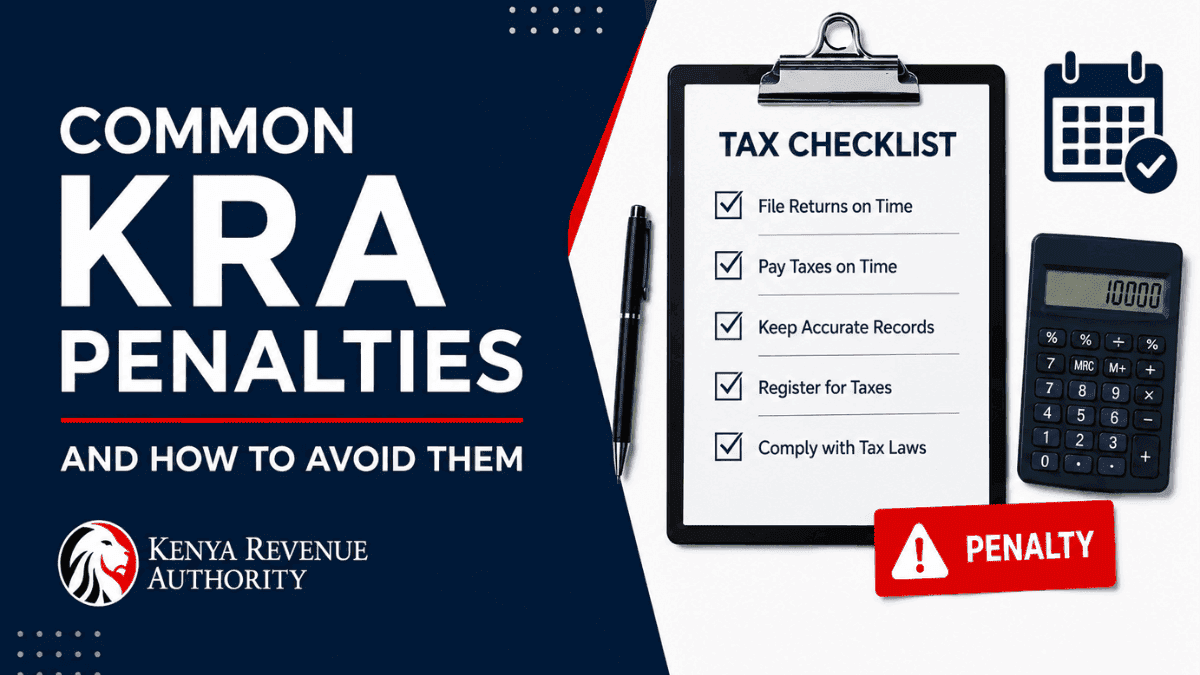
Tax compliance is an important responsibility for every Kenyan taxpayer, whether you are an employee, business owner, freelancer, landlord, or investor. Unfortunately, many people only pay attention to their tax obligations after receiving a notice from the Kenya Revenue Authority (KRA). By that time, penalties and interest may have already accumulated.
Understanding common KRA penalties can help you avoid unnecessary financial losses and maintain a good compliance record. While some penalties result from deliberate tax evasion, many arise from simple mistakes such as missing filing deadlines, failing to update tax records, or misunderstanding tax obligations.

This guide explains the most common KRA penalties in Kenya, why they occur, and practical steps you can take to avoid them.
Understanding KRA Penalties
KRA penalties are financial charges imposed on taxpayers who fail to comply with tax laws and regulations. These penalties are designed to encourage timely filing, accurate reporting, and prompt payment of taxes.
Depending on the nature of the violation, a taxpayer may face:
- Fixed monetary penalties
- Percentage-based penalties
- Interest charges on unpaid taxes
- Additional enforcement actions
In many cases, penalties continue accumulating until the issue is resolved, making early action extremely important.
Common KRA Penalties and How to Avoid Them
Let’s look at the most frequent penalties Kenyan taxpayers encounter and the best ways to prevent them.
Late Filing of Tax Returns
One of the most common KRA penalties affects taxpayers who fail to submit their tax returns by the required deadline.
Every registered taxpayer with a KRA PIN is generally expected to file annual tax returns, even when they have no income to declare. This is commonly known as filing a NIL return.
Missing the filing deadline can result in penalties being automatically generated through the iTax system.
How to Avoid Late Filing Penalties
The simplest solution is to file your returns early rather than waiting until the last few days before the deadline.
Consider these practices:
- Mark important filing deadlines on your calendar.
- File NIL returns if you have no taxable income.
- Keep your iTax account credentials secure and accessible.
- Avoid relying on last-minute internet connections or system availability.
Filing early gives you enough time to correct errors and avoid unnecessary stress.
Late Payment of Taxes
Submitting a tax return does not automatically mean your obligations are complete. If taxes are due and payment is delayed, KRA may impose penalties and interest on the outstanding amount.
This issue commonly affects businesses, landlords, self-employed professionals, and companies with tax liabilities.
How to Avoid Late Payment Penalties
Good cash flow planning is essential.
You can reduce the risk by:
- Setting aside funds for taxes throughout the year.
- Paying taxes immediately after filing.
- Reviewing tax obligations regularly.
- Monitoring due dates for VAT, PAYE, withholding tax, and income tax.
Businesses that treat tax payments as a routine operating expense are less likely to face compliance problems.
Failure to File NIL Returns
Many people assume they do not need to file returns because they are unemployed or have not earned any income during the year. This misconception leads thousands of taxpayers into penalty situations every year.
As long as you have an active KRA PIN and are required to file returns, failure to submit NIL returns may attract penalties.
How to Avoid NIL Return Penalties
Even if you are a student, unemployed, or inactive in business, check whether you are required to file annual returns.
A NIL return typically takes only a few minutes to submit through the iTax portal and can save you significant penalties later.
Incorrect Tax Returns
Errors in tax declarations can trigger penalties, audits, or additional assessments from KRA.
Mistakes may include:
- Underreporting income
- Claiming incorrect deductions
- Entering wrong figures
- Omitting taxable transactions
- Using outdated records
Even unintentional errors can create compliance issues.
How to Avoid Incorrect Return Penalties
Accuracy matters more than speed.
Before submitting any return:
- Reconcile your records carefully.
- Verify figures against bank statements and invoices.
- Confirm calculations.
- Review supporting documentation.
If your tax affairs are complex, consulting a qualified tax professional can help reduce risk.
Failure to Register for Taxes
Some individuals and businesses become liable for specific taxes but fail to register for them.
For example, a growing business may exceed registration thresholds or begin activities that require VAT registration without realizing it.
Failure to register can lead to penalties and backdated tax obligations.
How to Avoid Registration Penalties
Review your business activities regularly and understand the taxes applicable to your operations.
This may include:
- Income Tax
- VAT
- PAYE
- Excise Duty
- Turnover Tax
Seeking professional advice when your business expands can help identify new tax obligations early.
Failure to Maintain Proper Records
KRA requires taxpayers to maintain accurate records that support tax declarations and transactions.
Poor record-keeping becomes a major problem during audits and compliance reviews.
Missing documents often make it difficult to prove income, expenses, or deductions.
How to Avoid Record-Keeping Penalties
Develop a habit of maintaining organized records throughout the year.
Useful records include:
- Invoices
- Receipts
- Bank statements
- Payroll records
- Tax payment confirmations
- Contracts and agreements
Digital storage solutions can help reduce the risk of losing important documents.
PAYE Compliance Penalties
Employers have a responsibility to deduct and remit Pay As You Earn (PAYE) taxes from employee salaries.
Failure to deduct, remit, or report PAYE correctly can result in significant penalties.
This issue often affects small businesses that lack dedicated payroll systems.
How to Avoid PAYE Penalties
Employers should establish a structured payroll process.
Best practices include:
- Calculating PAYE accurately.
- Remitting deductions before deadlines.
- Maintaining payroll records.
- Conducting periodic payroll reviews.
Automated payroll software can significantly reduce errors.
VAT Compliance Penalties
Value Added Tax (VAT) compliance can be challenging, particularly for growing businesses.
Common mistakes include late filing, late payment, incorrect invoicing, and inaccurate VAT calculations.
These errors can quickly result in financial penalties.

How to Avoid VAT Penalties
Successful VAT compliance requires consistent monitoring.
Business owners should:
- Keep accurate sales and purchase records.
- Reconcile VAT transactions monthly.
- Issue compliant invoices.
- File VAT returns on time.
Regular reviews help identify discrepancies before they become costly.
Penalties Arising from Tax Audits
A tax audit occurs when KRA examines your financial records to verify compliance.
Audits may reveal undeclared income, unsupported deductions, or reporting inconsistencies.
When discrepancies are discovered, taxpayers may face additional taxes, penalties, and interest.
How to Avoid Audit-Related Penalties
Preparation is the best defense.
Maintain complete documentation and ensure your tax declarations match your financial records.
If selected for an audit, cooperate fully and provide requested information promptly.
Interest Charges: The Hidden Cost Many Taxpayers Ignore
While taxpayers often focus on penalties, interest charges can become even more expensive over time.
Interest generally accumulates on unpaid tax balances until the debt is settled. This means a relatively small tax obligation can grow substantially if ignored for months or years.
Prompt action whenever KRA raises an assessment can help minimize additional costs.
What To Do If You Receive a KRA Penalty
Receiving a penalty notice does not necessarily mean the situation cannot be resolved.
Start by reviewing the notice carefully and identifying the reason for the penalty. Many issues arise from filing errors, missed deadlines, or incomplete information.
You should then:
- Verify the accuracy of the assessment.
- Gather supporting documentation.
- Correct any filing mistakes.
- Pay outstanding obligations promptly.
- Seek professional assistance where necessary.
The sooner you address the issue, the easier it is to limit additional penalties and interest.
Best Practices for Staying KRA Compliant
Avoiding penalties is usually much easier than dealing with them after they occur.
A proactive compliance strategy should include:
- Filing returns before deadlines.
- Paying taxes on time.
- Keeping accurate financial records.
- Monitoring changes in tax regulations.
- Conducting periodic compliance reviews.
- Using qualified tax professionals when needed.
- Maintaining access to your iTax account.
These habits not only reduce penalties but also improve financial management and business credibility.
Frequently Asked Questions
Late filing of tax returns is among the most common KRA penalties. Many taxpayers forget to file annual returns or assume they do not need to submit NIL returns.
Yes. If you are required to file returns and fail to submit a NIL return, KRA may impose penalties even when you have not earned any income.
Yes. Interest can accumulate on outstanding tax liabilities until the balance is fully settled, making delays more expensive over time.
Review the notice carefully, confirm the reason for the penalty, gather supporting records, and address the issue as soon as possible to prevent further charges.
Yes. A business may face separate penalties for late filing, late payment, incorrect returns, VAT non-compliance, or PAYE violations simultaneously.
Absolutely. Filing early reduces the risk of missing deadlines, provides time to correct mistakes, and helps taxpayers avoid system congestion during peak filing periods.
Final Thoughts
Common KRA penalties can quickly become expensive, but most are entirely avoidable. The majority stem from missed deadlines, inaccurate reporting, poor record-keeping, or failure to understand tax obligations.
Whether you are an individual taxpayer or a business owner, staying organized and proactive is the most effective way to avoid penalties. Regular filing, timely payments, accurate records, and a basic understanding of Kenya’s tax requirements can save you significant money and stress in the long run.
Tax compliance should not be viewed as a once-a-year task. It is an ongoing process that protects your finances, supports business growth, and helps you maintain a positive relationship with KRA.
Trade on the Go. Anywhere, Anytime
If you’re ready to apply what you’ve learned, consider trading with a globally recognized forex and CFD broker like XM .
The platform offers competitive spreads, fast execution, and access to advanced trading tools, including real-time charts and flexible account types, making it suitable for both beginners and experienced traders. Open a trading account for free and start trading today and join millions of traders and investors on the global forex market.
Trading involves risk. Ensure you understand how the markets work before investing.

Vincent Nyagaka is the founder of Chweya, where he breaks down complex financial topics into simple insights. A trader since 2015, he uses his market experience to help readers better understand investing, trading, and personal finance.