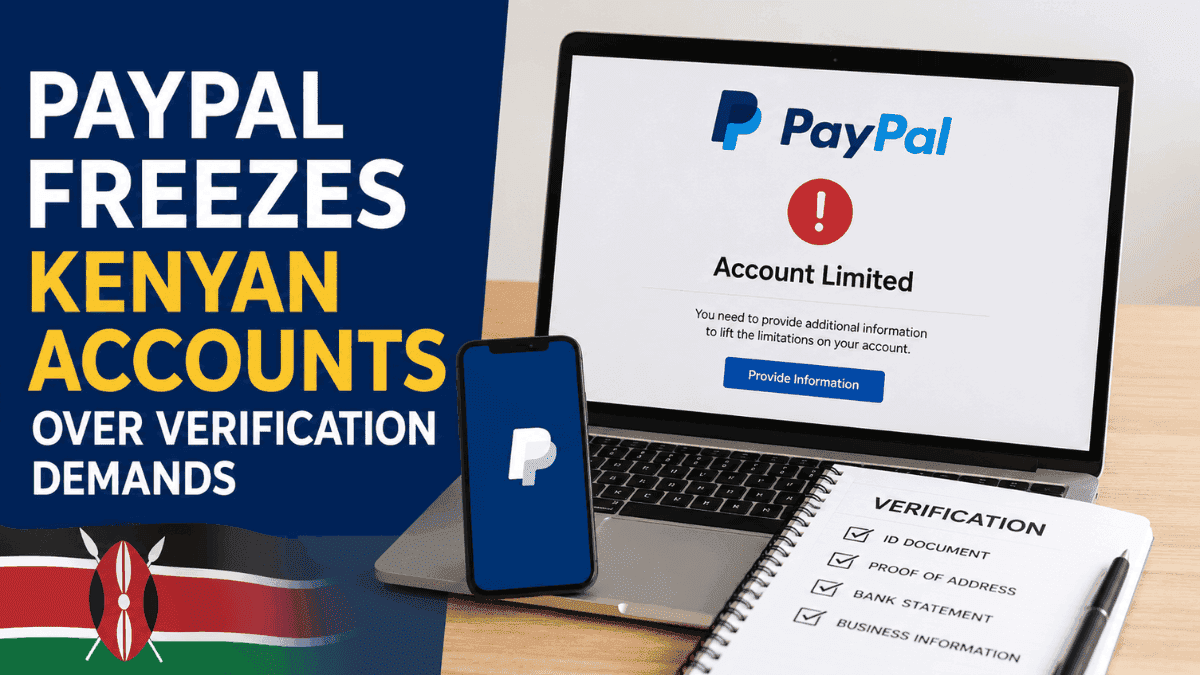
Many Kenyan freelancers, online business owners, remote workers, and digital entrepreneurs have recently been caught off guard as PayPal Freezes Kenyan Accounts Over Verification Demands. Reports indicate that numerous account holders have faced restrictions, frozen balances, and even permanent limitations after failing to satisfy additional verification requirements requested by the global payments giant.
The development has sparked concern across Kenya’s growing digital economy, where PayPal remains one of the most widely used platforms for receiving international payments. For thousands of users who depend on cross-border transactions, the sudden account freezes have raised important questions about compliance, money laundering controls, and the future of online payments in Kenya. Recent reports show that some affected users were informed that their balances could remain frozen for up to 180 days while reviews are completed.

What Happened?
The issue centers around PayPal’s increased scrutiny of certain Kenyan accounts as part of broader compliance and anti-money laundering efforts.
Affected users have reported receiving notifications requesting additional documentation to verify their identity, source of funds, business activities, or transaction history. Those who failed to provide the requested information within specified timelines reportedly faced account limitations or permanent restrictions.
According to reports, users can still view their account information and transaction records, but many are unable to send or receive payments while restrictions remain in place. Some have also been informed that their balances may be held for as long as 180 days before withdrawal becomes possible.
For freelancers waiting for client payments or businesses relying on PayPal cash flow, such restrictions can create significant financial disruptions.
Why Is PayPal Demanding More Verification?
Understanding the reasons behind these actions helps explain why the company is tightening controls.
Financial technology companies operating globally must comply with strict regulations designed to combat:
- Money laundering
- Terrorism financing
- Identity fraud
- Tax evasion
- Online scams and financial crime
When payment providers identify unusual transaction patterns, sudden increases in account activity, inconsistent account information, or missing verification documents, they often trigger additional reviews.
PayPal’s verification procedures are part of what financial institutions call Know Your Customer (KYC) requirements. KYC refers to the process of confirming a customer’s identity and understanding the nature of their financial activities.
These requirements are not unique to Kenya. Similar verification reviews occur worldwide whenever payment providers identify potential compliance risks.
Kenya’s Growing Focus on Anti-Money Laundering Compliance
The recent account restrictions come at a time when Kenya is under increased international pressure to strengthen its anti-money laundering framework.
Authorities have been working to improve oversight of financial transactions and address concerns raised by international watchdogs regarding illicit financial flows. Reports suggest that the broader environment of enhanced compliance monitoring may be influencing how global financial institutions assess transactions originating from or connected to Kenya.
This does not mean Kenyan users are automatically viewed as suspicious. Rather, financial institutions are applying stricter standards to ensure they meet global regulatory obligations.
As a result, digital payment platforms are becoming more aggressive in requesting documentation and verifying account activities.
Who Is Most Affected?
Not every PayPal user in Kenya is experiencing restrictions.
Reports suggest the impact appears concentrated among users whose accounts trigger additional compliance reviews. This may include:
Freelancers Receiving International Payments
Freelancers often receive funds from multiple clients across different countries.
Without clear documentation showing the source of payments, such activity can sometimes appear unusual to automated monitoring systems.
Online Businesses
E-commerce sellers processing international transactions may face verification requests if transaction volumes increase rapidly or if business information is incomplete.
Digital Service Providers
Graphic designers, writers, software developers, marketers, and consultants who receive overseas payments may be required to prove the legitimacy of their income sources.
High-Volume Transaction Accounts
Accounts that experience sudden spikes in payment activity are often flagged for review regardless of the user’s country.
Common Documents PayPal May Request
Verification requests vary depending on the account and the nature of transactions.
In many cases, payment processors ask users to provide documents such as:
- National ID or passport
- Proof of address
- Bank statements
- Business registration certificates
- Tax documentation
- Invoices issued to clients
- Contracts or service agreements
- Evidence showing the source of funds
The goal is to establish that account activities are legitimate and consistent with the user’s stated business or personal profile.
The Impact on Kenyan Freelancers and Remote Workers
The biggest concern for many Kenyans is the effect on income.
Over the past decade, Kenya has become one of Africa’s leading hubs for digital work. Thousands of professionals earn money through freelancing platforms, remote employment arrangements, content creation, consulting services, and online businesses.
When a PayPal account is frozen, users may suddenly lose access to:
- Client payments
- Business revenue
- Project deposits
- Emergency funds
- Subscription income
For individuals who depend entirely on online earnings, even a temporary restriction can create serious financial challenges.
The situation highlights the risks of relying exclusively on a single payment platform.
Why Some Funds Are Held for 180 Days
One aspect that has caused significant frustration is PayPal’s policy of holding funds for up to 180 days in certain situations.
When an account is permanently limited or undergoing a serious compliance review, the company may retain funds while assessing potential disputes, chargebacks, fraud risks, or regulatory concerns.
This practice is not unique to Kenya and forms part of PayPal’s global risk management procedures.
Reports indicate that some affected Kenyan users were specifically informed that their balances could remain inaccessible for up to six months before release.
Although frustrating for account holders, the policy is intended to protect the payment system against financial losses and unresolved claims.
How Kenyan Users Can Protect Their Accounts
The recent developments provide important lessons for anyone using PayPal professionally.
Complete Verification Early
Do not wait until PayPal requests documents.
Verify your identity, bank account, and contact information as soon as possible.
Keep Account Information Consistent
Names, addresses, phone numbers, and banking details should match official records.
Small inconsistencies can trigger additional scrutiny.
Maintain Proper Business Records
Keep copies of:
- Invoices
- Client agreements
- Payment confirmations
- Tax records
- Business registration documents
These records can become critical if PayPal requests proof of business activities.
Avoid Unusual Transaction Patterns
Sudden spikes in payment volumes or receiving funds unrelated to your normal activities may trigger reviews.
Consistency helps reduce compliance concerns.
Respond Quickly to Requests
Ignoring verification emails can worsen the situation.
Provide requested documentation promptly and ensure files are clear and complete.
Alternatives to Consider
The recent account restrictions have prompted many Kenyan freelancers and businesses to explore alternative payment solutions.
Diversifying payment methods can reduce dependence on a single provider and improve financial resilience.
Options commonly used by Kenyan professionals include bank transfers, international money transfer services, digital payment platforms, and direct payment arrangements with clients.

Having multiple payment channels ensures business continuity if one provider experiences restrictions or delays.
What This Means for Kenya’s Digital Economy
The PayPal verification crackdown highlights a broader shift occurring across the global financial system.
Regulators and payment providers are demanding greater transparency regarding who sends money, who receives it, and why transactions occur. As compliance standards become stricter, digital workers and online businesses must adapt by maintaining better records and stronger financial documentation.
While the restrictions may create short-term challenges, they also reflect the increasing maturity of international payment systems. Companies operating globally face growing pressure to identify risks and comply with anti-money laundering regulations across multiple jurisdictions.
For Kenyan freelancers and entrepreneurs, the key lesson is clear: compliance is no longer optional. Proper documentation, accurate account information, and transparent business practices are becoming essential requirements for participating in the global digital economy.
Will PayPal Continue Operating in Kenya?
At present, there is no indication that PayPal plans to exit the Kenyan market.
The current actions appear focused on compliance reviews and verification requirements rather than a withdrawal of services. Kenyan users can still access PayPal, create accounts, and use the platform subject to its terms and verification standards.
The company’s recent actions suggest a stronger emphasis on risk management rather than a reduction in its presence within Kenya.
Final Thoughts
The story of PayPal Freezes Kenyan Accounts Over Verification Demands serves as a reminder that digital payments increasingly operate within a heavily regulated environment.
For affected users, frozen balances and account limitations can be frustrating and financially damaging. Yet from a compliance perspective, PayPal is responding to growing global expectations around anti-money laundering controls, customer verification, and transaction monitoring.
Kenyan freelancers, online entrepreneurs, and remote workers can protect themselves by maintaining accurate records, responding quickly to verification requests, and diversifying their payment options. Those who treat compliance as part of doing business online will be better positioned to navigate an increasingly regulated digital economy while maintaining uninterrupted access to international payments.
Trade on the Go. Anywhere, Anytime
If you’re ready to apply what you’ve learned, consider trading with a globally recognized forex and CFD broker like XM .
The platform offers competitive spreads, fast execution, and access to advanced trading tools, including real-time charts and flexible account types, making it suitable for both beginners and experienced traders. Open a trading account for free and start trading today and join millions of traders and investors on the global forex market.
Trading involves risk. Ensure you understand how the markets work before investing.

Vincent Nyagaka is the founder of Chweya, where he breaks down complex financial topics into simple insights. A trader since 2015, he uses his market experience to help readers better understand investing, trading, and personal finance.