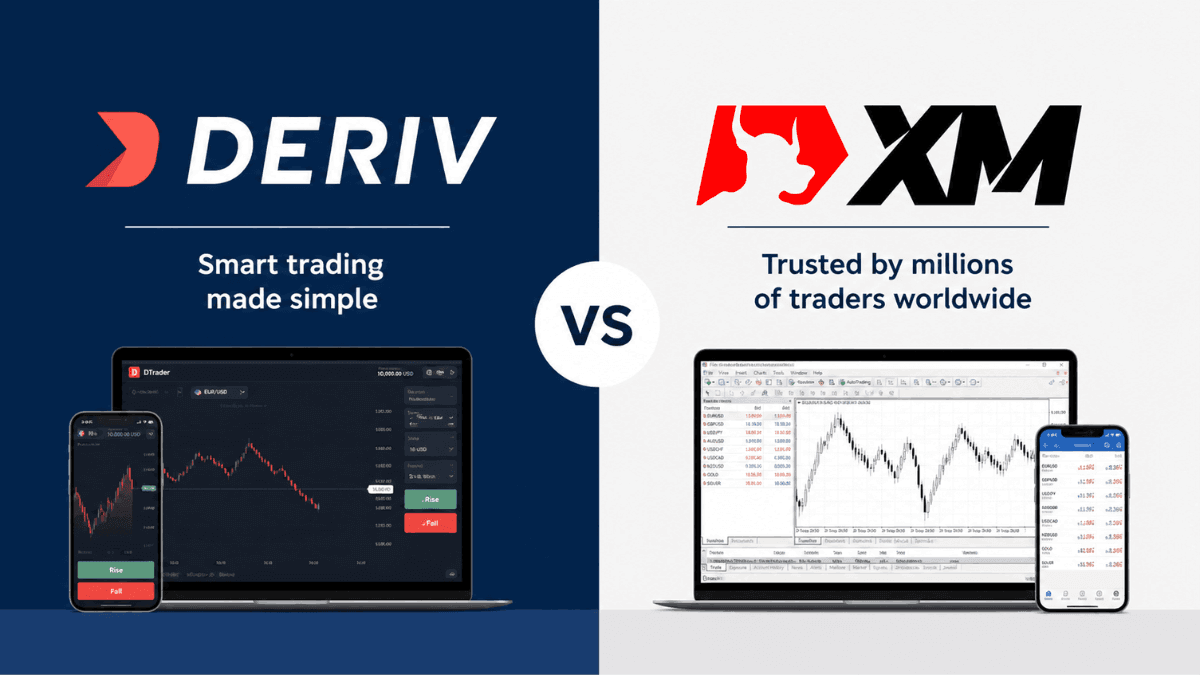
Choosing between Deriv and XM can feel overwhelming, especially if you want a platform that matches your trading goals. This Deriv vs XM comparison breaks everything down clearly, helping you decide which broker suits your needs in 2026.
Both brokers are popular globally and offer forex and CFD trading, but they differ in regulation, platforms, fees, and trading experience. Understanding these differences is key to avoiding costly mistakes.
Click Here To Join our Telegram Community
| Feature | Deriv | XM |
|---|---|---|
| Regulation | Multiple regulators (including offshore jurisdictions) | Strong regulation (CySEC, ASIC, FSC) |
| Minimum Deposit | From $5 (varies by method) | From $5 |
| Trading Platforms | DTrader, DBot, DMT5 | MT4, MT5 |
| Account Types | Standard, Synthetic, Financial | Micro, Standard, XM Zero |
| Spread | Low spreads (variable) | Low to moderate spreads |
| Leverage | Up to 1:1000 (varies) | Up to 1:1000 (varies by region) |
| Commission | Mostly commission-free | Commission on Zero accounts |
| Copy Trading | Limited (via bots/automation) | Available (via MT platforms) |
| Deposit/Withdrawal Methods | E-wallets, crypto, local agents | Bank transfer, cards, e-wallets |
| Customer Support | 24/7 support | 24/5 multilingual support |
| Start Trading | ✅ Trade with Deriv | ✅ Open Account with XM |
Deriv and XM Overivew
Before diving into detailed comparisons, it helps to understand what each broker offers at a glance.
What Is Deriv?
Deriv is a well-established online trading platform known for its synthetic indices and flexible trading options. It evolved from Binary.com and focuses on simplicity, accessibility, and innovative trading instruments.
It appeals to traders who want unique markets available 24/7, along with low entry requirements and multiple account types.
What Is XM?
XM is a globally recognized forex and CFD broker with a strong reputation for regulation and trader education. It offers a wide range of financial instruments, including forex, commodities, indices, and stocks.
The platform is particularly popular among beginners due to its educational resources and low minimum deposit requirements.
Regulation and Safety
When comparing Deriv vs XM, safety should always come first because it directly impacts your funds and trading experience.
Deriv Regulation
Deriv operates under multiple regulatory entities across different jurisdictions. While it does have licenses, some of them come from offshore regulators.
This doesn’t automatically mean it is unsafe, but traders should be aware that investor protection may be limited depending on the entity they sign up with.
XM Regulation
XM stands out for its strong regulatory framework. It is licensed by top-tier authorities such as:
- CySEC (Cyprus Securities and Exchange Commission)
- ASIC (Australian Securities and Investments Commission)
This level of regulation gives XM an edge in terms of trust and fund security.
Trading Platforms
Your trading platform determines how smoothly you can execute trades and analyze markets.
Deriv Platforms
Deriv offers a variety of proprietary platforms, including:
- DTrader (simple interface for beginners)
- DBot (automated trading)
- DMT5 (Deriv’s version of MT5)
These platforms are designed to be flexible and user-friendly, especially for traders interested in automation or synthetic indices.
XM Platforms
XM focuses on industry-standard platforms:
- MetaTrader 4 (MT4)
- MetaTrader 5 (MT5)
These platforms are widely trusted and come with advanced charting tools, indicators, and support for automated trading through Expert Advisors.
Trading Instruments
The range of available assets can shape your trading strategy.
Deriv Instruments
Deriv is known for its unique offerings, including:
- Synthetic indices (available 24/7)
- Forex pairs
- Commodities
- Cryptocurrencies
Synthetic indices are especially attractive because they are not affected by real-world events.
XM Instruments
XM provides a more traditional selection of markets:
- Forex (major, minor, exotic pairs)
- Stocks
- Indices
- Commodities
- Precious metals
This makes XM ideal for traders who prefer real-world market exposure.
Fees and Spreads
Understanding costs is essential when comparing Deriv vs XM because fees directly affect your profits.
Deriv Fees
Deriv generally offers competitive spreads and low trading costs. Many accounts have no commission, but spreads can vary depending on the instrument.
There are also minimal deposit requirements, making it accessible for beginners.
XM Fees
XM offers both commission-free and commission-based accounts. Spreads are slightly higher on standard accounts but lower on zero accounts.
While XM may not always be the cheapest, its pricing is transparent and reliable.
Account Types and Minimum Deposit
Different account options allow traders to choose what suits their experience level.
Deriv Accounts
Deriv provides flexible account types with low entry barriers. Some accounts can be opened with very small deposits, making it beginner-friendly.
It also allows easy switching between demo and live accounts.
XM Accounts
XM offers several account types, including:
- Micro Account
- Standard Account
- XM Zero Account
The minimum deposit starts as low as $5, which is attractive for new traders.
Deposits and Withdrawals
Smooth transactions are a major factor when choosing a broker.
Deriv Payments
Deriv supports a wide range of payment methods:
- E-wallets (Skrill, Neteller)
- Cryptocurrencies
- Local payment agents (popular in Africa)
Withdrawals are generally fast, especially when using e-wallets.
XM Payments
XM also supports multiple payment options:
- Bank transfers
- Credit/debit cards
- E-wallets
XM is known for zero deposit fees and relatively fast processing times.
User Experience and Education
A broker’s usability and learning resources can make a big difference, especially for beginners.
Deriv Experience
Deriv focuses on simplicity and innovation. Its platforms are easy to navigate, even for new traders.
However, its educational resources are somewhat limited compared to larger brokers.
XM Experience
XM excels in education and support. It offers:
- Free webinars
- Trading tutorials
- Market analysis
This makes XM a strong choice for beginners who want structured learning.
Pros and Cons
A quick summary helps highlight the strengths and weaknesses of each broker.
Deriv Pros and Cons
Pros:
- Unique synthetic indices
- Low minimum deposit
- Flexible platforms
Cons:
- Weaker regulatory oversight
- Limited educational resources
XM Pros and Cons
Pros:
- Strong regulation
- Excellent educational content
- Trusted trading platforms
Cons:
- No synthetic indices
- Slightly higher spreads on some accounts
Deriv vs XM: Key Differences
Understanding the core differences helps you make a faster decision.
- Regulation: XM is stronger
- Trading Instruments: Deriv offers unique synthetic markets
- Platforms: XM uses industry-standard MT4/MT5
- Beginner Support: XM is better for education
- Flexibility: Deriv offers more innovative tools
Which Broker Should You Choose?
The right choice between Deriv and XM depends on your trading style and priorities.
If you prefer innovative trading options like synthetic indices and want a flexible, low-cost platform, Deriv may be the better fit. It works well for traders who value accessibility and 24/7 markets.
If you prioritize safety, regulation, and structured learning, XM is the stronger choice. It is especially suitable for beginners and traders who want exposure to real financial markets.
Final Verdict
Both Deriv and XM are solid brokers, but they serve different types of traders. Deriv stands out for innovation and flexibility, while XM leads in trust, education, and traditional trading.
The best approach is to define your goals first, then choose the broker that aligns with them. That way, you are not just picking a platform—you are building a trading foundation that supports long-term success.
Frequently Asked Questions About Deriv vs XM
What is the main difference between Deriv and XM?
The main difference in the Deriv vs XM comparison is their focus and trading environment. Deriv offers synthetic indices and flexible, 24/7 trading, while XM focuses on traditional forex and CFD markets with stronger regulation and educational support.
Is Deriv or XM better for beginners?
XM is generally better for beginners because it provides structured education, webinars, and a highly regulated environment. Deriv is also beginner-friendly in terms of ease of use, but it lacks the same depth of learning resources.
Which broker has lower fees, Deriv or XM?
Deriv typically offers lower trading costs with tight spreads and no commission on many accounts. XM may have slightly higher spreads on standard accounts, but it offers competitive pricing on zero accounts and maintains transparent fee structures.
Can I trade synthetic indices on XM?
No, synthetic indices are exclusive to Deriv. XM does not offer synthetic markets, as it focuses on real-world financial instruments like forex, stocks, and commodities.
Is XM safer than Deriv?
XM is considered safer due to its regulation by top-tier authorities such as CySEC and ASIC. Deriv is regulated as well, but some of its licenses are offshore, which may offer less investor protection depending on your region.
Which platform is better: Deriv or XM?
The better platform depends on your needs. Deriv offers proprietary platforms with automation features, while XM uses MetaTrader 4 and 5, which are widely trusted and packed with advanced tools for analysis and trading.
Trade on the Go. Anywhere, Anytime
If you’re ready to apply what you’ve learned, consider trading with a globally recognized forex and CFD broker like XM .
The platform offers competitive spreads, fast execution, and access to advanced trading tools, including real-time charts and flexible account types, making it suitable for both beginners and experienced traders. Open a trading account for free and start trading today and join millions of traders and investors on the global forex market.
Trading involves risk. Ensure you understand how the markets work before investing.

Our financial editorial team covers global markets, economic policy, and investment trends. We combine real-time research with AI-powered writing assistants to deliver accurate, timely, and easy-to-read articles. Our editors review all content to ensure quality, neutrality, and clarity for our readers.