This Goat Funded Trader review provides a clear, practical evaluation of the prop firm, focusing on how it works, who it suits, and where traders should be cautious. The goal is to help you decide whether Goat Funded Trader fits your trading style, risk tolerance, and experience level.
Proprietary trading firms can offer capital access without personal risk, but the details matter. Evaluation rules, drawdown limits, and payout terms often determine whether a firm is trader-friendly or frustrating over time. This review examines those details carefully, using plain language and real-world context.
Click Here To Join our Telegram Community
Goat Funded Trader Overview
Goat Funded Trader is a proprietary trading firm that provides traders with simulated capital after they pass a structured evaluation. Once funded, traders earn a share of the profits they generate, while the firm enforces strict risk management rules.
The firm positions itself as accessible to both new and experienced traders by offering multiple account sizes and straightforward trading objectives. Like most prop firms, it does not allow trading with real market capital during evaluations, but payouts are based on simulated performance.
How the Goat Funded Trader Works
Goat Funded Trader follows a step-by-step process that begins with an evaluation and ends with profit withdrawals. Understanding each stage helps avoid surprises later.
Account Selection and Fees
Traders begin by choosing an account size, which determines the profit target, drawdown limits, and evaluation fee. Larger accounts come with higher fees but offer greater profit potential once funded.
Fees are typically paid upfront and are non-refundable unless the firm explicitly states otherwise. This means traders should treat the evaluation fee as a business expense rather than a deposit.
The Evaluation Phase Explained
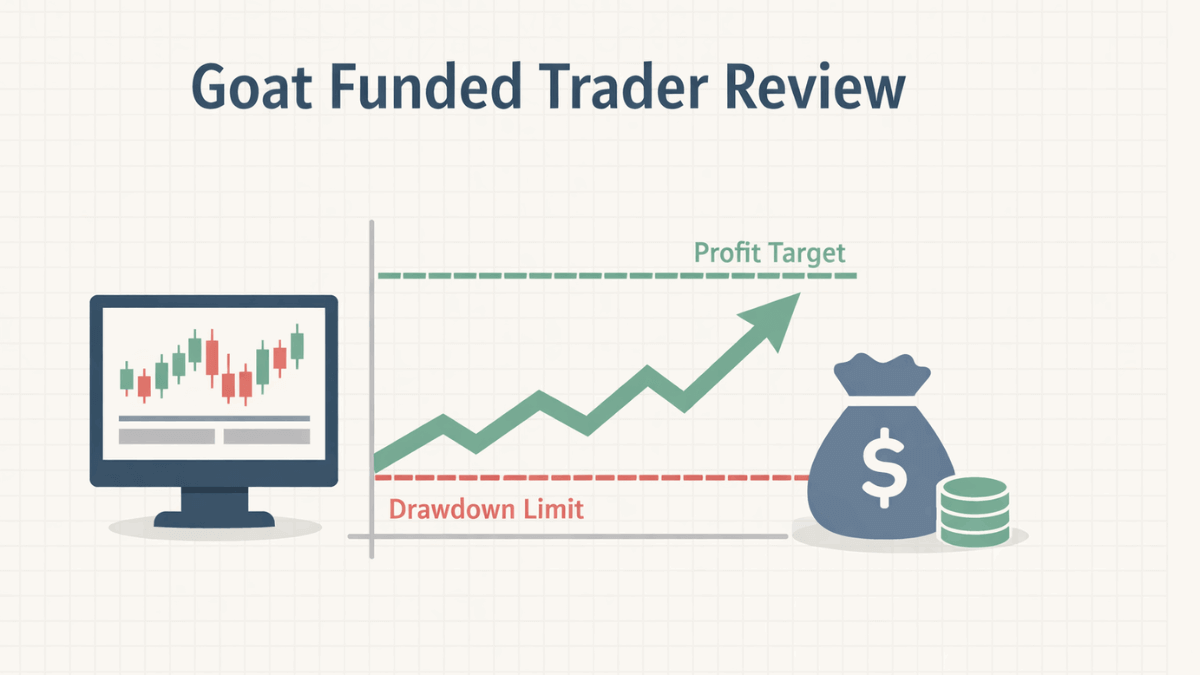
The evaluation phase tests whether a trader can meet profit goals while respecting drawdown rules. Traders must hit a specific profit target without exceeding daily or overall loss limits.
The evaluation does not reward aggressive trading. Consistency and discipline matter more than fast gains, as one oversized loss can fail the account.
Getting Funded After Passing
After successfully completing the evaluation, traders receive a funded account under the firm’s trading rules. At this stage, profit-sharing applies, and traders can request payouts based on the firm’s schedule.
Funded accounts still operate under strict risk parameters. Passing the evaluation does not remove drawdown limits or behavioral expectations.
Trading Rules and Risk Limits
Every prop firm lives or dies by its rules, and Goat Funded Trader is no exception. These rules are designed to protect the firm while encouraging responsible trading.
Maximum Drawdown Rules
Goat Funded Trader enforces both daily and overall drawdown limits. The daily drawdown caps how much you can lose in a single trading day, while the overall drawdown defines the maximum loss allowed across the account’s lifetime.
These limits are usually calculated based on account balance or equity. Traders who hold positions overnight should pay close attention to how floating losses are treated.
Profit Targets and Consistency
Profit targets must be reached without violating drawdown rules. Some account types may also include consistency requirements, discouraging traders from hitting targets with one large trade.
Consistency rules favor traders who use structured strategies rather than high-risk approaches. This aligns with long-term profitability but can frustrate traders used to aggressive scaling.
Trading Style Restrictions
Certain trading styles may be restricted, such as latency arbitrage, grid trading, or news-based scalping. These restrictions are common across the prop firm industry.
Before purchasing an evaluation, traders should read the prohibited strategies section carefully. Violating these rules can lead to account termination even if profit targets are met.
Tradable Instruments and Platforms
Goat Funded Trader offers access to popular markets that appeal to retail traders worldwide. The platform and instrument choice influences execution quality and strategy compatibility.
Available Markets
Most accounts support major forex pairs, indices, commodities, and sometimes cryptocurrencies. The exact list can vary depending on account type and liquidity conditions.
Forex traders will find adequate coverage for major and minor pairs, while index traders benefit from instruments like the US and European stock indices.
Trading Platforms Offered
Goat Funded Trader typically supports widely used platforms such as MetaTrader. These platforms allow traders to use custom indicators, expert advisors, and familiar charting tools.
Platform stability matters, especially during volatile sessions. Traders should test execution quality during the evaluation to ensure it matches their strategy requirements.
Profit Splits and Payout Structure
Profit-sharing and payout reliability are among the most important factors in any prop firm review. Goat Funded Trader promotes competitive splits, but the details deserve attention.
Profit Split Percentage
Most funded accounts offer a profit split that favors the trader, often starting around industry norms. Higher splits may be available after meeting certain milestones or maintaining consistent performance.
While the percentage matters, payout frequency and processing speed are equally important for cash flow planning.
Payout Schedule and Methods
Payouts are usually available after a defined trading period, such as bi-weekly or monthly cycles. Traders must meet minimum profit thresholds before requesting a withdrawal.
Payment methods can include bank transfers or online payment providers. Processing times vary, so traders should plan accordingly rather than relying on instant access.
Fees, Costs, and Hidden Considerations
Understanding the true cost of trading with Goat Funded Trader goes beyond the evaluation fee. Ongoing rules can indirectly affect profitability.
Evaluation Fees Explained
Evaluation fees scale with account size. Smaller accounts are more affordable but offer limited profit potential, while larger accounts require a higher upfront commitment.
These fees are standard in the industry, but traders should compare cost-to-profit ratios before choosing an account.
Reset and Retry Costs
If an evaluation fails, traders may need to pay again to retry. Some firms offer discounted resets, while others require full repurchase.
This makes risk management during the evaluation especially important. Avoiding emotional trading can save high costs over time.
Pros of Goat Funded Trader
Goat Funded Trader offers several strengths that appeal to disciplined traders looking for structured growth.
- Clear evaluation rules that reward consistency
- Multiple account sizes for different experience levels
- Competitive profit splits for funded traders
- Access to popular trading platforms and instruments
These advantages make the firm suitable for traders who already follow a rules-based approach.
Cons and Potential Drawbacks
No prop firm is perfect, and Goat Funded Trader has limitations that some traders may find restrictive.
- Strict drawdown rules that leave little room for error
- Evaluation fees that can add up after multiple attempts
- Restrictions on certain high-risk or automated strategies
Traders who prefer flexible risk-taking or experimental strategies may feel constrained by these rules.
Goat Funded Trader vs Other Prop Firms
Comparing Goat Funded Trader with other firms helps put its offering into perspective. While many rules are similar across the industry, small differences matter.
Below is a simple comparison table
| Feature | Goat Funded Trader | Typical Prop Firm |
| Evaluation Fee | Moderate, depends on account size | Varies: low to high |
| Profit Target | Moderate, clearly defined | Varies by firm |
| Drawdown Limits | Strict daily and total limits | Varies, some stricter, some looser |
| Profit Split | Competitive, trader-friendly | Typically 70–90% |
| Trading Platforms | Common platforms like MetaTrader | Varies (some offer proprietary platforms) |
| Tradable Markets | Forex, indices, commodities (varies) | Depends on firm’s offerings |
| Strategy Restrictions | Rules against high-risk strategies | Depends on firm |
| Account Sizes | Multiple options | Multiple options |
| Payout Frequency | Set schedule (e.g., monthly/bi-weekly) | Varies |
| Risk Management Focus | Emphasizes consistency | Industry standard risk rules |
Some competitors offer higher profit splits but stricter consistency rules. Others allow more trading freedom but enforce tighter drawdowns. Goat Funded Trader sits in the middle, balancing structure with accessibility.
Choosing the right firm depends less on marketing claims and more on how well the rules match your trading behavior.
Who Is Goat Funded Trader Best For?
Goat Funded Trader is best suited for traders who already understand risk management and can trade consistently under pressure. Beginners with a solid demo trading background may also benefit if they treat the evaluation as a learning experience.
Traders who struggle with overtrading or emotional decisions may find the rules challenging. In such cases, additional practice on a personal demo account can help before attempting the evaluation.
Is Goat Funded Trader Legit?
Legitimacy in prop trading depends on transparency, clear rules, and reliable payouts. Goat Funded Trader appears to operate within standard industry practices and provides documented rules for traders to follow.
That said, traders should always verify the latest terms directly on the firm’s official website. Prop firm conditions can change, and staying informed protects your time and capital.
Risk Management Tips for Passing the Evaluation
Passing the evaluation requires more than a profitable strategy. Execution and discipline play a major role.
Focus on Small, Consistent Wins
Target modest daily gains rather than large single trades. This reduces drawdown risk and aligns with most prop firm rules.
Respect Daily Loss Limits
Stopping for the day after hitting a loss limit preserves your account. One bad session should not undo weeks of progress.
Avoid Overtrading
Quality setups matter more than quantity. Overtrading often leads to emotional mistakes and rule violations.
Frequently Asked Questions About Goat Funded Trader?
Goat Funded Trader is a proprietary trading firm that allows traders to trade with simulated capital after passing an evaluation. Traders earn a percentage of the profits while following strict risk management rules set by the firm.
Goat Funded Trader operates like most modern prop firms, using evaluations, clear trading rules, and profit-sharing models. While it appears legitimate, traders should always review the latest terms on the official website and understand that profits are based on simulated trading accounts.
The cost depends on the account size you choose during the evaluation phase. Larger accounts require higher one-time evaluation fees, and these fees are usually non-refundable if the evaluation fails.
There is no fixed time limit as long as the minimum trading day requirements are met. Traders can pass the evaluation quickly if they reach the profit target while respecting drawdown rules, or take longer by trading more conservatively.
Goat Funded Trader typically allows trading on major forex pairs, indices, commodities, and sometimes cryptocurrencies. The exact instruments available depend on the account type and platform offered.
Once funded, traders receive a percentage of their profits based on the firm’s profit split policy. Payouts are requested after meeting minimum profit thresholds and are processed according to the firm’s payout schedule and payment methods.
Final Verdict
This Goat Funded Trader review shows a prop firm that prioritizes structure, discipline, and risk control. It offers a fair opportunity for traders who can follow rules and manage emotions under pressure.
For disciplined traders seeking capital without personal market risk, Goat Funded Trader can be a reasonable option. For those still refining their strategy or risk control, spending more time on demo trading may lead to better results before committing to an evaluation.