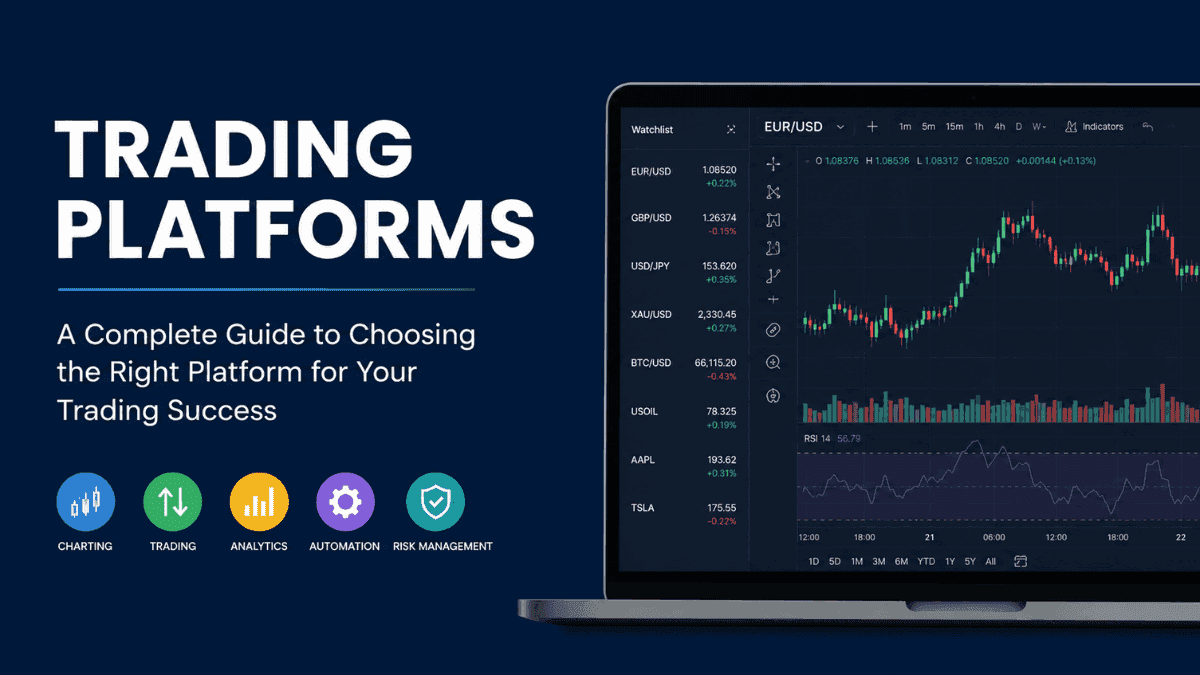
A trading platform is one of the most important tools a trader will ever use. Whether you trade forex, stocks, cryptocurrencies, commodities, or indices, your trading platform controls how you analyze charts, place orders, manage risk, and monitor the markets in real time.
Many traders focus heavily on strategies while ignoring the software they use every day. That can become a costly mistake. A slow platform, limited charting tools, poor execution speeds, or unstable mobile apps can directly affect your trading performance. Choosing the right trading platform is not just about convenience — it can influence your consistency, confidence, and long-term results.

This guide explains what trading platforms are, how they work, the different types available, their advantages and disadvantages, and how to choose the best trading platform for your trading style.
What Is a Trading Platform?
A trading platform is software that allows traders and investors to access financial markets through a broker or financial institution. It acts as the bridge between you and the market, letting you open, manage, and close trades from your computer, web browser, or smartphone.
Most modern trading platforms provide far more than simple order execution. They also include charting tools, technical indicators, news feeds, market analysis tools, watchlists, and risk management features.
Some platforms are designed for beginners and focus on simplicity. Others are built for professional traders who require advanced charting, automated trading systems, and direct market access.
Popular trading platforms include:
- MetaTrader 4
- MetaTrader 5
- cTrader
- TradingView
- NinjaTrader
Each platform has its own strengths, weaknesses, and ideal user base.
How Trading Platforms Work
At their core, trading platforms connect traders to liquidity providers and exchanges through brokers. When you place a trade, the platform sends your order electronically to the broker’s server, where it is processed and executed.
The process usually works like this:
- You analyze the market using charts and indicators
- You place a buy or sell order
- The platform sends the order to the broker
- The broker executes the order in the market
- Your position appears in the trading terminal
This process happens within milliseconds on high-quality platforms. Fast execution matters because delays can cause slippage, which occurs when your order is filled at a different price than expected.
A reliable trading platform should provide stable connectivity, accurate price feeds, and efficient order execution even during volatile market conditions.
Types of Trading Platforms
Not all trading platforms are built for the same purpose. Understanding the major categories helps you choose software that matches your goals.
Desktop Trading Platforms
Desktop platforms are installed directly onto your computer. These platforms typically offer the most advanced features and fastest performance.
Professional traders often prefer desktop platforms because they support:
- Advanced charting
- Multiple monitor setups
- Automated trading
- Custom indicators
- Faster order execution
Platforms like MetaTrader 5 and NinjaTrader are widely used on desktop environments.
The downside is reduced portability. You need access to your installed device unless the platform supports cloud syncing.
Web-Based Trading Platforms
Web trading platforms run directly in your browser without requiring installation. They have become increasingly popular because they allow traders to access markets from almost any device with internet access.
These platforms are ideal for traders who value flexibility and convenience. Many brokers now provide powerful browser-based terminals with impressive charting tools and responsive interfaces.
TradingView is one of the best-known web-based platforms thanks to its modern design and community features.
Mobile Trading Platforms
Mobile trading platforms allow you to trade using smartphones or tablets. They are useful for monitoring trades, managing risk, and responding to sudden market movements while away from your desk.
Good mobile platforms should offer:
- Fast execution
- Clean charting tools
- Push notifications
- Secure login systems
- Stable performance
Mobile trading has grown rapidly over the last few years because traders increasingly want flexibility and instant market access.
Still, mobile apps have limitations. Small screens make deep technical analysis harder, and emotional trading can become more tempting when markets are always in your pocket.
Features to Look for in a Trading Platform
A trading platform should do more than simply open and close trades. The best platforms improve efficiency, reduce mistakes, and help traders make informed decisions.
User-Friendly Interface
A cluttered interface can slow you down and create unnecessary confusion. A good trading platform should feel intuitive from the beginning.
You should be able to:
- Navigate charts easily
- Place orders quickly
- Modify stop-loss and take-profit levels without confusion
- Access account history and reports efficiently
Beginners especially benefit from platforms that simplify the learning process without sacrificing important functionality.
Charting Tools and Indicators
Charts are central to technical analysis. A quality trading platform should provide customizable charts with multiple timeframes and technical indicators.
Common indicators include:
- Moving averages
- RSI
- MACD
- Bollinger Bands
- Fibonacci tools
Some platforms also allow traders to create custom indicators or import third-party tools.
Order Types
Different trading strategies require different order execution methods. A good trading platform should support various order types beyond simple market execution.
Important order types include:
- Market orders
- Limit orders
- Stop orders
- Trailing stops
- One-cancels-the-other (OCO) orders
These tools help traders manage entries, exits, and risk more effectively.
Speed and Stability
Execution speed matters more than many beginners realize. During volatile market conditions, delays can significantly affect profitability.
A reliable trading platform should remain stable during:
- High-impact news releases
- Market openings
- Sudden volatility spikes
- Heavy trading sessions
Frequent freezing, disconnections, or lagging charts are major warning signs.
Security and Regulation
Security should never be overlooked. Trading accounts contain sensitive financial data and real capital.
A trustworthy trading platform should provide:
- Two-factor authentication
- Encrypted connections
- Secure server infrastructure
- Strong account protection systems
The broker offering the platform should also be regulated by reputable authorities whenever possible.
Trading Platform vs Broker: What’s the Difference?
Many beginners confuse trading platforms with brokers, but they are not the same thing.
A broker is the company that provides access to financial markets and holds your trading account. The trading platform is the software you use to interact with the broker and execute trades.
For example, many brokers offer MetaTrader 4 or cTrader as their platform. The platform itself is separate from the brokerage company.
This distinction matters because the same platform can feel very different depending on the broker’s execution quality, spreads, pricing, and server infrastructure.
Popular Trading Platforms
Several trading platforms dominate the online trading industry. Each serves a different type of trader.
MetaTrader 4 (MT4)
MetaTrader 4 remains one of the most widely used forex trading platforms in the world.
It became popular because of its simplicity, lightweight design, and support for automated trading through Expert Advisors (EAs). Many forex brokers still offer MT4 because of its massive ecosystem of indicators and trading robots.
MT4 works especially well for forex-focused traders who prioritize reliability and automation.
MetaTrader 5 (MT5)
MetaTrader 5 is the newer version of MT4 and supports more asset classes, including stocks and futures.
It offers additional timeframes, more technical indicators, faster backtesting, and improved order management tools.
Some traders still prefer MT4 because of familiarity, but MT5 continues to gain popularity among multi-asset traders.
cTrader
cTrader is known for its modern interface, advanced order execution, and institutional-style design.
Scalpers and advanced forex traders often appreciate cTrader’s depth-of-market features and transparent execution environment.
The platform also supports algorithmic trading through cAlgo.
TradingView
TradingView combines charting, market analysis, and social networking features into one platform.
Its clean interface and browser-based design make it popular among traders across forex, stocks, crypto, and commodities markets.
TradingView is especially respected for its advanced charting capabilities and community-generated ideas.
How to Choose the Best Trading Platform
The best trading platform depends on your goals, experience level, and trading style.
Consider Your Market
Different markets require different tools. A forex trader may prioritize execution speed and automated trading support, while a stock investor may care more about research tools and portfolio tracking.
Before choosing a platform, ask yourself what you plan to trade most frequently.
Think About Your Strategy
Your strategy should influence your platform selection.
For example:
- Scalpers need ultra-fast execution
- Swing traders may prioritize charting tools
- Algorithmic traders require automation support
- Long-term investors often want research and portfolio analytics
A mismatch between platform and strategy creates unnecessary friction.
Test the Demo Account
Most brokers provide demo accounts that let you test the trading platform using virtual funds.
This is one of the best ways to evaluate:
- Ease of use
- Chart responsiveness
- Order execution
- Available tools
- Mobile experience
Spending time on a demo account can prevent frustration later.
Check Costs and Fees
Some trading platforms are free, while others charge subscription fees or premium data costs.
You should also consider broker-related costs tied to the platform, including:
- Spreads
- Commissions
- Overnight swap fees
- Withdrawal fees
A platform with excellent tools may not be worth it if trading costs are excessively high.
Advantages of Modern Trading Platforms
Trading technology has improved dramatically over the years. Modern platforms provide retail traders with tools that were once reserved for institutional professionals.
Key advantages include:
- Instant market access
- Advanced charting capabilities
- Real-time news integration
- Automated trading systems
- Mobile accessibility
- Improved risk management tools
These features have made financial markets more accessible than ever before.
Risks and Limitations of Trading Platforms
Even the best trading platform cannot eliminate trading risks. Technology problems, emotional decisions, and market volatility still affect outcomes.
Traders should understand the limitations of platform technology.
Technical Failures
Internet outages, platform freezes, and server downtime can occur unexpectedly. During highly volatile events, execution delays may increase.
Professional traders often prepare backup plans, including secondary internet connections or alternative devices.
Overtrading
Easy market access can encourage impulsive behavior. Constant notifications and mobile trading apps sometimes tempt traders to overtrade.
Successful trading still depends on discipline, patience, and proper risk management — not just technology.
Learning Curve
Advanced platforms can overwhelm beginners. Features like algorithmic trading, depth-of-market tools, and complex indicators require time to master.
New traders should focus on understanding core platform functions before diving into advanced tools.
Are Free Trading Platforms Good Enough?
Free trading platforms can absolutely be good enough for many traders. In fact, some of the world’s most popular platforms are available at no direct cost through brokers.
The key question is not whether a platform is free, but whether it provides reliable execution, useful tools, and a stable trading experience.
Some free platforms offer excellent value, while others cut corners on performance or features. Always evaluate quality over price alone.
The Future of Trading Platforms
Trading platforms continue evolving rapidly as technology changes financial markets.
Artificial intelligence, cloud computing, machine learning, and advanced analytics are beginning to reshape how traders interact with markets. More platforms are integrating:
- AI-powered insights
- Enhanced automation tools
- Social trading features
- Cross-device synchronization
- Advanced risk analytics
Mobile trading is also becoming increasingly sophisticated, narrowing the gap between desktop and smartphone experiences.
At the same time, competition among brokers and software developers continues pushing platforms toward faster execution, better interfaces, and lower costs.
Final Thoughts
A trading platform is far more than a piece of software. It is the environment where every trading decision happens, from analysis to execution and risk management.
The best trading platform for you depends on your experience level, preferred markets, strategy, and personal workflow. Some traders value simplicity, while others need institutional-grade tools and automation capabilities.
Before committing real capital, spend time testing different platforms through demo accounts. Check their charting systems, order execution speeds, mobile apps, and overall usability. A platform that feels comfortable and reliable can help reduce friction and improve your overall trading experience.
Technology alone will not make someone profitable. Discipline, strategy, education, and risk management still matter most. But choosing the right trading platform can give you a stronger foundation and a smoother path as you develop your trading skills.
Frequently Asked Questions About Trading Platforms
Many beginners start with user-friendly platforms like MetaTrader 4 or TradingView because they balance simplicity with useful trading tools.
Yes. Most modern trading platforms provide mobile apps for Android and iOS devices, allowing traders to analyze charts and execute trades on the go.
Many platforms are free through brokers, although some advanced tools or premium data services may require subscriptions.
MetaTrader 5 supports more asset classes, additional indicators, and improved backtesting compared to MetaTrader 4.
Popular forex trading platforms include MetaTrader 4, MetaTrader 5, and cTrader. The best option depends on your trading style and broker preferences.
Trade on the Go. Anywhere, Anytime
If you’re ready to apply what you’ve learned, consider trading with a globally recognized forex and CFD broker like XM .
The platform offers competitive spreads, fast execution, and access to advanced trading tools, including real-time charts and flexible account types, making it suitable for both beginners and experienced traders. Open a trading account for free and start trading today and join millions of traders and investors on the global forex market.
Trading involves risk. Ensure you understand how the markets work before investing.