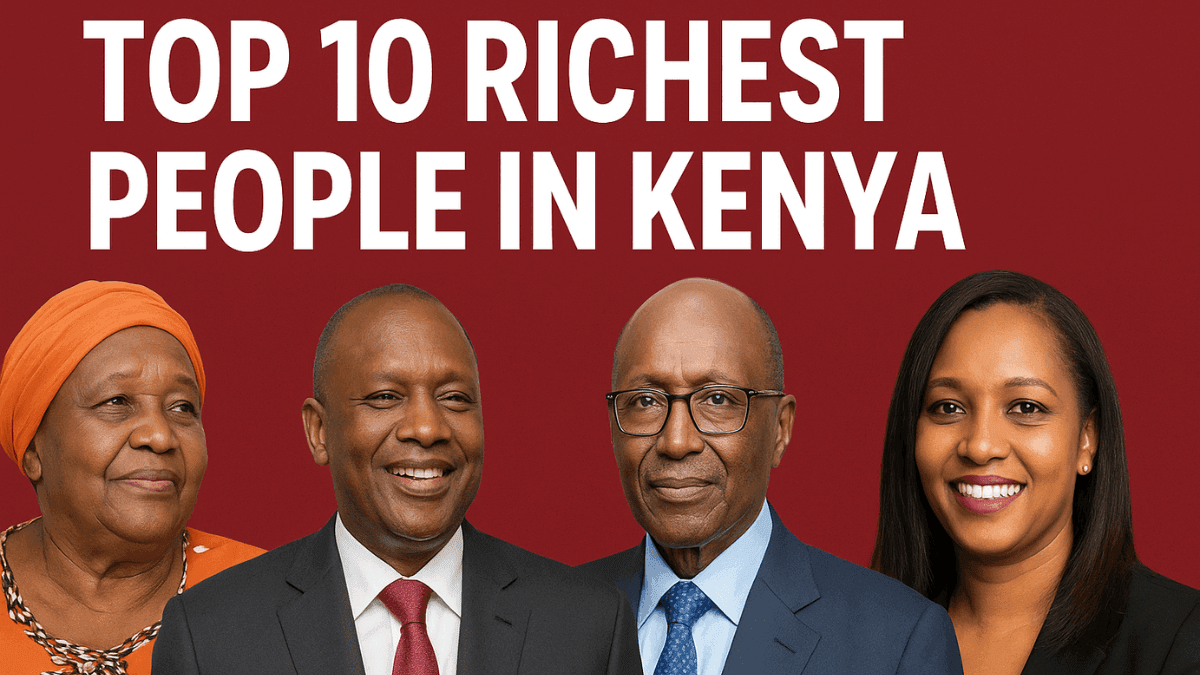
Kenya is home to some of the wealthiest individuals in Africa. From banking and telecommunications to manufacturing, agriculture, real estate, and politics-linked business empires, the richest people in Kenya have built fortunes that shape not only the country’s economy but also the wider East African region.
What makes their stories fascinating is that their wealth comes from very different paths. Some inherited family businesses and expanded them aggressively. Others started small, spotted opportunities early, and built billion-shilling empires over decades. Many of these billionaires now control companies listed on the Nairobi Securities Exchange (NSE), vast land holdings, regional conglomerates, and multinational investments.
Click Here To Join our Telegram Community
In this guide, you will learn who the richest people in Kenya are, how they made their money, the industries that dominate Kenyan wealth, and what their success reveals about the country’s economy.
How Wealth Is Measured in Kenya
Before looking at the richest people in Kenya, it helps to understand how wealth estimates are calculated. Unlike salaried income, billionaire wealth is usually tied to ownership of businesses, shares, property, and investments.
Analysts typically consider:
- Shares in publicly listed companies
- Private business valuations
- Real estate assets
- Agricultural land and operations
- Investments in banking, telecoms, and manufacturing
- International holdings
Exact net worth figures are difficult to confirm because many wealthy Kenyans hold assets privately through family companies, trusts, or investment firms. That is why different reports may rank individuals differently from year to year.
Industries That Create Billionaires in Kenya
Kenya’s wealthy elite are heavily concentrated in a few key industries. Understanding these sectors gives you insight into where large fortunes are created in the country.
Banking and Finance
Kenya has one of Africa’s strongest banking sectors. Investors with large stakes in banks have accumulated enormous wealth through dividends, expansion, and rising stock valuations.
Banks such as Equity Group Holdings, KCB Group, and Co-operative Bank of Kenya have played a major role in creating billionaire investors.
Telecommunications
The telecom industry transformed Kenya’s economy, especially through mobile money. The rise of Safaricom and M-Pesa created one of Africa’s most profitable corporate ecosystems.
Large shareholders and executives connected to telecommunications have benefited enormously over the years.
Manufacturing
Manufacturing remains a powerful source of wealth in Kenya. Billionaires with interests in cement, steel, plastics, edible oils, and consumer products continue to dominate regional markets.
Industrial families often own multiple companies across East Africa, making manufacturing one of the most stable wealth generators.
Real Estate and Land
Land ownership has historically been tied to wealth in Kenya. Some of the richest families own massive tracts of land, commercial buildings, luxury developments, and high-value urban property.
In cities like Nairobi, real estate appreciation alone has created multi-billion-shilling fortunes.
Richest People in Kenya and Their Sources of Wealth
The rankings of the richest people in Kenya can change depending on market conditions, business performance, and asset valuations. Still, several names consistently appear among the country’s wealthiest individuals.
Moi Family
The Moi family remains one of the wealthiest and most influential families in Kenya. Their fortune is connected to land, banking, insurance, media, energy, and agriculture.
The family accumulated extensive assets during and after the presidency of former President Daniel Arap Moi. Their investments reportedly include stakes in financial institutions, ranches, educational institutions, and prime real estate.
Despite public scrutiny over the years, the Moi family continues to maintain significant economic influence across multiple sectors.
Kenyatta Family
The Kenyatta family is widely believed to be among the richest families in Kenya. Their business empire stretches across banking, media, hospitality, dairy farming, and land ownership.
The family is associated with major investments linked to companies such as NCBA Group and Brookside Dairy. Their land holdings alone are believed to be worth billions of shillings.
Former President Uhuru Kenyatta is one of the most recognizable members of the family, though the wealth spans generations and multiple business entities.
Manu Chandaria
Manu Chandaria is one of Kenya’s most respected industrialists. He built his wealth through the Comcraft Group, a multinational manufacturing conglomerate with operations across Africa.
His business interests include steel, aluminum, plastics, and cable manufacturing. Unlike many wealthy figures tied to politics, Chandaria is often praised for his entrepreneurial leadership and philanthropy.
Over the years, he has become a symbol of long-term industrial success in East Africa.
Chris Kirubi
Although the late Chris Kirubi passed away in 2021, his influence on Kenyan business remains enormous. He built a vast empire through investments in media, manufacturing, real estate, and finance.
Kirubi owned significant stakes in companies such as Centum Investment Company and had extensive commercial property holdings.
His rise from humble beginnings to billionaire status made him one of Kenya’s most admired self-made entrepreneurs.
James Mwangi
James Mwangi transformed Equity Group Holdings from a struggling building society into one of Africa’s largest banks.
While much of his wealth comes from shares and executive compensation, his impact goes beyond personal riches. Equity Bank expanded financial access for millions of Kenyans who previously lacked formal banking services.
Mwangi is frequently recognized as one of the most influential business leaders in Africa.
Naushad Merali
Naushad Merali built his fortune through telecommunications, agriculture, manufacturing, and investment holdings.
He was heavily involved in the growth of Kenya’s telecom sector and held major stakes in companies connected to mobile communication and technology infrastructure.
His diversified investment strategy helped him remain among Kenya’s wealthiest businessmen for many years.
Bhimji Depar Shah
Bhimji Depar Shah is the founder of the Bidco Group, one of East Africa’s largest manufacturing companies.
Bidco produces consumer goods ranging from cooking oil and soaps to detergents and food products. The company expanded aggressively across East Africa and became a household name in millions of homes.
Shah’s success highlights the power of manufacturing and consumer products in wealth creation.
Peter Munga
Peter Munga is best known as one of the founders of Equity Group Holdings.
He started from modest beginnings and played a key role in building the bank into a regional financial giant. His investment portfolio later expanded into education, agriculture, and other sectors.
Munga’s story is often cited as an example of entrepreneurship and persistence in Kenya.
Vimal Shah
Vimal Shah helped grow the Bidco brand into one of the most recognized manufacturing companies in East Africa.
Under his leadership, the company diversified into edible oils, beverages, hygiene products, and agribusiness. He is also known for advocating industrial growth and local manufacturing within Kenya.
His influence extends beyond business into economic policy discussions and entrepreneurship development.
S.K. Macharia
S.K. Macharia built his wealth primarily through media and broadcasting. He is associated with Royal Media Services, one of Kenya’s largest media companies.
The company owns popular television and radio stations that command massive audiences nationwide.
Media ownership in Kenya can be extremely profitable because of advertising revenue, political influence, and audience reach.
The Role of Family Wealth in Kenya
Many wealthy individuals in Kenya belong to business families that have operated for generations. Family-controlled conglomerates remain extremely powerful because they combine land ownership, political networks, and diversified investments.
In many cases, wealth is transferred through:
- Family holding companies
- Inherited land and property
- Shares in private businesses
- Long-standing commercial relationships
- Regional expansion across East Africa
This structure helps preserve wealth over decades, even during economic downturns.
Self-Made Billionaires vs Inherited Wealth
Not every wealthy Kenyan inherited riches. Some built their fortunes from scratch through entrepreneurship, innovation, or strategic investing.
Entrepreneurs such as Chris Kirubi and Peter Munga are often celebrated because they started with limited resources and built large enterprises over time.
Inherited wealth, however, still plays a major role in Kenya’s economic landscape. Access to capital, networks, education, and land creates advantages that are difficult for ordinary entrepreneurs to match.
How the Richest People in Kenya Influence the Economy
The richest people in Kenya do far more than accumulate wealth. Their businesses employ thousands of people, contribute taxes, support exports, and attract foreign investment.
Large corporations owned by wealthy families often influence:
- Employment opportunities
- Infrastructure development
- Banking access
- Manufacturing output
- Agricultural production
- Media and communication
- Regional trade
At the same time, critics sometimes raise concerns about economic inequality, political influence, and market concentration among elite business groups.
Philanthropy and Social Impact
Several wealthy Kenyans are also known for philanthropy. Many fund scholarships, hospitals, schools, religious institutions, and community projects.
For example, Manu Chandaria has long been associated with charitable causes and educational support.
Corporate foundations linked to major Kenyan companies also invest heavily in healthcare, environmental projects, and youth empowerment programs.
Challenges Facing Wealthy Businesses in Kenya
Even the richest people in Kenya face serious business challenges. Economic fluctuations, currency depreciation, taxation, political instability, and global market pressures can affect profitability.
Common challenges include:
- High operating costs
- Inflation and currency weakness
- Political uncertainty
- Competition from imports
- Regulatory changes
- Global commodity price shifts
Businesses that survive for decades usually adapt by diversifying their investments and expanding into regional markets.
Emerging Young Millionaires in Kenya
Kenya’s business landscape is changing. Technology, fintech, digital marketing, online commerce, and content creation are producing a new generation of wealthy entrepreneurs.
Young founders are increasingly building wealth through:
- Mobile apps
- E-commerce businesses
- Forex education and fintech
- Agritech startups
- YouTube and digital media
- Real estate development
- Cryptocurrency-related services
While few have reached billionaire status yet, the next generation of Kenyan wealth may look very different from traditional industrial empires.
What You Can Learn From Kenya’s Wealthiest Individuals
Studying the richest people in Kenya reveals several patterns that appear repeatedly across industries.
Successful wealthy entrepreneurs often:
- Build businesses for the long term
- Diversify income streams
- Invest heavily in relationships and networks
- Reinvest profits instead of overspending
- Expand regionally rather than staying local
- Focus on industries with constant demand
Another major lesson is patience. Most of these fortunes were not built overnight. Many took decades to grow through consistent expansion and strategic investment.
Final Thoughts
The richest people in Kenya represent a mix of industrialists, financiers, political families, media owners, and entrepreneurs who have shaped the country’s economy for generations.
Some inherited vast business empires, while others built wealth from humble beginnings through persistence and strategic thinking. Their influence stretches far beyond personal net worth because their companies employ workers, fund development projects, and drive major sectors of the Kenyan economy.
As Kenya’s economy continues evolving, new industries such as fintech, digital commerce, renewable energy, and technology may produce the next wave of billionaires. Still, traditional sectors like banking, manufacturing, telecommunications, and land ownership remain the foundation of massive wealth in the country today.
Trade on the Go. Anywhere, Anytime
If you’re ready to apply what you’ve learned, consider trading with a globally recognized forex and CFD broker like XM .
The platform offers competitive spreads, fast execution, and access to advanced trading tools, including real-time charts and flexible account types, making it suitable for both beginners and experienced traders. Open a trading account for free and start trading today and join millions of traders and investors on the global forex market.
Trading involves risk. Ensure you understand how the markets work before investing.

Our financial editorial team covers global markets, economic policy, and investment trends. We combine real-time research with AI-powered writing assistants to deliver accurate, timely, and easy-to-read articles. Our editors review all content to ensure quality, neutrality, and clarity for our readers.