If you’ve ever followed central bank announcements, bond markets, or forex news, you’ve probably come across the term Basis Point. Financial professionals use basis points every day because they provide a precise way to describe small percentage changes without confusion.
Whether you’re a trader, investor, business owner, or simply trying to understand financial news, learning how basis points work will make it much easier to interpret interest rate decisions, bond yields, loan costs, and market movements. This guide explains everything you need to know in simple language, complete with practical examples.

What Is a Basis Point?
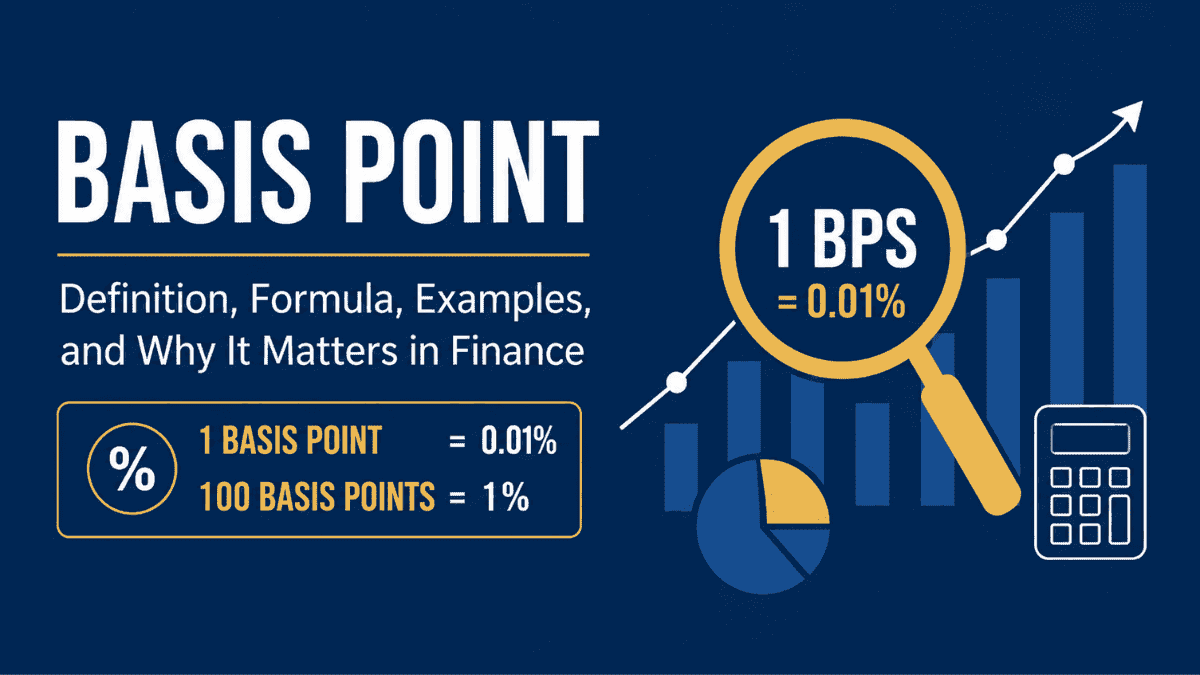
A Basis Point (BPS) is a unit used in finance to measure very small percentage changes. One basis point equals 0.01%, or one one-hundredth of one percent.
Financial markets use basis points instead of percentages because percentages can sometimes be misunderstood. Saying that an interest rate increased by “1%” could mean two different things:
- It increased by one percentage point (for example, from 5% to 6%).
- It increased by 1% of the original rate (from 5% to 5.05%).
Using basis points removes this ambiguity.
Basis Point Formula
The relationship between basis points and percentages is straightforward:
1 Basis Point = 0.01%
100 Basis Points = 1%
You can convert between the two using these formulas:
Percentage = Basis Points ÷ 100
Basis Points = Percentage × 100
Basis Point Conversion Table
Understanding common conversions makes financial news much easier to follow.
| Basis Points | Percentage |
|---|---|
| 1 BPS | 0.01% |
| 5 BPS | 0.05% |
| 10 BPS | 0.10% |
| 25 BPS | 0.25% |
| 50 BPS | 0.50% |
| 75 BPS | 0.75% |
| 100 BPS | 1.00% |
| 150 BPS | 1.50% |
| 200 BPS | 2.00% |
| 500 BPS | 5.00% |
Why Are Basis Points Used?
Finance requires precision. This section explains why professionals prefer basis points over percentages.
Imagine a central bank raises interest rates from 4.50% to 4.75%.
Instead of saying rates increased by “0.25%,” financial analysts say rates increased by 25 basis points.
This wording makes it immediately clear that:
- The increase was exactly 0.25 percentage points.
- There is no confusion about whether it was a relative or absolute increase.
- Everyone interprets the change the same way.
That clarity is especially important in markets where even tiny movements can involve millions or billions of dollars.
How to Calculate Basis Points
Calculating basis points becomes easy once you know the basic conversion.
Example 1: Interest Rate Increase
Interest rate moves from 6.00% to 6.25%.
Difference:
6.25 − 6.00 = 0.25%
Convert to basis points:
0.25 × 100 = 25 basis points
Example 2: Interest Rate Decrease
Mortgage rate falls from 8.20% to 7.95%.
Difference:
8.20 − 7.95 = 0.25%
The mortgage rate decreased by 25 basis points.
Example 3: Bond Yield
A government bond yield rises from 10.15% to 10.65%.
Difference:
0.50%
0.50 × 100 = 50 basis points
Basis Points vs Percentage Points
These two concepts are often confused, but they are not the same.
A percentage point measures the arithmetic difference between two percentages.
A basis point simply expresses that same difference using smaller units.
For example:
- Rate changes from 2% to 3%.
- Increase = 1 percentage point.
- Increase = 100 basis points.
Another example:
- Rate changes from 5.25% to 5.50%.
- Increase = 0.25 percentage points.
- Increase = 25 basis points.
The value is identical—the unit of measurement is different.
Why Basis Points Matter in Trading
Small changes in interest rates can create major movements across financial markets. Understanding basis points helps traders react more intelligently to economic news.
Forex Trading
Interest rates strongly influence currency values.
If a central bank raises rates by 50 basis points instead of the expected 25 basis points, investors may buy that country’s currency because higher rates often attract foreign capital.
For example:
- Higher interest rates can strengthen a currency.
- Lower interest rates may weaken it.
- Unexpected basis point changes often increase market volatility.
Forex traders closely monitor central bank meetings because even a 25-basis-point surprise can move currency pairs significantly.
Stock Market
Companies borrow money to finance expansion and operations.
When interest rates rise by several basis points:
- Borrowing becomes more expensive.
- Corporate profits may decline.
- Growth stocks often face additional pressure.
- Investors may shift toward lower-risk assets.
Markets often react within seconds of rate announcements.
Bond Market
Bond prices and bond yields move in opposite directions.
If bond yields rise by 50 basis points:
- Existing bond prices generally fall.
- Newly issued bonds become more attractive.
- Investors may rebalance their portfolios.
Professional bond traders discuss yield changes almost exclusively in basis points.
How Central Banks Use Basis Points
Central banks adjust benchmark interest rates to manage inflation, economic growth, employment, and financial stability.
Rate changes are usually announced in increments such as:
- 25 basis points
- 50 basis points
- 75 basis points
- 100 basis points
For example:
If the benchmark rate increases from 8.50% to 9.00%, the central bank has raised rates by 50 basis points.
Financial media almost always report monetary policy decisions using basis points because the terminology is standardized worldwide.
Basis Points in Loans and Mortgages
Borrowers can save or spend thousands depending on relatively small basis point changes.
Imagine a mortgage interest rate drops from:
7.25% to 7.00%
That equals a reduction of 25 basis points.
Although 0.25% appears small, over a 20- or 30-year mortgage, it can significantly reduce total interest paid.
Banks also use basis points when pricing:
- Home loans
- Personal loans
- Business loans
- Credit facilities
- Commercial lending
Basis Points in Investment Management
Asset managers frequently describe investment costs using basis points.
For example:
A mutual fund charges an annual management fee of 75 basis points.
Since:
75 basis points = 0.75%
An investor with $100,000 invested would pay:
0.75% × $100,000 = $750 annually
Expressing fees in basis points allows investors to compare investment products more accurately.
Basis Points and Inflation
Inflation expectations influence interest rate decisions.
Suppose inflation rises faster than expected.
A central bank might respond by raising interest rates by 50 basis points to slow spending and reduce inflationary pressure.
On the other hand, if inflation falls sharply and economic growth weakens, policymakers may cut rates by 25 or 50 basis points to encourage borrowing and investment.
Examples of Basis Points
Looking at everyday financial scenarios helps illustrate why basis points are so widely used.
Example 1: Savings Account
Your bank increases savings interest from:
3.00% to 3.20%
Difference:
20 basis points
Example 2: Corporate Bond
Corporate bond yield increases from:
5.60% to 6.10%
Difference:
50 basis points
Example 3: Central Bank Announcement
Policy rate changes:
6.50% → 6.75%
Increase:
25 basis points
Financial headlines would report:
“The central bank raised interest rates by 25 basis points.”
Advantages of Using Basis Points
Basis points have become the global standard because they improve accuracy and communication.
Some key advantages include:
- Eliminates confusion between percentage changes and percentage points.
- Makes financial communication more precise.
- Standardizes reporting across global markets.
- Simplifies comparisons between investment products.
- Helps traders interpret market-moving news quickly.
- Reduces misunderstandings in contracts and financial reports.
Common Mistakes People Make
Many beginners misunderstand basis points at first. Recognizing these mistakes will help you avoid costly confusion.
Confusing Percentages with Basis Points
Remember:
100 basis points equals 1%, not 100%.
Assuming Larger Numbers
Because the word “basis” sounds technical, many people assume one basis point represents a large change.
In reality:
1 basis point = 0.01%
It is extremely small.
Misreading Financial Headlines
If a news article says rates increased by 75 basis points, that means:
75 BPS = 0.75%
It does not mean rates increased by 75%.
Tips for Remembering Basis Points
A few memory tricks can make conversions almost automatic.
- Move the decimal two places to convert basis points into percentages.
- Multiply percentages by 100 to get basis points.
- Remember that 100 basis points always equals exactly 1%.
- Practice converting common values like 25, 50, and 75 basis points until they become familiar.
With regular exposure to financial news, these conversions quickly become second nature.
Frequently Asked Questions About Basis Point
One basis point equals 0.01%, which is one one-hundredth of one percent.
There are 100 basis points in one percentage point.
Traders use basis points because they eliminate ambiguity when discussing small changes in interest rates, bond yields, investment returns, and fees.
No. A basis point is a much smaller unit. One basis point equals 0.01%, while 100 basis points equal 1%.
Central banks announce interest rate increases or decreases in basis points to communicate policy changes precisely. Common adjustments include 25, 50, or 75 basis points.
Divide the number of basis points by 100.
Examples:
25 BPS = 0.25%
50 BPS = 0.50%
100 BPS = 1.00%
Final Thoughts
A Basis Point may seem like a small unit, but it plays a central role in modern finance. Whether you’re reading about central bank decisions, comparing mortgage rates, evaluating investment fees, or trading forex and bonds, basis points provide the precision needed to understand exactly how much something has changed.
Once you remember that 1 basis point equals 0.01% and 100 basis points equal 1%, interpreting financial news becomes much easier. As you gain more experience in investing or trading, you’ll notice that professionals almost always use basis points because they communicate changes clearly, accurately, and without ambiguity. Understanding this simple concept is a valuable step toward becoming more financially literate and making better-informed financial decisions.
Trade on the Go. Anywhere, Anytime
If you’re ready to apply what you’ve learned, consider trading with a globally recognized forex and CFD broker like XM .
The platform offers competitive spreads, fast execution, and access to advanced trading tools, including real-time charts and flexible account types, making it suitable for both beginners and experienced traders. Open a trading account for free and start trading today and join millions of traders and investors on the global forex market.
Trading involves risk. Ensure you understand how the markets work before investing.