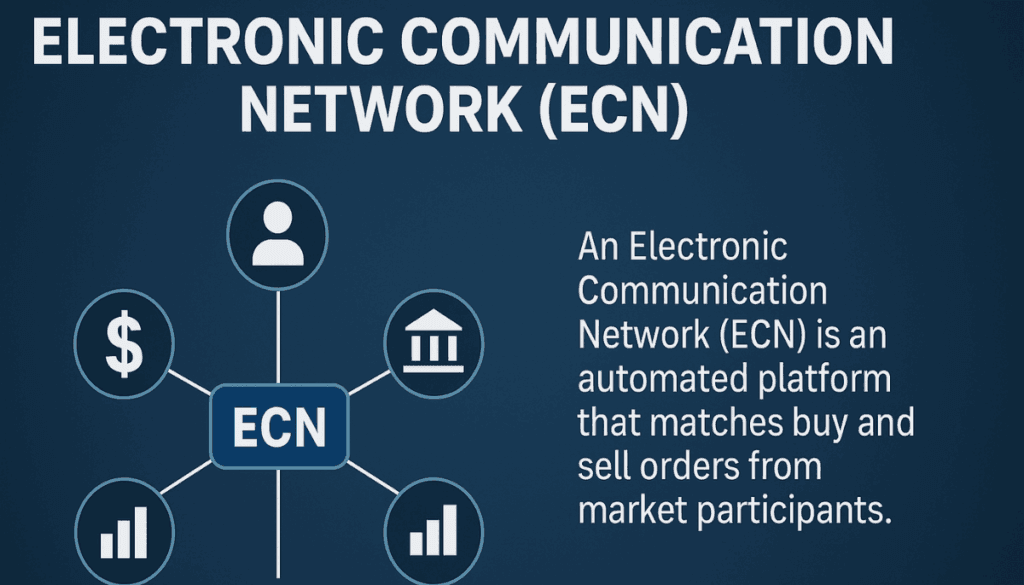
An Electronic Communication Network (ECN) is a digital system that automatically matches buy and sell orders from different market participants. Because an ECN connects traders directly to liquidity providers, it offers fast execution, tight spreads, and a more transparent trading environment. This makes ECN trading especially popular among forex traders who value fairness and efficiency.
Before diving deeper, it is important to understand how ECNs transform traditional market structure and why they matter in modern trading.
What Is an Electronic Communication Network (ECN)?
An Electronic Communication Network (ECN) is an automated platform that brings together buyers and sellers from across the world and matches their orders without a middleman. In trading terms, an ECN acts as a bridge connecting retail traders, banks, financial institutions, hedge funds, and other liquidity providers into one digital marketplace.
Unlike traditional brokers who may take the opposite side of your trade, an ECN does not trade against you. Instead, it simply connects your order to the best available price in the market. This model promotes fairness, transparency, and competition among liquidity providers.
How an ECN Works
Before looking at the features and benefits, it helps to understand the process behind ECN execution.
Order Matching Explained
When a trader places a buy or sell order:
- The ECN scans its network of liquidity providers.
- It finds the best available bid (buy) or ask (sell) price.
- The system automatically matches the order with the opposite side.
- Execution happens within milliseconds.
This automated matching system ensures traders get the most competitive prices available at that moment.
No Dealing Desk Intervention
ECNs operate on a No Dealing Desk (NDD) model. This means:
- The broker does not set the prices.
- There is no manual price manipulation.
- Orders go straight to the market.
This structure reduces conflicts of interest and increases trust.
Key Features of ECN Trading Platforms
To appreciate ECNs fully, here are some important characteristics that distinguish them from other systems:
1. Tight and Variable Spreads
ECNs offer some of the lowest spreads in the market, especially during high-liquidity periods. Prices come directly from major banks and institutions competing to provide the best quote.
2. Fast Execution Speed
With no manual intervention, ECN trades are executed almost instantly. This is ideal for:
- Day traders
- Scalpers
- High-frequency trading strategies
3. Full Market Transparency
An ECN shows real-time price flows from multiple liquidity providers. Traders can see:
- True market prices
- Available orders
- Depth of market (DOM) on some platforms
4. Ability to Trade During News and Volatile Conditions
ECNs remain stable during fast-moving markets because pricing comes from multiple global sources.
5. Anonymous Trading
Some ECNs allow traders to execute orders without revealing their identity, reducing the risk of biased pricing.
Benefits of Using an ECN Broker
Before exploring the challenges, let’s highlight the major advantages that attract many forex and crypto traders.
1. Lower Spreads and True Market Pricing
Because ECNs aggregate prices from many providers, traders enjoy highly competitive spreads that are often close to zero.
2. Reduced Risk of Price Manipulation
ECN brokers cannot manipulate prices since they do not trade against their clients. This greatly improves trust and confidence.
3. Better Execution During High Volatility
Unlike market makers who may freeze or widen spreads during news events, ECNs continue to provide real prices from global liquidity pools.
4. Ideal for Professional Strategies
Scalpers, algorithmic traders, and institutional traders often prefer ECNs because execution is fast and transparent.
Drawbacks of ECN Trading
Just like any trading model, ECNs have a few limitations. It is important to be aware of them so you can choose the right broker setup.
1. Commissions on Every Trade
ECN brokers earn through commissions. This means:
- You pay a small fee per lot
- Costs may be higher for small accounts
2. Variable Spreads
Spreads are not fixed. During low-liquidity hours (such as market open or close), spreads can widen.
3. Minimum Deposit Requirements
Some ECN accounts require a higher starting balance compared to standard accounts.
4. Requires Some Trading Experience
Because the environment is more “raw,” beginners may find ECN conditions harder to navigate at first.
ECN vs Non-ECN Brokers: What’s the Difference?
Before choosing a broker, understanding the contrast helps you make an informed decision.
ECN Broker
- Connects traders directly to the market
- Makes money through commissions
- Provides variable spreads
- No dealing desk
- Transparent pricing
Market Maker (Non-ECN) Broker
- Sets its own prices
- May take the opposite side of trades
- Offers fixed or variable spreads
- Can manipulate order execution
- Less transparency
For traders who prioritize fairness and speed, ECN models are often the preferred choice.
Who Should Use an ECN Account?
Transitioning into practical guidance, here are the types of traders who benefit most from ECN trading:
- Scalpers – Need fast execution and low spreads.
- Day traders – Benefit from transparent pricing.
- Algorithmic traders – Rely on stable, efficient trade matching.
- High-volume traders – Prefer lower overall costs.
- Experienced traders – Who want to avoid dealing desk manipulation.
Beginners can still use ECNs, but they should understand spread variations and commission structures first.
ECN in Forex Trading
Shifting focus to its most common use, ECN technology is extremely popular in forex markets. It gives access to:
- Interbank liquidity
- Real bid/ask quotes
- Faster order execution
This type of environment improves efficiency and lowers trading costs, especially when trading major currency pairs with high liquidity.
FAQs About Electronic Communication Network (ECN)
1. What is an ECN in forex trading?
An ECN in forex trading is an automated system that connects traders directly to liquidity providers such as banks and financial institutions. It matches buy and sell orders at the best available prices without a dealing desk.
2. How is an ECN broker different from a market maker?
An ECN broker sends your trades directly to the market, while a market maker sets its own prices and may take the opposite side of your trade. ECNs offer transparency and lower spreads, while market makers may offer fixed spreads but less transparency.
3. Why do traders prefer ECN accounts?
Traders prefer ECN accounts because they provide tight spreads, fast execution, and no dealing desk intervention. This setup benefits scalpers, day traders, and algorithmic traders who need reliable execution.
4. Are ECN trading fees higher?
ECN brokers usually charge a commission on each trade, which can make costs slightly higher for small accounts. However, the reduced spreads often offset these fees, making ECN trading cost-effective for many traders.
5. Is ECN trading suitable for beginners?
ECN trading can be used by beginners, but it is best for traders who understand variable spreads, volatility, and commission structures. New traders may find standard accounts easier to start with.
6. Can ECN brokers manipulate prices?
No. ECN brokers do not control the pricing because they receive quotes directly from multiple liquidity providers. This reduces the risk of manipulation and ensures more accurate market pricing.
Conclusion
An Electronic Communication Network (ECN) plays a vital role in modern trading by offering a transparent, fair, and efficient environment where traders and liquidity providers interact directly. It eliminates unnecessary middlemen, reduces conflicts of interest, and ensures that traders receive the best available prices at any moment. Whether you are a scalper looking for razor-thin spreads or an experienced trader seeking honest execution, ECN trading provides a professional-level marketplace accessible to everyone.
If you want reliability, transparency, and fast execution, an ECN broker is one of the strongest choices in the trading world.
 Join Our Telegram Channel