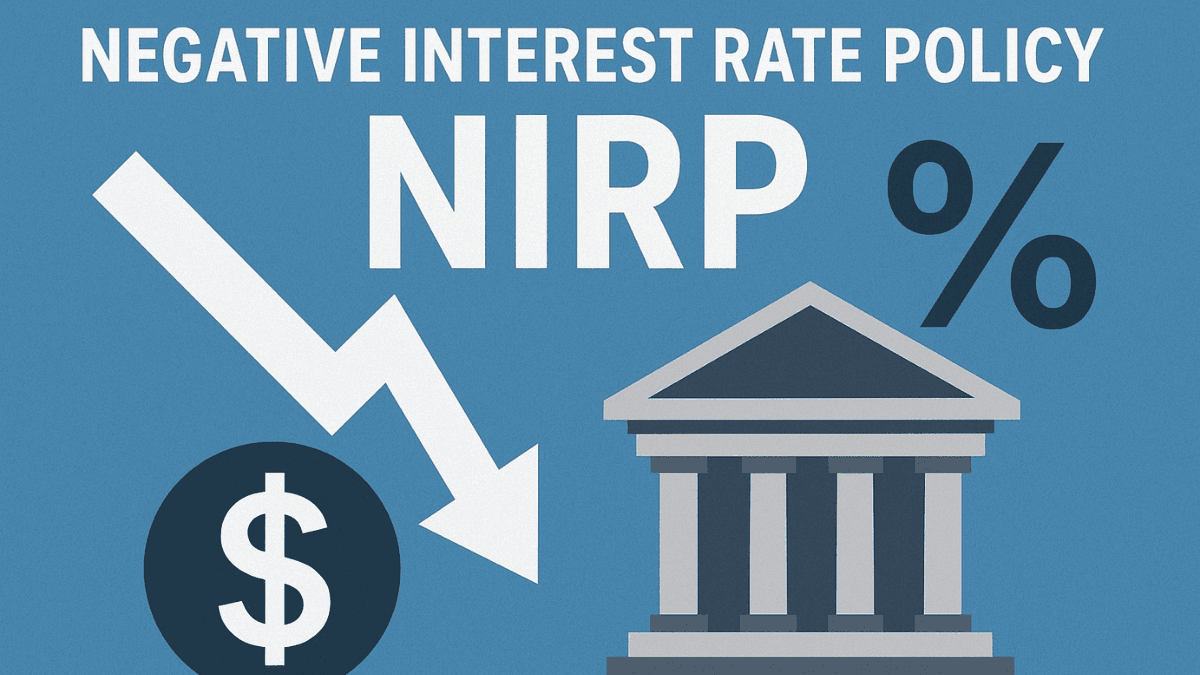
Negative Interest Rate Policy (NIRP) is one of the most unconventional tools modern central banks have used to stimulate weak economies. When interest rates fall below zero, banks may be charged for holding excess reserves at the central bank instead of earning interest on them. The goal is simple in theory: encourage lending, spending, and investment rather than saving idle cash.
For many people, the idea sounds strange at first. Why would anyone pay to keep money in a bank? Yet countries such as Japan, Switzerland, Sweden, and members of the Eurozone experimented with negative rates after years of slow growth, low inflation, and weak economic demand.

Understanding how negative interest rates work can help investors, traders, and everyday consumers make sense of central bank policy decisions, currency movements, bond markets, and broader economic trends.
What is a Negative Interest Rate Policy?
Negative Interest Rate Policy refers to a monetary policy where a central bank sets its benchmark interest rate below 0%. This means commercial banks may have to pay interest to hold excess reserves with the central bank.
Under normal conditions, central banks raise or lower rates to influence borrowing and spending. Lower rates usually encourage businesses and consumers to borrow money because loans become cheaper. Negative rates take that idea one step further by attempting to discourage banks from holding cash altogether.
The policy became more common after the 2008 global financial crisis. Many developed economies faced stubbornly low inflation and weak growth despite already having near-zero interest rates. Traditional policy tools were losing effectiveness, so central banks explored more aggressive measures.
How Negative Interest Rates Work
To understand NIRP properly, it helps to see how money flows through the banking system. Central banks hold reserves for commercial banks, and those reserves typically earn interest.
When rates turn negative, banks effectively pay a fee for parking excess funds at the central bank. Policymakers hope banks respond by increasing lending to consumers and businesses instead.
A Simple Example
Imagine a commercial bank has $1 billion in excess reserves.
If the central bank rate is:
- +1%, the bank earns interest on those reserves
- 0%, the bank earns nothing
- -0.5%, the bank pays 0.5% annually to keep the money there
Rather than absorb those costs, the bank may try to:
- Lend more money
- Buy higher-yielding assets
- Encourage investment activity
- Reduce cash hoarding
This increased economic activity is supposed to support growth and inflation.
Why Central Banks Use Negative Interest Rates
Central banks do not adopt negative rates casually. The policy is usually introduced during periods of economic stress, weak inflation, or stagnation.
The primary objective is to stimulate demand when conventional monetary policy has already pushed rates close to zero.
Fighting Deflation
Deflation occurs when prices fall consistently over time. While lower prices may sound beneficial initially, prolonged deflation can damage the economy.
Consumers may delay spending because they expect prices to drop further. Businesses then earn less revenue, reduce investment, and sometimes cut jobs. Economic activity slows even more.
Negative rates attempt to reverse that cycle by encouraging spending and investment.
Encouraging Lending
Banks play a central role in economic expansion. If they lend more money, businesses can expand operations, and consumers can finance purchases such as homes or vehicles.
NIRP aims to push banks toward lending instead of sitting on excess reserves.
Weakening the Currency
Lower interest rates often reduce demand for a country’s currency because investors seek better yields elsewhere.
A weaker currency can help exporters by making goods cheaper internationally. Countries heavily dependent on exports may see this as an advantage during slow economic periods.
Countries That Used a Negative Interest Rate Policy
Several major economies experimented with negative rates over the past decade. Each case offers valuable lessons about the effectiveness and limitations of the policy.
The Eurozone
The European Central Bank introduced negative deposit rates in 2014. Policymakers wanted to combat weak inflation and sluggish growth following the European debt crisis.
Banks were charged for holding excess reserves, and the ECB hoped this would stimulate lending across the Eurozone economy.
Japan
The Bank of Japan adopted negative interest rates in 2016 after years of low inflation and economic stagnation.
Japan had already experienced decades of weak price growth, making it one of the most closely watched examples of unconventional monetary policy.
Switzerland
The Swiss National Bank introduced deeply negative rates partly to weaken the Swiss franc, which investors viewed as a safe-haven currency.
A stronger franc hurt Swiss exporters, so policymakers attempted to reduce foreign demand for the currency.
Sweden
The Sveriges Riksbank was among the earliest adopters of negative rates. Sweden later returned rates to zero after assessing the long-term effects on financial markets and banks.
Did Negative Interest Rates Work?
The answer depends on how success is measured. Negative rates produced some economic stimulus, but they also created unintended side effects.
Most economists agree that NIRP helped loosen financial conditions and support lending to some degree. Borrowing costs fell, asset prices rose, and financial markets remained liquid.
Still, the policy did not always generate strong inflation or rapid economic growth.
Areas Where NIRP Helped
Negative rates appeared to support economies in several ways:
- Government and corporate borrowing costs declined
- Mortgage rates became cheaper in some countries
- Asset prices, including stocks and bonds, generally rose
- Banks increased lending activity in certain regions
Financial markets also interpreted negative rates as a sign that central banks would continue supporting economic growth aggressively.
Limitations and Problems
The policy also created challenges that became more visible over time.
Banks struggled with profitability because earning margins shrank when rates stayed extremely low. Pension funds and insurance companies faced difficulties generating returns for long-term obligations.
Savers were another major concern. Many people felt punished for keeping money in traditional savings accounts.
There was also evidence that extremely low rates encouraged excessive risk-taking in financial markets as investors searched for higher yields.
Impact on Consumers and Savers
Negative rates affect ordinary people differently depending on how banks pass costs through the financial system.
In many countries, retail depositors were shielded from directly paying negative rates on everyday savings accounts. Banks feared customers would withdraw physical cash if penalties became too severe.
Still, consumers felt the impact indirectly through:
- Lower savings account returns
- Reduced pension yields
- Rising housing prices
- Changes in investment behavior
People seeking stable income often struggled during prolonged low-rate environments because traditional savings products generated almost no return.
How Negative Interest Rates Affect Forex Markets
Currency traders pay close attention to central bank policies because interest rates heavily influence exchange rates.
When a country adopts negative rates, its currency may weaken as investors move capital toward higher-yielding economies.
This dynamic can create strong trends in forex markets.
Interest Rate Differentials
Forex markets often react to differences in interest rates between countries.
For example, if one country maintains positive rates while another moves deeply into negative, investors may favor the higher-yielding currency.
That is why central bank announcements from institutions such as the Federal Reserve, European Central Bank, and Bank of Japan can trigger significant currency volatility.
Carry Trades
Negative rates also influence carry trades, where investors borrow in low-yield currencies to invest in higher-yielding assets elsewhere.
The Japanese yen became a popular funding currency for carry trades during long periods of ultra-low rates in Japan.
Effects on Stock and Bond Markets
Financial markets react strongly to changes in monetary policy, and negative rates can reshape investor behavior across multiple asset classes.
Bond Markets
Government bond yields often fall when central banks cut rates below zero.
In some cases, investors accepted negative yields on government bonds because they expected economic weakness, central bank support, or future capital gains.
This created unusual situations where investors effectively paid governments for the privilege of lending them money.
Stock Markets
Lower rates generally support equities because companies can borrow more cheaply and future earnings become more attractive relative to low-yield bonds.
Technology and growth stocks particularly benefited during periods of ultra-low interest rates.
Still, stock market gains fueled concerns about asset bubbles and excessive speculation.
Criticism of the Negative Interest Rate Policy
Many economists remain skeptical about the long-term effectiveness of negative rates. Critics argue that the policy may distort financial markets while delivering limited economic benefits.
One major concern is diminishing returns. Once rates move deeply negative, the extra stimulus may become weaker because banks and consumers change behavior in unexpected ways.
Another criticism involves financial stability. Cheap borrowing costs can encourage excessive debt accumulation and inflated asset prices.
Some economists also argue that structural economic problems cannot be solved solely through monetary policy. Weak productivity, aging populations, and labor market issues may require fiscal reforms instead.
Could Negative Interest Rates Return?
Although many central banks moved away from negative rates after inflation surged globally in the early 2020s, the policy has not disappeared permanently from the economic toolkit.
If major economies face another prolonged recession combined with very low inflation, policymakers could revisit NIRP alongside quantitative easing and other unconventional measures.
Central banks now have more experience with the policy than they did before 2014. That experience may influence how aggressively they use it in future downturns.
At the same time, many policymakers appear cautious about relying too heavily on negative rates again because of the pressure placed on banks, pension systems, and savers.
Negative Interest Rates vs Zero Interest Rates
People often confuse a zero-interest rate policy with a negative interest rate policy, but there is an important distinction.
A zero-interest-rate environment means borrowing costs are extremely low but not below zero. Banks generally do not pay penalties for holding reserves.
Under NIRP, the central bank deliberately pushes rates below zero to create stronger incentives for lending and investment.
The difference may seem small numerically, yet psychologically and financially, it changes how institutions behave.
What Investors and Traders Should Watch
Negative interest rate environments can create both risks and opportunities for investors and traders.
Understanding central bank communication becomes especially important because financial markets often react before actual policy changes occur.
Key factors to monitor include:
- Inflation trends
- Economic growth data
- Employment reports
- Central bank meeting statements
- Bond yield movements
- Currency strength
Traders who understand how monetary policy affects market sentiment are often better positioned to anticipate volatility across forex, equities, and fixed-income markets.
Final Thoughts
Negative Interest Rate Policy remains one of the most controversial experiments in modern monetary policy. Central banks introduced it during extraordinary economic conditions when traditional tools no longer seemed sufficient.
The policy helped lower borrowing costs and support financial markets in several economies. Yet it also exposed weaknesses in the banking system, reduced returns for savers, and raised concerns about long-term financial stability.
For traders, investors, and anyone following the global economy, understanding NIRP provides valuable insight into how central banks respond during periods of economic stress. Monetary policy does not operate in isolation. Its effects ripple through currencies, bonds, stock markets, consumer behavior, and global capital flows.
As future economic cycles unfold, the debate around negative interest rates is unlikely to disappear.
Trade on the Go. Anywhere, Anytime
If you’re ready to apply what you’ve learned, consider trading with a globally recognized forex and CFD broker like XM .
The platform offers competitive spreads, fast execution, and access to advanced trading tools, including real-time charts and flexible account types, making it suitable for both beginners and experienced traders. Open a trading account for free and start trading today and join millions of traders and investors on the global forex market.
Trading involves risk. Ensure you understand how the markets work before investing.