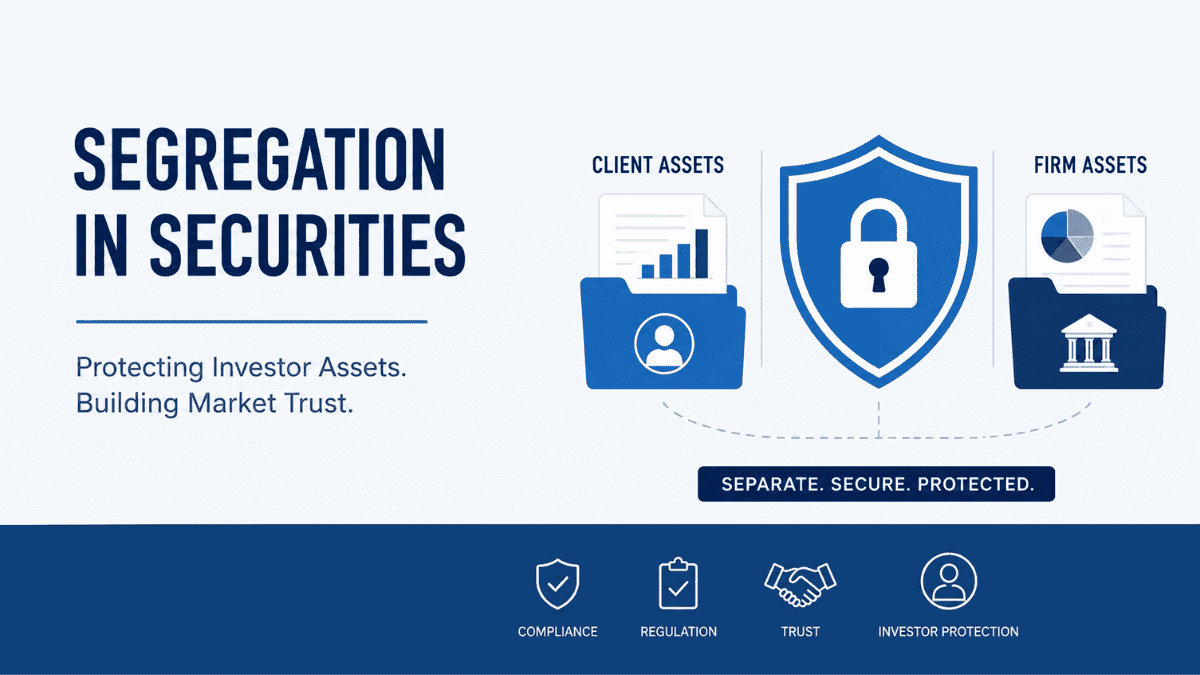
When investors deposit money or securities with a broker, bank, or financial institution, they trust that those assets will be handled responsibly. One of the most important safeguards in the financial industry is the segregation of securities. This practice helps protect client assets from misuse, operational risks, and potential losses if a financial institution experiences financial difficulties.
Understanding securities segregation is essential whether you are a retail investor, institutional investor, trader, or financial professional. It forms the foundation of investor protection frameworks worldwide and plays a critical role in maintaining confidence in financial markets.
Click Here To Join our Telegram Community
What Is Segregation in Securities?
Segregation in securities refers to the practice of keeping client assets separate from a financial institution’s own assets. These assets may include stocks, bonds, mutual funds, exchange-traded funds (ETFs), cash balances, and other investment holdings.
The primary objective is simple: client-owned assets should never be mixed with the firm’s proprietary assets. If a brokerage firm, custodian, or investment company faces insolvency, segregated assets remain identifiable as belonging to clients rather than becoming part of the firm’s estate.
Think of it like a secure storage facility. Each customer’s belongings are kept in clearly designated spaces rather than being mixed with the storage company’s property. The same principle applies in the securities industry.
Why Segregation in Securities Matters
Investor protection is the cornerstone of modern financial markets. Segregation requirements exist because history has shown what can happen when firms fail to properly separate customer assets.
Without segregation, client assets could potentially be:
- Used to fund company operations
- Pledged as collateral for corporate debts
- Exposed to creditors during bankruptcy proceedings
- Misappropriated through fraud or misconduct
- Difficult to identify during insolvency processes
By maintaining strict separation, regulators reduce these risks and strengthen trust in financial institutions.
For individual investors, segregation provides reassurance that their investments remain legally distinct from the assets of the institutions that manage them.
How Segregation in Securities Works
Understanding the mechanics behind segregation helps investors appreciate its importance. Financial institutions typically implement segregation through dedicated accounts, recordkeeping systems, and operational controls.
Separate Custody Arrangements
Most regulated firms maintain separate custody accounts for client holdings. These accounts are specifically designated for customer assets and are not used for the firm’s operational purposes.
Custodians, depositories, and clearing houses maintain records showing which assets belong to clients and which belong to the institution itself.
Accurate Recordkeeping
Segregation relies heavily on detailed records. Financial institutions must maintain accurate books that clearly identify:
- Asset ownership
- Transaction histories
- Account balances
- Beneficial owners
- Custody locations
These records are regularly reviewed and reconciled to ensure accuracy.
Daily Reconciliation Processes
Many regulatory frameworks require firms to perform regular reconciliations between internal records and external custody records.
This process helps identify discrepancies quickly and ensures client assets remain properly accounted for at all times.
Types of Segregation in Securities
Different forms of segregation exist depending on the nature of the assets and the regulatory environment.
Cash Segregation
Cash segregation involves keeping customer funds in dedicated client money accounts separate from company operating accounts.
For example, funds deposited into a trading account should not be used to pay employee salaries, rent, or other business expenses.
Securities Segregation
Securities segregation applies to investment instruments such as shares, bonds, and ETFs.
The institution maintains records showing that specific securities are held on behalf of clients rather than owned by the firm itself.
Physical Segregation
Historically, physical certificates were stored separately to distinguish client ownership.
Although electronic recordkeeping has largely replaced paper certificates, the concept remains relevant in modern custody systems.
Operational Segregation
Operational segregation involves internal controls, procedures, and oversight mechanisms that prevent unauthorized use of client assets.
These controls often include approval requirements, monitoring systems, and independent audits.
Segregation in Securities and Brokerage Firms
Brokerage firms are among the most heavily regulated entities with respect to client asset protection.
When you open a brokerage account, the firm typically acts as an intermediary between you and the financial markets. Although the securities may be held electronically, they remain your property.
Brokerages must establish systems that distinguish customer positions from proprietary trading positions. This separation helps ensure that customer investments remain protected even if the firm experiences financial challenges.
Regulators routinely inspect brokerage firms to verify compliance with segregation requirements and other investor protection rules.
The Role of Custodians in Asset Segregation
Custodians play a crucial role in maintaining segregated securities accounts.
A custodian is a financial institution responsible for safeguarding securities on behalf of investors. These institutions provide secure storage, transaction settlement, and recordkeeping services.
Institutional investors such as pension funds, mutual funds, insurance companies, and asset managers often rely on custodians to ensure proper asset protection.
The use of independent custodians adds an additional layer of security because the investment manager does not control the assets alone.
Regulatory Requirements for Segregation in Securities
Financial regulators around the world impose strict rules governing client asset segregation.
While specific requirements vary by jurisdiction, the underlying principles remain similar.
United States
In the United States, brokerage firms are subject to customer protection rules established by the U.S. Securities and Exchange Commission and overseen by organizations such as the Financial Industry Regulatory Authority.
These rules require brokers to safeguard customer assets and maintain adequate reserves.
United Kingdom
The Financial Conduct Authority enforces detailed client asset rules designed to protect customer money and investments.
Firms must maintain robust segregation procedures and conduct regular reconciliations.
European Union
European regulations impose custody and asset-protection requirements across various financial market frameworks.
These rules help ensure consistent investor protection across member states.
Other Jurisdictions
Many countries, including Australia, Canada, Singapore, South Africa, and Japan, have implemented similar safeguards requiring financial institutions to separate client assets from corporate holdings.
Benefits of Segregation in Securities
Segregation provides numerous benefits for investors and financial markets.
Enhanced Investor Protection
The most significant benefit is the protection of client assets from company-related financial risks.
Investors gain confidence knowing their assets remain legally identifiable as their own property.
Reduced Counterparty Risk
Counterparty risk refers to the possibility that a financial institution may fail to meet its obligations.
Segregation helps reduce this risk by limiting exposure to the institution’s financial condition.
Greater Market Confidence
Financial markets function more efficiently when participants trust that their assets are protected.
Strong segregation frameworks encourage investment and market participation.
Improved Regulatory Compliance
Segregation requirements promote transparency, accountability, and operational discipline within financial institutions.
Risks When Segregation Fails
Although segregation requirements are designed to protect investors, failures can still occur.
Weak controls, fraud, poor governance, or operational errors may compromise asset protection measures.
Potential consequences include:
- Delays in asset recovery
- Legal disputes
- Financial losses
- Regulatory penalties
- Reputational damage
Several high-profile financial scandals have demonstrated the importance of robust custody and segregation systems.
These incidents often lead to stronger regulations and enhanced oversight across the industry.
Segregation in Securities vs Commingling
Investors often encounter the term “commingling” when discussing asset protection.
Commingling occurs when client assets are mixed with company assets or assets belonging to other parties without proper controls or identification.
Segregation is designed specifically to prevent commingling.
While certain pooled investment structures may hold assets collectively for operational efficiency, ownership records must still clearly identify each investor’s entitlement.
The distinction is crucial because proper recordkeeping preserves investor rights even when assets are held within pooled arrangements.
How Investors Can Verify Asset Protection
Investors should not assume that asset segregation is automatically guaranteed. Performing due diligence remains important.
Consider taking the following steps:
- Verify that the broker or custodian is properly regulated.
- Review disclosures regarding custody and client asset handling.
- Understand where securities are held.
- Check whether an independent custodian is involved.
- Read account agreements carefully.
- Monitor account statements regularly.
Asking questions about custody arrangements is a sign of prudent investing, not distrust.
Common Misconceptions About Segregation in Securities
Many investors misunderstand how segregation works.
Segregation Does Not Eliminate Investment Risk
Segregation protects ownership rights, not investment performance.
If a stock loses value, segregation cannot prevent market losses.
Segregation Is Not Insurance
Although segregation protects client ownership, it does not function like an insurance policy against all possible risks.
Other investor compensation schemes or protection programs may provide additional safeguards depending on the jurisdiction.
Segregation Does Not Guarantee Immediate Recovery
Even when assets are properly segregated, administrative processes during insolvency may take time.
Recovery is often easier and more effective than in non-segregated situations, but it may not be instantaneous.
The Future of Securities Segregation
Technology continues to reshape how financial institutions safeguard assets.
Digital custody platforms, blockchain-based recordkeeping systems, automated reconciliations, and real-time monitoring tools are improving transparency and operational efficiency.
Regulators are also paying close attention to emerging asset classes such as cryptocurrencies and tokenized securities. As these markets evolve, segregation principles remain central to protecting investor interests.
The fundamental idea has not changed: client assets should remain separate, identifiable, and protected regardless of the technology used to manage them.
Conclusion
Segregation in securities is one of the most important investor protection mechanisms in modern finance. By keeping client assets separate from company assets, financial institutions reduce the risks associated with insolvency, operational failures, and misuse of funds.
Whether you are investing through a brokerage account, mutual fund, pension plan, or wealth management service, understanding how asset segregation works can help you make more informed decisions. Strong segregation practices support transparency, strengthen trust, and contribute to the overall stability of financial markets.
For investors, the takeaway is straightforward: always work with regulated institutions, understand custody arrangements, and ensure your assets are protected through proper segregation procedures.
Trade on the Go. Anywhere, Anytime
If you’re ready to apply what you’ve learned, consider trading with a globally recognized forex and CFD broker like XM .
The platform offers competitive spreads, fast execution, and access to advanced trading tools, including real-time charts and flexible account types, making it suitable for both beginners and experienced traders. Open a trading account for free and start trading today and join millions of traders and investors on the global forex market.
Trading involves risk. Ensure you understand how the markets work before investing.