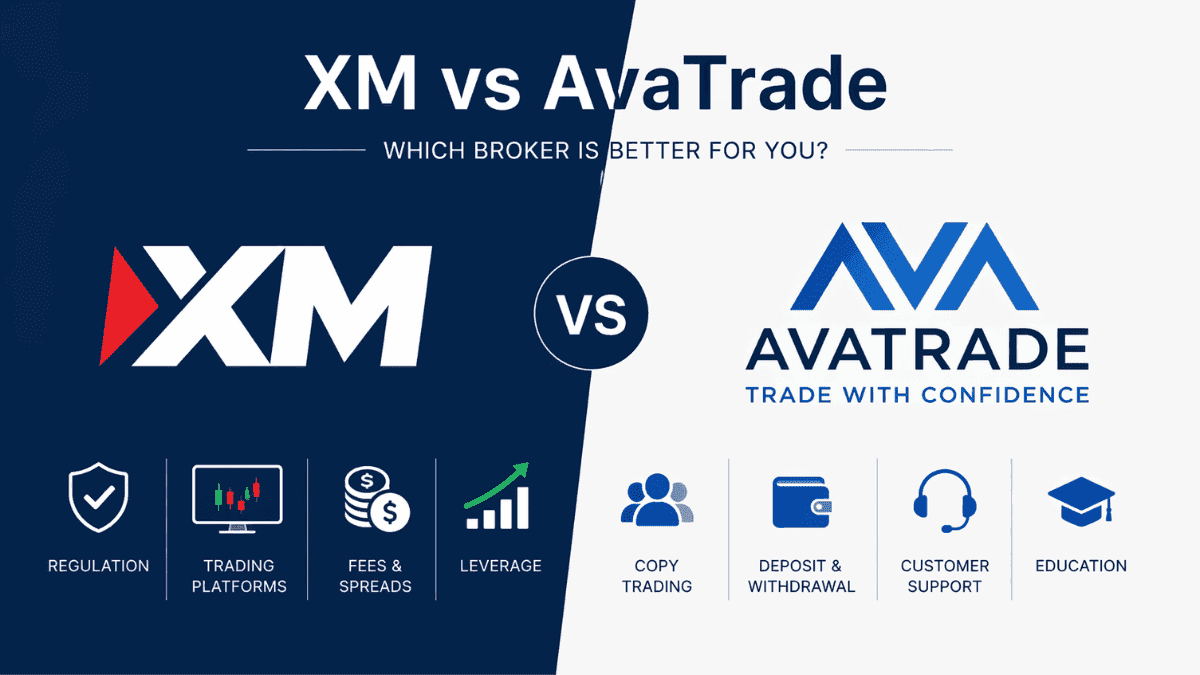
If you’re trying to decide between XM vs AvaTrade, you’re not alone. Both brokers are well-established, globally recognized, and popular among beginners and experienced traders alike. But once you look beyond the marketing, the differences start to matter, especially when it comes to fees, platforms, and trading style.
This guide breaks everything down in plain English so you can confidently choose the broker that actually fits your needs.

| Feature | XM | AvaTrade |
|---|---|---|
| Regulation | CySEC, ASIC, FSC (multiple jurisdictions) | Central Bank of Ireland, ASIC, FSCA, FSA Japan |
| Minimum Deposit | From $5 | Around $100 |
| Trading Platforms | MT4, MT5, XM App | MT4, MT5, AvaTradeGO, WebTrader, AvaOptions |
| Account Types | Micro, Standard, Ultra Low, Shares | Standard, Professional |
| Spread | From ~0.6 pips (variable) | From ~0.9–1.2 pips (fixed) |
| Leverage | Up to 1:1000 (region dependent) | Up to 1:400 (regulation dependent) |
| Commission | Mostly no commission | No commission on standard trading |
| Copy Trading | Yes (built-in system) | Yes (AvaSocial, DupliTrade, ZuluTrade) |
| Deposit/Withdrawal Methods | Cards, bank transfer, Skrill, Neteller | Cards, bank transfer, e-wallets |
| Customer Support | 24/5 multilingual support | 24/5 support + regional account managers |
XM vs AvaTrade: Quick Overview
Before diving deep, it helps to understand the core positioning of each broker and what they’re known for.
XM at a glance
XM is widely known for its low minimum deposit and flexible account types. It’s especially appealing if you’re starting small or want access to tight spreads without committing a large amount of capital.
AvaTrade at a glance
AvaTrade leans more toward structured trading, offering fixed spreads, strong regulation, and a wide range of platforms, including options trading. It tends to appeal to traders who value stability and risk management tools.
Regulation and Trustworthiness
Trust is non-negotiable in trading, so let’s start with how these brokers are regulated.
XM regulation
XM operates under multiple regulatory bodies, including:
- CySEC (Cyprus)
- ASIC (Australia)
- FSC (Belize)
This multi-jurisdiction setup allows XM to serve clients globally while maintaining a reasonable level of oversight.
AvaTrade regulation
AvaTrade stands out for its strong regulatory framework, including:
- Central Bank of Ireland
- ASIC (Australia)
- FSCA (South Africa)
- FSA (Japan)
This broader and stricter regulatory coverage gives AvaTrade a slight edge in terms of overall trust and compliance.
Verdict: AvaTrade is generally stronger on regulation, especially if you prioritize safety.
Account Types and Minimum Deposit
Your starting capital and trading goals play a big role here.
XM accounts
XM offers several account types:
- Micro Account (ideal for beginners)
- Standard Account
- XM Ultra Low Account
- Shares Account
The minimum deposit can be as low as $5, which makes XM extremely accessible.
AvaTrade accounts
AvaTrade keeps things simpler:
- Standard retail account
- Professional account (for eligible traders)
The minimum deposit is typically $100, which is still reasonable but higher than XM’s.
Verdict: XM is better for beginners or low-budget traders.
Trading Platforms and Tools
This is where your day-to-day experience really takes shape.
XM platforms
XM supports:
- MetaTrader 4 (MT4)
- MetaTrader 5 (MT5)
- XM mobile app
These platforms are industry standards, offering advanced charting, indicators, and automated trading via Expert Advisors (EAs).
AvaTrade platforms
AvaTrade offers a broader ecosystem:
- MT4 and MT5
- AvaTradeGO (mobile app)
- AvaOptions (for options trading)
- WebTrader
The inclusion of AvaOptions is a major differentiator if you’re interested in forex options trading.
Verdict: AvaTrade wins on platform variety; XM is strong but more traditional.
Spreads, Fees, and Commissions
Costs can quietly eat into your profits, so this section deserves attention.
XM pricing
XM primarily offers variable spreads:
- Starting from 0.6 pips (Ultra Low accounts)
- No commission on most accounts
This setup works well for traders who prefer flexible pricing that can tighten during high liquidity.
AvaTrade pricing
AvaTrade uses fixed spreads in most cases:
- Typically around 0.9–1.2 pips on major pairs
- No commission trading
Fixed spreads provide predictability, especially during volatile market conditions.
Verdict: XM is cheaper in ideal conditions; AvaTrade is more predictable.
Leverage and Risk Management
Leverage can amplify both profits and losses, so how each broker handles it matters.
XM leverage
- Up to 1:1000 (depending on region)
- Flexible leverage options
This high leverage is attractive but requires discipline.
AvaTrade leverage
- Typically up to 1:400 (varies by regulation)
- Strong emphasis on risk management tools
AvaTrade also provides features like negative balance protection and stop-loss tools.
Verdict: XM offers higher leverage; AvaTrade focuses more on controlled risk.
Copy Trading and Automation
Not everyone wants to trade manually and that’s where these features come in.
XM copy trading
XM offers built-in copy trading features, allowing you to:
- Follow experienced traders
- Automatically replicate trades
- Customize risk levels
AvaTrade copy trading
AvaTrade supports social trading through platforms like:
- AvaSocial
- DupliTrade
- ZuluTrade
This gives you access to a broader ecosystem of signal providers.
Verdict: AvaTrade has a more advanced copy trading network.
Deposit and Withdrawal Methods
Convenience matters, especially when moving funds.
XM payments
XM supports:
- Bank transfers
- Credit/debit cards
- E-wallets (Skrill, Neteller)
Processing is generally fast, with no internal fees.
AvaTrade payments
AvaTrade offers similar methods:
- Bank transfer
- Cards
- E-wallets
However, withdrawal processing can sometimes take slightly longer depending on verification.
Verdict: Both are reliable; XM may have a slight speed advantage.
Customer Support and User Experience
When things go wrong, support quality becomes critical.
XM support
- 24/5 multilingual support
- Live chat, email, phone
- Strong educational resources
AvaTrade support
- 24/5 customer support
- Dedicated account managers (in some regions)
- Extensive educational content
Verdict: Both perform well, with AvaTrade slightly more structured for long-term clients.
XM vs AvaTrade Key Differences Recap
Here’s what really separates these two brokers in practical terms:
- XM is better for low-budget traders and high-leverage strategies
- AvaTrade is better for regulation, platform diversity, and structured trading
- XM offers tighter spreads in optimal conditions
- AvaTrade provides more stability with fixed spreads
- AvaTrade has a stronger copy trading ecosystem
Which Broker Should You Choose?
The right choice depends on how you trade, not just what looks better on paper.
If you’re just starting or want flexibility with a small deposit, XM is hard to beat. It removes many entry barriers and gives you room to experiment without committing much capital.
If you prefer a more regulated environment, predictable costs, and access to advanced tools like options trading, AvaTrade is the more polished choice.
A practical way to decide is to ask yourself: do you value flexibility and low entry costs, or structure and stability? Your answer will point you in the right direction.
Final Thoughts
Choosing between XM and AvaTrade isn’t about finding the “best” broker overall, it’s about finding the best fit for your trading style. Both brokers are reputable, widely used, and capable of supporting different types of traders.
Take advantage of demo accounts if you can. Spending a few days testing each platform often reveals more than any comparison ever could.
FAQs About XM vs AvaTrade
1. Which is better for beginners, XM or AvaTrade?
Both XM and AvaTrade are beginner-friendly, but XM is often easier to start with due to its very low minimum deposit and flexible account types. You can begin trading with a small amount and learn without heavy financial pressure.
AvaTrade, on the other hand, offers a more structured environment with fixed spreads and strong risk management tools, which can help beginners avoid unpredictable trading costs. If you value simplicity and low entry barriers, XM usually feels more accessible.
2. Is XM cheaper than AvaTrade in terms of trading fees?
It depends on how and when you trade. XM typically offers variable spreads that can go very low during high liquidity periods, especially on its Ultra Low accounts. This can make it cheaper for active traders in good market conditions.
AvaTrade uses fixed spreads, which are slightly higher on average but more predictable. This means you won’t see sudden spread widening during volatile markets. So XM can be cheaper overall, but AvaTrade offers more consistency.
3. Which broker offers better regulation and safety?
Both brokers are regulated, but AvaTrade generally has a stronger regulatory footprint. AvaTrade is overseen by multiple top-tier regulators, including the Central Bank of Ireland and ASIC, which adds an extra layer of trust.
XM is also regulated across several jurisdictions, like CySEC and ASIC, making it a reliable broker as well. However, AvaTrade’s broader global regulation network gives it a slight edge in terms of perceived safety.
4. Do XM and AvaTrade offer copy trading?
Yes, both brokers support copy trading, but they do it differently.
XM provides a built-in copy trading system where you can follow experienced traders and automatically replicate their trades. It’s simple and integrated into their ecosystem.
AvaTrade offers more advanced social and copy trading options through platforms like AvaSocial, DupliTrade, and ZuluTrade. This gives traders access to a wider network of strategy providers and more customization options.
5. Which broker has better trading platforms?
XM mainly focuses on MetaTrader 4 (MT4) and MetaTrader 5 (MT5), which are industry-standard platforms known for advanced charting and automated trading tools.
AvaTrade also supports MT4 and MT5 but adds more variety with AvaTradeGO, AvaOptions, and WebTrader. This makes AvaTrade more versatile, especially for traders interested in options trading or mobile-first platforms.
6. Can I trade with XM or AvaTrade using a small deposit?
Yes, but XM is more flexible for small accounts. You can start trading with as little as a few dollars, depending on the account type.
AvaTrade typically requires a higher minimum deposit, usually around $100. While still accessible, it is more suited for traders who are ready to start with a slightly larger capital base.
Trade on the Go. Anywhere, Anytime
If you’re ready to apply what you’ve learned, consider trading with a globally recognized forex and CFD broker like XM .
The platform offers competitive spreads, fast execution, and access to advanced trading tools, including real-time charts and flexible account types, making it suitable for both beginners and experienced traders. Open a trading account for free and start trading today and join millions of traders and investors on the global forex market.
Trading involves risk. Ensure you understand how the markets work before investing.

Vincent Nyagaka is the founder of Chweya, where he breaks down complex financial topics into simple insights. A trader since 2015, he uses his market experience to help readers better understand investing, trading, and personal finance.