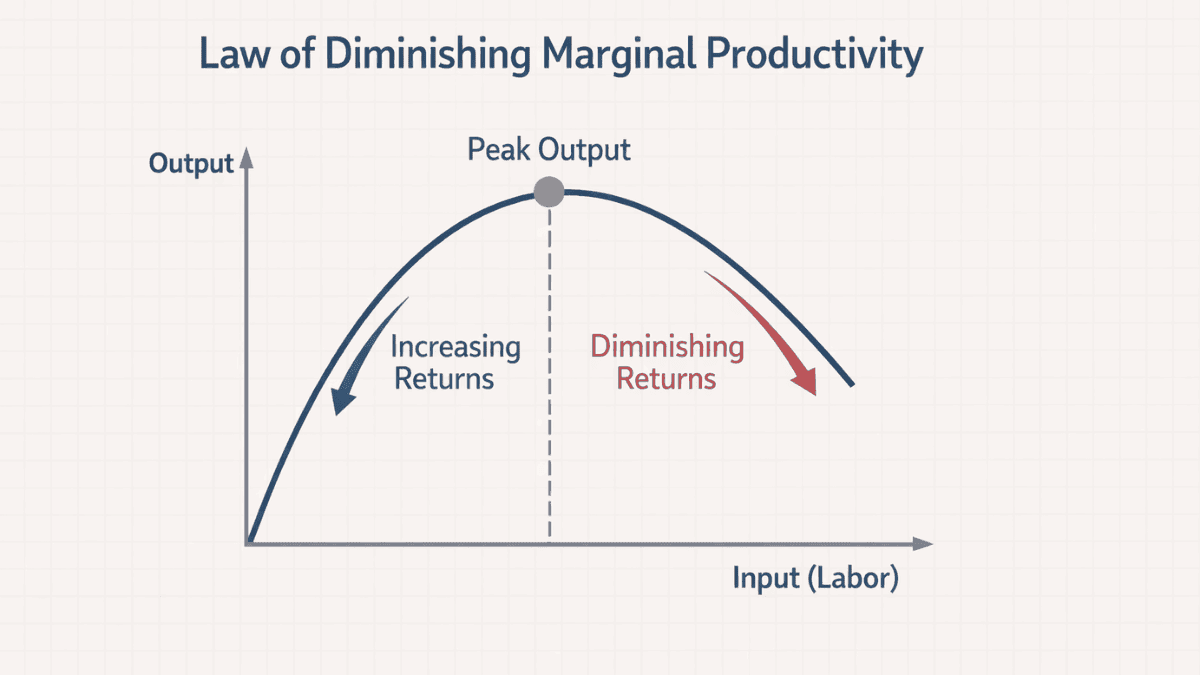
The Law of Diminishing Marginal Productivity explains how adding more of one input, while keeping others constant, eventually leads to smaller increases in output. It is a core concept in economics that helps explain how businesses make decisions about labor, capital, and resource allocation.
At its heart, the idea is simple: when you keep increasing one factor of production like labor while everything else stays the same, each additional unit contributes less to total output over time. This does not mean output decreases immediately, but rather that the rate of increase slows down.

Why This Law Matters in Economics
Understanding this law helps explain how firms operate efficiently and why productivity does not grow endlessly. It provides insight into real-world challenges like overcrowded workplaces, overuse of land, or inefficient allocation of resources.
Businesses rely on this principle when deciding how many workers to hire or how much to invest in production. Without it, firms might assume that adding more resources will always lead to proportional gains, which is rarely true.
The Basic Concepts
To grasp the concept, imagine a small farm with fixed land and tools. Adding workers initially boosts productivity because tasks are shared more effectively.
However, after a certain point, additional workers begin to get in each other’s way. The farm becomes crowded, tools are limited, and efficiency drops. Each new worker still contributes, but less than the previous one.
Key Terms You Should Know
Before going deeper, it helps to understand a few important terms used in this concept.
Marginal Product
This refers to the additional output produced by adding one more unit of an input, such as labor.
Total Product
This is the total amount of output produced by all inputs combined.
Fixed and Variable Inputs
Fixed inputs remain constant (like land or machinery), while variable inputs (like labor) can be adjusted.
How the Law Works Step by Step
The law follows a predictable pattern that unfolds in three main stages. Each stage reflects how productivity changes as more input is added.
Stage 1: Increasing Returns
At the beginning, adding more workers increases productivity at an increasing rate. Workers can specialize, collaborate, and use resources more efficiently.
This stage is often the most productive phase, where businesses see rapid gains.
Stage 2: Diminishing Returns
After a certain point, each additional worker adds less output than the previous one. The workplace becomes crowded, and fixed resources are stretched thin.
This is where the Law of Diminishing Marginal Productivity takes effect.
Stage 3: Negative Returns
If too many workers are added, total output may actually decrease. Workers interfere with each other, causing inefficiencies and mistakes.
Examples
This concept is easier to understand when applied to everyday situations.
Farming Example
A farmer hires workers to harvest crops. Initially, more workers mean faster harvesting. After a while, the field becomes crowded, and workers slow each other down.
Factory Example
In a factory with limited machines, adding more workers can increase output at first. Eventually, workers must wait to use machines, reducing their productivity.
Office Environment
In a small office, hiring more employees can boost output. However, limited desk space, computers, or supervision can lead to inefficiencies.
Causes of Diminishing Marginal Productivity
Several factors contribute to this phenomenon, and understanding them helps businesses avoid inefficiencies.
- Limited fixed resources such as land, machinery, or workspace
- Overcrowding, which reduces efficiency and coordination
- Management challenges as supervision becomes harder with more workers
- Lack of specialization opportunities once the optimal team size is reached
Each of these factors plays a role in reducing the effectiveness of additional inputs.
Graphical Representation (Conceptual Overview)
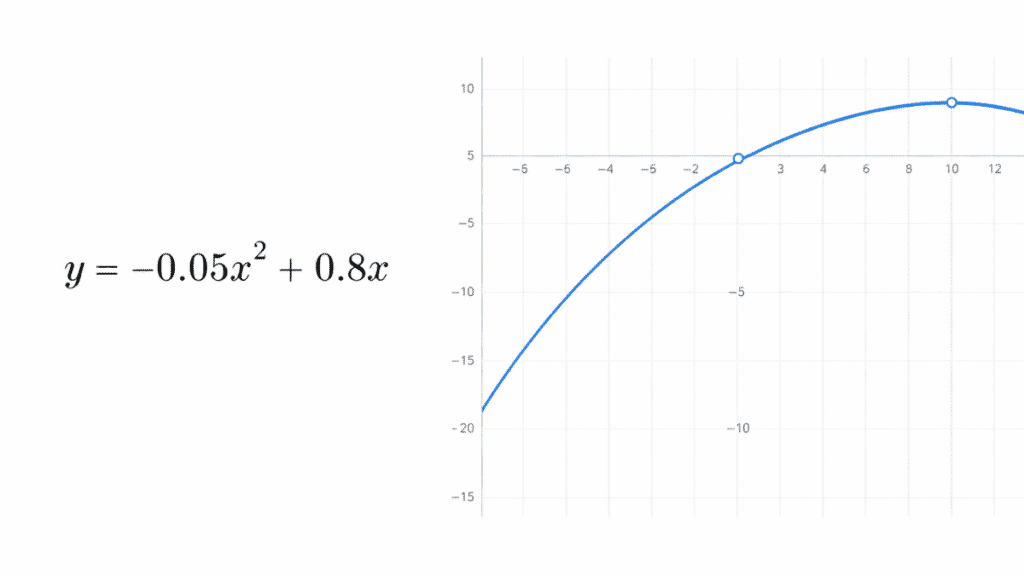
Economists often use graphs to show how marginal productivity changes as inputs increase. The curve typically rises at first, peaks, and then slopes downward.
This downward slope represents diminishing marginal productivity, where each additional unit contributes less than before.
How to Read This Graph
This curve shows the relationship between input (x-axis, like labor) and output (y-axis).
- Left side (rising curve): Output increases at an increasing rate
This is the stage of increasing returns, where workers become more productive through specialization. - Peak point (top of curve): Maximum marginal productivity
This is the most efficient level of input. - Right side (downward slope): Output still increases, but at a decreasing rate
This is where diminishing marginal productivity sets in—each extra worker adds less output than the previous one.
Why the Curve Bends Downward
The downward slope happens because one or more inputs (like land, machines, or space) are fixed. As more workers are added, they have fewer resources to work with, leading to inefficiencies.
Connecting This to the Featured Image
The image I generated earlier is essentially a cleaner, editorial version of this same concept:
- Upward curve → increasing returns
- Peak → optimal productivity
- Downward slope → diminishing returns
If you want, I can create an even more labeled step-by-step diagram (Stage 1, 2, 3) or a version you can directly embed in your blog post.
Assumptions Behind the Law
To apply this law correctly, certain conditions must be met. These assumptions help simplify real-world complexities.
- At least one factor of production is fixed
- Technology remains constant
- Inputs are added in equal units
- The quality of inputs does not change
These assumptions ensure that changes in output are due only to the increase in one variable input.
Practical Applications in Business
This law is not just theoretical; it has real implications for how businesses operate.
Hiring Decisions
Firms use this concept to determine the optimal number of employees. Hiring beyond this point can reduce efficiency and increase costs.
Resource Allocation
Managers allocate resources carefully to avoid overcrowding and inefficiencies.
Cost Management
Understanding diminishing returns helps businesses control production costs and maximize profits.
Limitations of the Law
While useful, the law does not apply in every situation. Real-world conditions can sometimes alter its effects.
Technological advancements can delay or even temporarily reverse diminishing returns. Improvements in machinery or processes can make additional inputs more productive.
Also, in knowledge-based industries, the relationship between inputs and outputs may not follow this pattern strictly.
Relationship with Other Economic Concepts
This law connects closely with other important ideas in economics.
Law of Variable Proportions
This is another name for the same concept when applied in the short run.
Returns to Scale
Unlike diminishing marginal productivity, returns to scale examine what happens when all inputs increase together.
Understanding these distinctions helps clarify how production behaves under different conditions.
Common Misunderstandings
Many people misinterpret this law, which can lead to confusion.
One common mistake is thinking that productivity always decreases. In reality, output still increases, but at a slower rate.
Another misunderstanding is assuming the law applies immediately. It only begins after a certain level of input is reached.
Final Thoughts
The Law of Diminishing Marginal Productivity is a fundamental principle that explains why more is not always better in production. It highlights the importance of balance and efficiency in using resources.
By understanding this concept, businesses and individuals can make smarter decisions about how to allocate time, labor, and capital. It serves as a practical reminder that optimal productivity comes from the right mix, not simply more of everything.
Trade on the Go. Anywhere, Anytime
If you’re ready to apply what you’ve learned, consider trading with a globally recognized forex and CFD broker like XM .
The platform offers competitive spreads, fast execution, and access to advanced trading tools, including real-time charts and flexible account types, making it suitable for both beginners and experienced traders. Open a trading account for free and start trading today and join millions of traders and investors on the global forex market.
Trading involves risk. Ensure you understand how the markets work before investing.