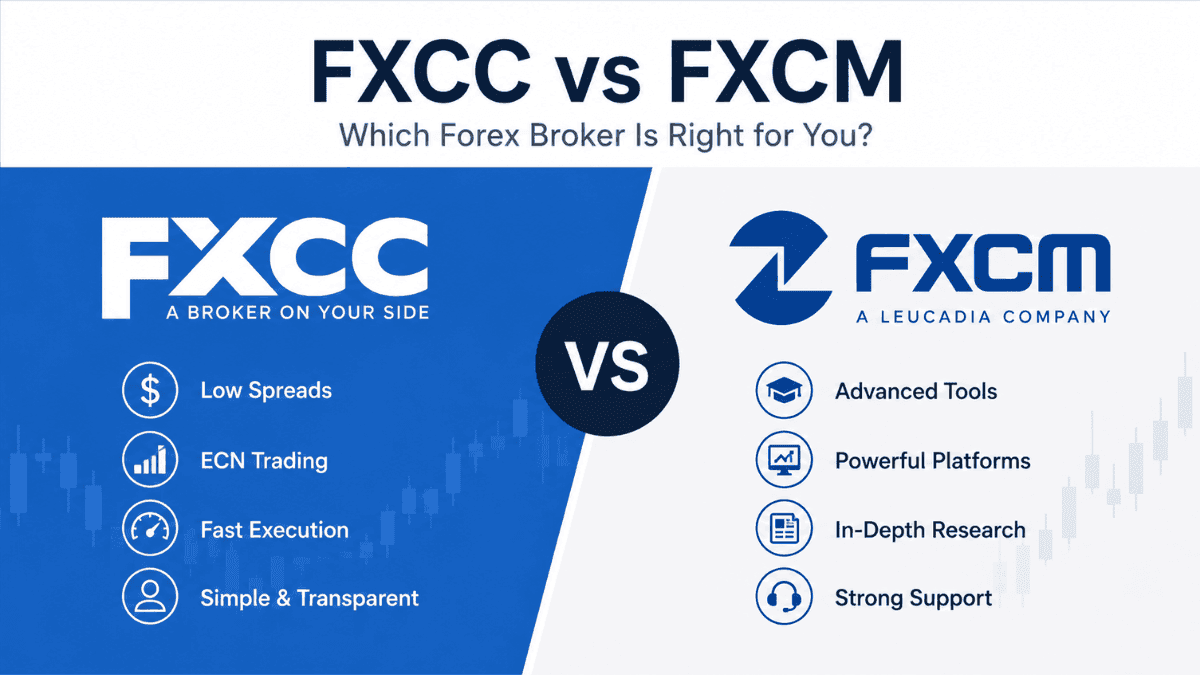
Choosing between FXCC and FXCM can be challenging because both brokers cater to forex traders but take very different approaches. While FXCC focuses on low-cost ECN trading and simplicity, FXCM offers a broader ecosystem of trading tools, market research, and platform options.
In this FXCC vs FXCM comparison, we’ll examine regulation, trading costs, platforms, account types, instruments, execution quality, and overall trading experience. By the end, you’ll have a clear understanding of which broker is the better fit for your trading goals.

FXCC vs FXCM at a Glance
Before diving into the details, it helps to understand the core differences between these two brokers.
| Feature | FXCC | FXCM |
|---|---|---|
| Regulation | Regulated through offshore and international entities | Regulated through multiple recognized financial authorities, depending on jurisdiction |
| Minimum Deposit | $0 (recommended higher for practical trading) | $50–$100 depending on region and account type |
| Trading Platforms | MT4, MT5, WebTrader, Mobile Apps | MT4, Trading Station, TradingView, Mobile Apps |
| Account Types | ECN XL Account | Standard Account, Professional Account (where available) |
| Spread | From 0.0 pips (variable ECN spreads) | Variable spreads from approximately 0.6 pips on major pairs |
| Leverage | Up to 1:500 (subject to regulation) | Up to 1:400 (subject to jurisdiction and regulation) |
| Commission (If Available) | No commission on ECN XL Account | Typically spread-based pricing; commissions may apply on certain products or account types |
| Copy Trading | Limited third-party solutions available | Supports social and automated trading integrations |
| Deposit/Withdrawal Methods | Bank Wire, Credit/Debit Cards, Skrill, Neteller, Crypto (where available) | Bank Wire, Credit/Debit Cards, Skrill, Neteller, Local Payment Options (region dependent) |
| Customer Support | Live Chat, Email, Phone Support | Live Chat, Email, Phone Support, Help Center |
| ✅ Get Started | ✅ Trade with FXCC | ✅ Open Account with FXCM |
Quick Verdict:
FXCC is generally the better choice for traders seeking low-cost ECN trading and tight spreads, while FXCM stands out for its educational resources, platform variety, research tools, and broader trading ecosystem.
FXCC is primarily known as an Electronic Communication Network (ECN) broker. An ECN broker routes orders directly to liquidity providers, helping traders access competitive spreads and market-based pricing. The broker keeps its offering streamlined, focusing on forex and CFDs with a strong emphasis on execution quality.
FXCM, on the other hand, is one of the longest-established names in online trading. Founded in 1999, it provides access to multiple asset classes, advanced trading tools, educational resources, and proprietary technology, appealing to both beginners and experienced traders.
For traders who prioritize simplicity and low costs, FXCC may appear attractive. For traders who value research, educational support, and platform diversity, FXCM often stands out.
Regulation and Trustworthiness
Regulation is one of the most important factors when evaluating any broker, as it directly affects client protection and operational transparency.
FXCC Regulation
FXCC operates through regulated entities and maintains compliance with applicable financial regulations in the jurisdictions where it serves clients.
The broker emphasizes transparent pricing and client fund segregation. While it may not possess the same global regulatory footprint as some industry giants, it has established a reputation for reliable service over the years.
FXCM Regulation
FXCM benefits from a long regulatory history and oversight from several respected financial authorities.
Its decades-long presence in the industry gives traders additional confidence. Regulatory compliance, investor protection measures, and transparent operational practices contribute significantly to FXCM’s credibility.
Which Broker Wins on Trust?
FXCM has the advantage here.
Its lengthy track record, global brand recognition, and broader regulatory presence make it one of the more established brokers in the retail trading industry. FXCC remains trustworthy, but FXCM’s history provides an additional layer of confidence for many traders.
Trading Platforms
The trading platform can significantly impact your trading efficiency, especially if you trade actively.
FXCC Trading Platforms
FXCC primarily focuses on the popular MetaTrader ecosystem.
Traders can access:
- MetaTrader 4 (MT4)
- MetaTrader 5 (MT5)
- Mobile trading applications
- Web-based trading
MT4 remains one of the most widely used platforms globally because of its custom indicators, Expert Advisors (EAs), and extensive community support.
MT5 expands on MT4 by offering additional order types, improved charting capabilities, and broader market access.
FXCM Trading Platforms
FXCM provides a wider range of platform choices.
These include:
- MetaTrader 4
- Trading Station
- TradingView integration
- Capitalise.ai automation tools
- Mobile applications
Trading Station is FXCM’s proprietary platform designed for active traders who need advanced analytics and execution features.
TradingView integration is particularly appealing because many traders already use TradingView charts for market analysis and idea sharing.
Platform Comparison Verdict
FXCM wins this category.
While FXCC offers excellent MT4 and MT5 support, FXCM provides greater flexibility through multiple trading environments and additional automation tools.
Tradable Markets
The variety of available markets can influence whether a broker suits your long-term trading needs.
FXCC Markets
FXCC focuses mainly on:
- Forex pairs
- Indices
- Commodities
- Precious metals
- CFDs
Its product range is sufficient for most forex-focused traders, though it remains relatively streamlined.
FXCM Markets
FXCM offers access to:
- Forex
- Indices
- Commodities
- Cryptocurrencies (subject to jurisdiction)
- Shares CFDs
- Other CFD products
This broader selection allows traders to diversify portfolios without opening multiple brokerage accounts.
Which Broker Offers More Markets?
FXCM generally offers greater market diversity.
If your primary interest is forex trading, FXCC’s selection will likely be enough. If you want broader exposure across multiple asset classes, FXCM has the edge.
Account Types
Account flexibility plays a major role in accommodating different trader profiles.
FXCC Accounts
FXCC keeps things relatively simple.
Its ECN-oriented structure appeals to traders who prefer straightforward pricing and direct market access. Rather than overwhelming clients with multiple account tiers, the broker focuses on maintaining a consistent trading environment.
FXCM Accounts
FXCM offers various account solutions depending on region and client classification.
The broker’s flexibility allows traders to select arrangements that align with their experience level and trading volume.
Which Account Structure Is Better?
This depends on your preferences.
FXCC is attractive for traders who appreciate simplicity. FXCM offers greater flexibility for traders with diverse requirements.
Spreads and Trading Costs
Trading costs directly affect profitability, especially for scalpers and high-frequency traders.
FXCC Spreads
FXCC is widely recognized for competitive ECN spreads.
Raw spreads can become extremely tight during liquid market conditions, particularly on major currency pairs such as EUR/USD.
This makes FXCC appealing to traders who execute numerous trades each day.
FXCM Spreads
FXCM also offers competitive pricing, though costs vary depending on market conditions, account type, and region.
The broker’s pricing remains competitive in the industry, but it may not always match the tightest ECN-style spreads offered by specialized brokers.
Cost Comparison
In terms of pure spread competitiveness, FXCC generally holds a slight advantage.
Traders focused heavily on minimizing spread costs may find FXCC more attractive. Traders seeking a balance between cost and platform functionality may prefer FXCM.
Execution Quality and Trading Environment
Execution quality often matters more than traders realize.
A broker offering low spreads but poor execution can still lead to higher trading costs through slippage and delays.
FXCC Execution
FXCC’s ECN model emphasizes direct access to liquidity providers.
This structure can help reduce conflicts of interest and improve the efficiency of order execution.
Scalpers and algorithmic traders often appreciate this environment.
FXCM Execution
FXCM has invested heavily in execution technology over the years.
The broker provides execution statistics and transparency reports that help traders understand how orders are handled.
This commitment to transparency is a notable strength.
Which Broker Executes Better?
Both brokers perform well.
FXCC may appeal more to traders seeking a pure ECN environment, while FXCM stands out for transparency and technological investment.
Education and Market Research
Educational resources can make a significant difference, especially for beginners.
FXCC Education
FXCC provides educational content, market updates, and trading resources.
The offering is useful but relatively straightforward compared to larger competitors.
FXCM Education
FXCM excels in trader education.
The broker offers:
- Webinars
- Trading guides
- Market analysis
- Video tutorials
- Research reports
- Economic insights
New traders can learn a great deal without relying on external resources.
Education Winner
FXCM clearly wins this category.
Its educational ecosystem is among the strongest available from retail forex brokers.
Copy Trading and Automated Trading
Automation has become increasingly important for modern traders.
FXCC Automation
FXCC supports automated trading through MetaTrader’s Expert Advisors.
This allows traders to implement algorithmic strategies directly on MT4 and MT5.
FXCM Automation
FXCM goes further by offering multiple automation solutions, including integrations with advanced trading tools and automated strategy development platforms.
Its Capitalise.ai integration is particularly valuable for traders who want automation without coding knowledge.
Automation Verdict
FXCM offers a more comprehensive automation ecosystem.
However, traders who primarily use MetaTrader Expert Advisors will find FXCC fully capable.
Customer Support
Reliable customer support becomes crucial when account or trading issues arise.
FXCC Support
FXCC provides multilingual support through various channels, including email and live chat.
Response quality is generally regarded as satisfactory.
FXCM Support
FXCM offers extensive customer service coverage backed by its global presence.
Its larger operational infrastructure often translates into broader availability of support.
Support Winner
FXCM has a slight advantage due to scale and global reach.
FXCC Pros and Cons
Pros
- Competitive ECN spreads
- MT4 and MT5 availability
- Direct market access approach
- Suitable for scalpers
- Simple account structure
Cons
- Fewer platform options
- Smaller educational offering
- Limited market variety compared to larger brokers
FXCM Pros and Cons
Pros
- Long industry history
- Strong regulatory reputation
- Excellent educational resources
- Multiple trading platforms
- TradingView integration
- Advanced automation tools
Cons
- Spreads may not always be as tight as dedicated ECN brokers
- Platform selection may feel overwhelming for complete beginners
FXCC vs FXCM: Which Broker Should You Choose?
The right choice depends largely on your trading style.
Choose FXCC if your primary goal is low-cost ECN trading, tight spreads, and straightforward execution. It is particularly well-suited to active forex traders, scalpers, and algorithmic traders who value execution efficiency above all else.
Choose FXCM if you want a more complete trading ecosystem. The broker shines in platform variety, educational content, market research, and advanced trading tools. Beginners and intermediate traders often benefit greatly from the additional resources available.
Final Verdict
When comparing FXCC vs FXCM, neither broker is universally better—they simply serve different types of traders.
FXCC excels in ECN-style trading conditions, competitive spreads, and execution-focused services. Traders who prioritize low trading costs and direct market access will likely appreciate its approach.
FXCM stands out for its reputation, regulatory history, educational resources, platform diversity, and advanced trading tools. It offers a more comprehensive trading experience, supporting traders at every stage of their journey.
For dedicated forex traders seeking tight spreads and simplicity, FXCC may be the better option. For traders looking for a well-rounded brokerage with extensive resources and platform flexibility, FXCM is often the stronger choice overall.
Frequently Asked Questions
1. Is FXCC better than FXCM for forex trading?
FXCC may be a better choice for traders who prioritize low spreads and an ECN trading environment. Its focus on direct market access appeals to scalpers and active forex traders. FXCM, however, offers a broader range of tools, educational resources, and platform options, making it suitable for traders seeking a more comprehensive trading experience.
2. Which broker has lower trading costs, FXCC or FXCM?
FXCC is generally known for offering tighter ECN spreads, particularly on major currency pairs during liquid market conditions. FXCM also offers competitive pricing, but costs can vary by account type and market conditions. Traders who focus heavily on minimizing spreads may prefer FXCC.
3. Are FXCC and FXCM regulated brokers?
Yes, both FXCC and FXCM operate under regulatory oversight in the jurisdictions where they provide services. FXCM has a longer history and a broader regulatory presence, which may provide additional confidence for some traders. As always, traders should verify the specific entity serving their region before opening an account.
4. Does FXCC or FXCM support MetaTrader platforms?
Both brokers support MetaTrader 4 (MT4), one of the most popular trading platforms worldwide. FXCC also offers MetaTrader 5 (MT5), while FXCM provides additional options, including Trading Station and TradingView integration.
5. Which broker is better for beginners?
FXCM is generally considered more beginner-friendly because of its extensive educational materials, webinars, trading guides, and market research. New traders can access valuable learning resources while gaining practical trading experience. FXCC is better suited to traders who already understand the basics and want a streamlined trading environment.
6. Can I use automated trading with FXCC and FXCM?
Yes, both brokers support automated trading strategies. FXCC allows traders to use Expert Advisors (EAs) on MT4 and MT5, while FXCM offers additional automation tools, including integrations that allow traders to create strategies without extensive coding knowledge.
Trade on the Go. Anywhere, Anytime
If you’re ready to apply what you’ve learned, consider trading with a globally recognized forex and CFD broker like XM .
The platform offers competitive spreads, fast execution, and access to advanced trading tools, including real-time charts and flexible account types, making it suitable for both beginners and experienced traders. Open a trading account for free and start trading today and join millions of traders and investors on the global forex market.
Trading involves risk. Ensure you understand how the markets work before investing.

Vincent Nyagaka is the founder of Chweya, where he breaks down complex financial topics into simple insights. A trader since 2015, he uses his market experience to help readers better understand investing, trading, and personal finance.