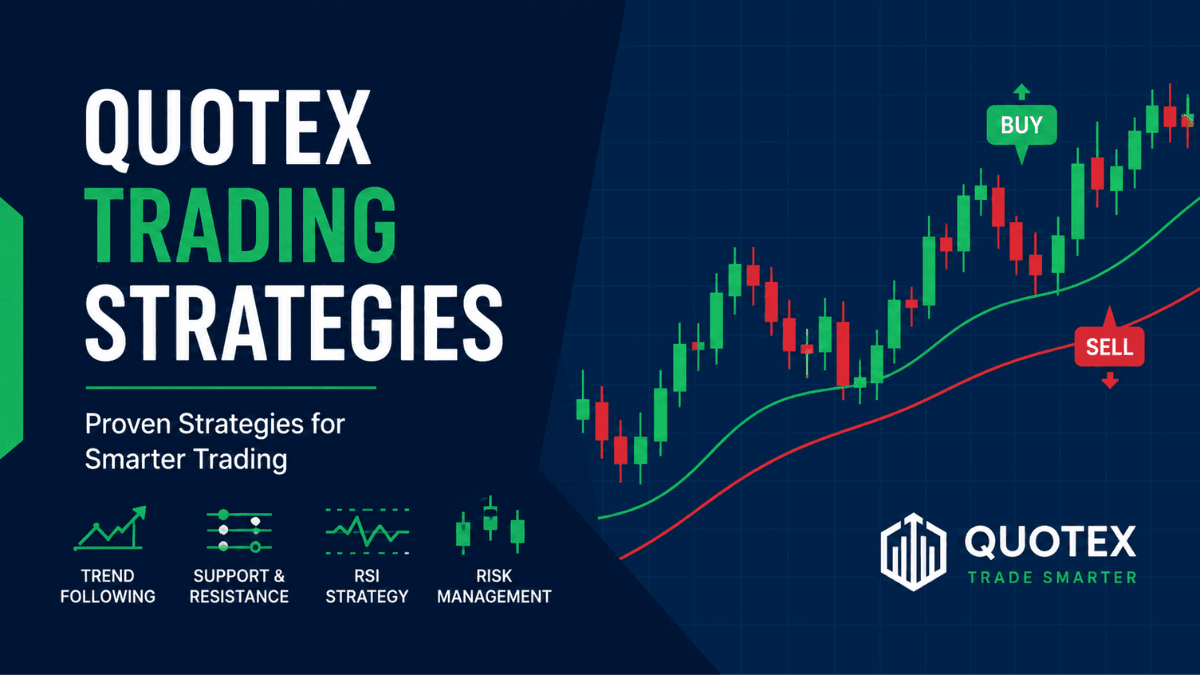
Trading on Quotex can look simple at first glance, but profitable trading requires much more than predicting whether the price will move up or down. The best Quotex trading strategies combine technical analysis, timing, discipline, and proper risk management to help traders make better decisions consistently.
Many beginners jump into short-term trades without understanding how the market structure works. That often leads to emotional trading, inconsistent results, and avoidable losses. A strong strategy gives you a framework. Instead of guessing, you follow conditions that improve your probability over time.
Click Here To Join our Telegram Community
This guide explains some of the most effective Quotex trading strategies for beginners and experienced traders alike. You’ll learn how these strategies work, when to use them, common mistakes to avoid, and how to build a trading approach that fits your style.
What Is Quotex?
Before diving into strategy, it helps to understand what Quotex actually offers and why traders are attracted to the platform.
Quotex is an online trading platform that focuses on digital options trading. Traders predict whether the price of an asset will finish higher or lower than the current price after a selected expiry time.
The platform includes:
- Forex currency pairs
- Cryptocurrencies
- Commodities
- Stock indices
- OTC (Over-the-Counter) assets
One reason Quotex has grown popular is its beginner-friendly interface. The platform is visually clean, simple to navigate, and includes built-in indicators that traders can use directly from the chart.
Still, simplicity can be deceptive. Short-term trading moves quickly, and without a strategy, many traders lose money by relying on emotions instead of analysis.
Why Trading Strategies Matter on Quotex
Successful trading is rarely random. A strategy helps remove impulsive decisions and creates a repeatable process you can evaluate over time.
Without a strategy, traders often:
- Enter trades too early
- Chase losses emotionally
- Trade during unpredictable conditions
- Ignore risk management
- Overtrade after wins or losses
A well-tested strategy helps you identify high-probability setups instead of trading every market movement. Even experienced traders focus on consistency rather than trying to win every trade.
The goal is not perfection. The goal is disciplined execution.
Understanding Market Trends Before Trading
Every trader should understand the market direction before placing a trade. Most strong Quotex trading strategies rely heavily on trend analysis.
A trend represents the overall direction of price movement:
- An uptrend forms when the price creates higher highs and higher lows
- A downtrend forms when the price creates lower highs and lower lows
- A sideways market moves within a range without a clear direction
Trading with the trend generally provides better probability than trading against it. For example, buying during a strong bullish market often carries less risk than attempting to predict reversals.
One of the simplest ways to identify a trend is through moving averages.
Although the equation above represents a basic linear trend relationship, moving averages on charts help smooth price action visually and reveal the broader direction more clearly.
Quotex Moving Average Strategy
The moving average strategy remains one of the most popular approaches among Quotex traders because it is simple and beginner-friendly.
How the Strategy Works
A moving average calculates the average price over a specific number of periods. Traders use it to identify trend direction and momentum.
Common settings include:
- 20-period moving average
- 50-period moving average
- 200-period moving average
When the price stays above the moving average, the market is generally bullish. When the price stays below it, the market is usually bearish.
Basic Buy Setup
Look for these conditions:
- Price remains above the moving average
- The moving average slopes upward
- Price pulls back toward the moving average
- Bullish candlestick confirmation appears
This setup attempts to join the existing trend instead of fighting it.
Basic Sell Setup
For bearish conditions:
- Price remains below the moving average
- The moving average slopes downward
- Price retraces toward the moving average
- Bearish candlestick confirmation forms
This strategy works best during trending markets rather than sideways conditions.
Support and Resistance Strategy
Support and resistance trading is one of the most reliable Quotex trading strategies because markets naturally react around important price zones.
What Is Support?
Support is an area where buyers tend to enter the market, slowing or stopping price declines.
What Is Resistance?
Resistance is an area where sellers tend to enter, slowing or stopping price increases.
Traders watch these zones because the price often reacts repeatedly at similar levels.
How to Trade Support and Resistance on Quotex
The idea is straightforward:
- Buy near support when bullish confirmation appears
- Sell near resistance when bearish confirmation appears
Candlestick confirmation is important. Avoid entering trades blindly just because the price touched a level.
For example, if EUR/USD repeatedly bounces from a support zone and forms a bullish engulfing candle, that may provide a stronger entry signal than support alone.
Common Mistakes
Many beginners draw too many levels on the chart. Focus only on clear zones where the price reacted multiple times previously.
Another mistake is ignoring market momentum. Strong trends can break through support and resistance levels easily.
RSI Strategy for Quotex Trading
The Relative Strength Index (RSI) is a momentum indicator that helps traders identify overbought and oversold conditions.
RSI = 100 – \frac{100}{1+RS}
The RSI typically moves between 0 and 100.
Key RSI Levels
- Above 70 = potentially overbought
- Below 30 = potentially oversold
How Traders Use RSI
If RSI moves above 70, traders may look for bearish reversals. If RSI drops below 30, traders may look for bullish reversals.
The RSI strategy becomes more powerful when combined with support and resistance.
For instance:
- Price reaches support
- RSI falls below 30
- Bullish candle forms
That combination can strengthen the trading setup significantly.
Important Warning
Overbought does not automatically mean the price will crash. Strong trends can keep RSI elevated for extended periods.
Always combine RSI with price action analysis.
Trendline Trading Strategy
Trendlines help traders visualize market direction and identify potential entry points.
Drawing a Trendline
In an uptrend:
- Connect higher lows
In a downtrend:
- Connect lower highs
The more times a price respects a trendline, the stronger it generally becomes.
Trading Trendline Bounces
Many Quotex traders wait for the price to touch a trendline before entering a trade in the trend direction.
For example:
- Uptrend remains intact
- Price retraces toward the trendline
- Bullish rejection candle appears
- Trader enters a buy position
Trendline strategies work especially well during strong market momentum.
Candlestick Pattern Strategy
Candlestick patterns provide valuable insight into buyer and seller behavior.
Some of the most useful patterns for Quotex traders include:
- Bullish engulfing
- Bearish engulfing
- Pin bars
- Doji candles
- Hammer candles
Bullish Engulfing Pattern
This occurs when a large bullish candle fully covers the previous bearish candle.
It often signals strong buying pressure entering the market.
Bearish Engulfing Pattern
The opposite occurs during bearish reversals. Sellers overwhelm buyers, creating a larger bearish candle.
Why Candlestick Confirmation Matters
Indicators alone are not enough. Candlestick confirmation helps traders avoid weak entries and improves timing.
Professional traders often prioritize price action over indicators because price itself reflects real market behavior.
Scalping Strategy on Quotex
Scalping focuses on very short-term trades, often lasting seconds or a few minutes. This style attracts many Quotex users because the platform supports short expiry times.
Scalping Characteristics
Scalping requires:
- Fast decision-making
- Strong concentration
- Clear entry rules
- Strict discipline
Popular Scalping Indicators
Many scalpers combine:
- Moving averages
- RSI
- Bollinger Bands
- Support and resistance
Risks of Scalping
Scalping can become emotionally exhausting. Beginners often overtrade because setups appear constantly.
Short-term trading also amplifies emotional mistakes. Revenge trading and impulsive entries become more common during rapid market movement.
New traders should practice on a demo account before risking real money.
Breakout Trading Strategy
Breakouts occur when the price moves strongly beyond support or resistance zones.
These moments often create powerful momentum opportunities.
How Breakouts Work
A breakout suggests that one side of the market has gained control.
Examples include:
- Buyers pushing above resistance
- Sellers breaking below support
Confirming a Breakout
False breakouts happen frequently, especially during low-volume sessions.
Traders often wait for:
- Strong candlestick momentum
- Increased volatility
- Retests of broken levels
Patience matters here. Entering too early can lead to unnecessary losses.
Best Timeframes for Quotex Trading
The best timeframe depends on your trading style and experience level.
Short Timeframes
1-minute and 5-minute charts provide more trading opportunities but also more market noise.
These are common among scalpers and aggressive traders.
Higher Timeframes
15-minute, 30-minute, and 1-hour charts generally produce cleaner setups.
Higher timeframes often reduce emotional pressure and improve trend clarity.
Many experienced traders prefer analyzing higher timeframes first before refining entries on lower charts.
Risk Management
Even the best Quotex trading strategies fail without proper risk management.
Many traders focus only on entries while ignoring account protection. That approach rarely lasts long.
Key Risk Management Rules
Professional traders commonly:
- Risk only a small percentage per trade
- Avoid emotional revenge trading
- Stop trading after multiple losses
- Maintain realistic expectations
A simple rule is to risk only what you can afford to lose comfortably.
Why Discipline Matters More Than Indicators
Indicators can help identify setups, but discipline determines long-term survival.
Two traders can use the same strategy and get completely different results because of emotional control.
Patience, consistency, and risk management separate long-term traders from gamblers.
Common Mistakes Quotex Traders Make
Most trading losses come from repeated behavioral mistakes rather than strategy failure.
Overtrading
Many traders feel the need to trade constantly. Strong traders wait patiently for quality setups.
Ignoring Market Conditions
Some strategies work well in trends but fail during sideways markets.
Adapting to conditions matters.
Trading Without a Plan
Entering random trades without rules usually leads to inconsistent results.
Every trade should have a clear reason behind it.
Chasing Losses
After losing several trades, some traders increase their position size emotionally.
This often accelerates losses instead of recovering them.
Demo Account vs Real Account Trading
One of the smartest ways to improve is by practicing on a demo account first.
A demo account allows traders to:
- Test strategies safely
- Learn platform tools
- Understand market behavior
- Build confidence gradually
Still, demo trading and real trading feel emotionally different.
Real money introduces fear and greed. That psychological pressure changes decision-making significantly.
Many traders perform well on demo accounts but struggle once emotions enter the equation.
Can You Really Make Money Using Quotex Trading Strategies?
Yes, some traders consistently profit using structured strategies and disciplined risk management. At the same time, trading carries real financial risk, and losses are part of the process.
There is no “secret strategy” that guarantees success. Markets constantly change, and even strong setups fail sometimes.
Successful traders usually focus on:
- Probability instead of certainty
- Long-term consistency
- Emotional discipline
- Continuous improvement
Approaching trading realistically gives you a much better chance of lasting longer in the market.
Final Thoughts
Learning effective Quotex trading strategies takes time, patience, and practice. Beginners often search for shortcuts, but consistent trading usually comes from mastering fundamentals rather than chasing magical indicators.
Start with simple strategies like moving averages, support and resistance, and candlestick confirmation. Focus on understanding why trades work instead of memorizing random signals.
Most importantly, protect your capital. A trader who manages risk well can survive losing streaks and continue improving. A trader who ignores risk management may not stay in the market long enough to learn.
The best traders are not necessarily the ones who win every trade. They are the ones who stay disciplined, adapt to changing conditions, and remain consistent over the long run.
Frequently Asked Questions About Quotex Trading Strategies
Moving average and support/resistance strategies are among the best for beginners because they are simple, visual, and easy to understand.
Yes, Quotex is designed for short-term digital options trading and supports multiple expiry times suitable for scalping and intraday strategies.
Yes, Quotex includes several built-in indicators such as RSI, Bollinger Bands, MACD, and moving averages.
Beginners should start with an amount they can afford to lose comfortably. Small position sizes help reduce emotional pressure while learning.
No trading strategy guarantees profits. Market conditions change constantly, and losses are always possible.
Yes, using a demo account helps traders test strategies and understand the platform before risking real money.
Trade on the Go. Anywhere, Anytime
If you’re ready to apply what you’ve learned, consider trading with a globally recognized forex and CFD broker like XM .
The platform offers competitive spreads, fast execution, and access to advanced trading tools, including real-time charts and flexible account types, making it suitable for both beginners and experienced traders. Open a trading account for free and start trading today and join millions of traders and investors on the global forex market.
Trading involves risk. Ensure you understand how the markets work before investing.

Vincent Nyagaka is the founder of Chweya, where he breaks down complex financial topics into simple insights. A trader since 2015, he uses his market experience to help readers better understand investing, trading, and personal finance.