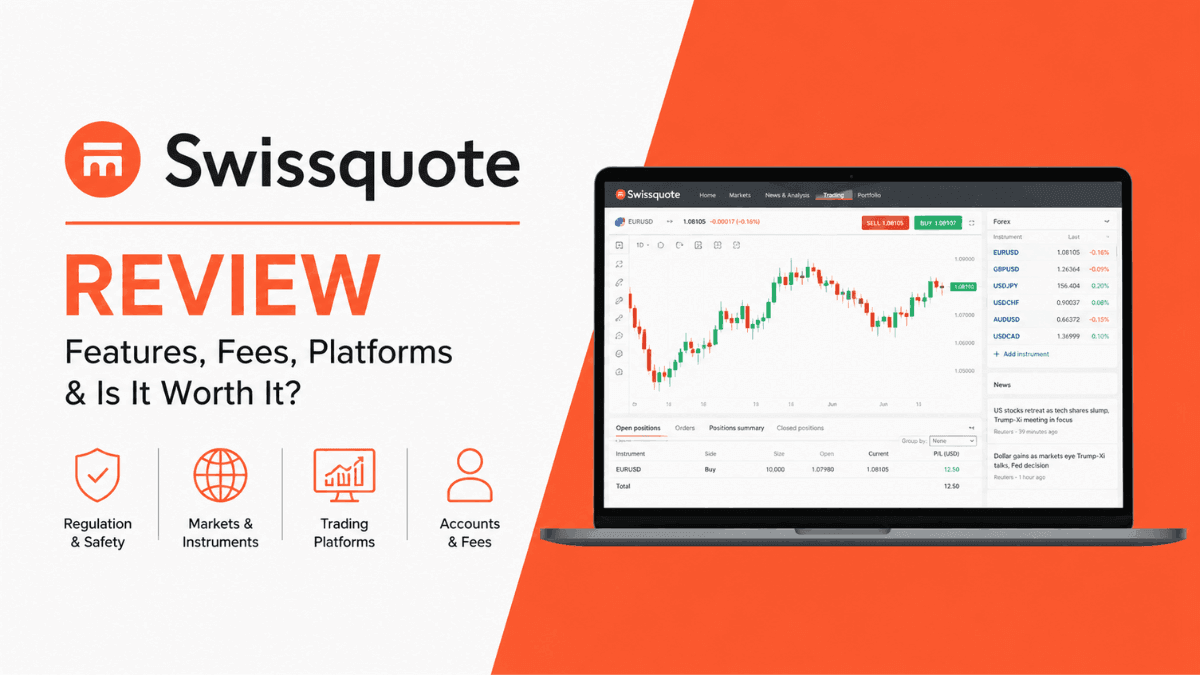
Choosing a forex and CFD broker is not just about spreads or leverage. You also need to consider regulation, platform reliability, customer support, available markets, and the overall trading experience. This Swissquote Review takes a deep look at one of the most established names in online trading and banking.
Founded in Switzerland, Swissquote has built a reputation as a broker that combines traditional banking security with modern online trading services. Unlike many forex brokers that operate only as trading companies, Swissquote is a publicly listed Swiss bank. That alone changes how many traders view the brand.

But is Swissquote actually worth using in 2026 and beyond? Does its premium reputation justify the higher trading costs some users complain about? And who is this broker really best suited for?
This detailed review answers all of those questions.
What Is Swissquote?
Swissquote is a Swiss-based online bank and multi-asset broker that offers forex, CFDs, stocks, ETFs, cryptocurrencies, bonds, commodities, and futures trading. The company was founded in 1996 and is headquartered in Gland, Switzerland.
Unlike many retail brokers that focus heavily on aggressive marketing and bonuses, Swissquote positions itself as a premium trading and investment platform. Its services appeal to traders who prioritize safety, transparency, and access to global financial markets.
One reason Swissquote stands out is that it operates under banking regulations in Switzerland. That gives clients an additional layer of confidence compared to offshore brokers with weaker oversight.
Today, Swissquote serves clients across Europe, Asia, the Middle East, and other international markets.
Swissquote Regulation and Safety
When evaluating any broker, regulation should always come first. A flashy platform means very little if your funds are not secure.
Swissquote performs strongly in this area because the company is regulated by multiple respected authorities worldwide.
Regulatory Licenses
Swissquote operates through different entities regulated in several jurisdictions, including:
- Swiss Financial Market Supervisory Authority (FINMA)
- Financial Conduct Authority (FCA) in the United Kingdom
- Dubai Financial Services Authority (DFSA)
- Malta Financial Services Authority (MFSA)
- Securities and Futures Commission (SFC) in Hong Kong
This multi-jurisdiction oversight helps the broker maintain high operational standards.
Is Swissquote Safe?
Swissquote is widely considered one of the safer brokers in the retail trading industry. There are several reasons for this reputation.
First, it is a licensed Swiss bank. Switzerland has some of the strictest financial regulations in the world. Client funds are generally segregated from company funds, reducing the risk of misuse.
Second, Swissquote is publicly traded on the SIX Swiss Exchange. Public companies must release financial reports and maintain transparency with shareholders and regulators.
Third, the broker has operated for decades without major scandals involving client fund mismanagement.
For traders who value long-term stability, Swissquote scores highly.
Swissquote Account Types
Swissquote offers multiple account types designed for different trading styles and experience levels. Understanding the differences can help you choose the right setup for your needs.
Standard Account
The Standard account is aimed at retail traders who want straightforward access to forex and CFD markets.
It generally includes:
- Access to MetaTrader and proprietary platforms
- Variable spreads
- No commission on many instruments
- Multi-asset trading access
This account is suitable for beginners and casual traders.
Premium Account
The Premium account is designed for traders with larger deposits who want tighter pricing.
Compared to the Standard account, Premium users may benefit from:
- Lower spreads
- Enhanced trading conditions
- More personalized support
This option tends to attract active traders.
Prime Account
The Prime account targets professional or high-volume traders.
It usually offers:
- Institutional-style pricing
- Very low spreads
- Competitive commissions
- Priority services
Scalpers and advanced traders often prefer this structure because tighter spreads can significantly reduce long-term trading costs.
Trading Platforms Available on Swissquote
A broker’s platform can dramatically impact your trading experience. Swissquote supports several popular platforms while also offering its own proprietary technology.
MetaTrader 4 (MT4)
MetaTrader 4 remains one of the most widely used forex platforms globally.
Swissquote’s MT4 offering supports:
- Expert Advisors (EAs)
- Technical indicators
- One-click trading
- Custom scripts
- Automated trading strategies
Many traders still prefer MT4 because of its simplicity and large online community.
MetaTrader 5 (MT5)
MetaTrader 5 provides additional features compared to MT4.
Key upgrades include:
- More timeframes
- More order types
- Improved backtesting
- Better asset management
- Enhanced charting tools
MT5 is generally better suited for traders who want broader market access beyond forex.
Swissquote Advanced Trader
Swissquote also offers its own proprietary platform called Advanced Trader.
This platform includes:
- Advanced charting tools
- Integrated news feeds
- Market analysis
- Algorithmic trading support
- Customizable workspace layouts
Some traders appreciate having a platform specifically designed around Swissquote’s ecosystem rather than relying only on MetaTrader.
Mobile Trading Apps
Swissquote’s mobile apps are available for both Android and iOS devices.
The mobile experience is clean and stable, allowing users to:
- Open and close trades
- Monitor markets
- Analyze charts
- Manage portfolios
- Deposit and withdraw funds
For traders who frequently monitor positions while away from a desktop setup, the mobile platform performs reliably.
Markets and Instruments Offered
One area where Swissquote performs well is market variety. The broker offers access to multiple asset classes through a single account ecosystem.
Forex Trading
Swissquote provides access to major, minor, and exotic currency pairs.
Popular pairs include:
- EUR/USD
- GBP/USD
- USD/JPY
- AUD/USD
- USD/CAD
Forex spreads can vary depending on the account type and market conditions.
CFD Trading
Clients can trade CFDs on:
- Indices
- Commodities
- Stocks
- Bonds
- Cryptocurrencies
This allows traders to speculate on price movements without owning the underlying asset.
Stock and ETF Investing
Swissquote also supports traditional investing services.
Users can purchase:
- Global stocks
- ETFs
- Mutual funds
- Bonds
This makes Swissquote appealing to traders who also want long-term investment exposure.
Cryptocurrency Trading
Crypto trading has become a major part of Swissquote’s offering.
Users can trade or invest in cryptocurrencies such as:
- Bitcoin
- Ethereum
- Ripple
- Litecoin
- Cardano
Swissquote’s banking background gives some crypto investors additional confidence compared to less-regulated crypto exchanges.
Swissquote Spreads, Fees, and Commissions
Pricing is one of the few areas where Swissquote receives mixed feedback.
Forex Spreads
Swissquote is generally not considered the cheapest forex broker on the market.
Standard accounts may have wider spreads compared to brokers focused purely on low-cost forex trading. However, Premium and Prime accounts can offer more competitive pricing.
For many traders, the extra cost is viewed as a trade-off for stronger regulation and banking-grade security.
Commission Structure
Commission charges depend on the account type and instrument traded.
Some accounts use spread-only pricing, while others combine tighter spreads with commissions.
Professional traders often prefer commission-based accounts because they provide more transparent execution costs.
Non-Trading Fees
Swissquote may charge additional fees such as:
- Inactivity fees
- Withdrawal charges in some cases
- Currency conversion fees
Before opening an account, it is important to carefully review the broker’s fee schedule.
Swissquote Deposit and Withdrawal Methods
Funding and withdrawing from your account is generally straightforward.
Available payment methods may include:
- Bank wire transfer
- Credit and debit cards
- Electronic payment systems
Because Swissquote operates as a bank, bank transfers are particularly well integrated into its services.
Withdrawal processing times are usually reliable, though international bank transfers can sometimes take several business days depending on the banking network involved.
Swissquote Customer Support
Customer support quality can significantly affect your overall trading experience, especially during volatile market conditions.
Swissquote offers customer support through:
- Telephone
- Live chat
- Help center resources
Support is available in multiple languages, which benefits international clients.
Most users report professional and knowledgeable support interactions, though response speed can vary during busy periods.
Swissquote Education and Research Tools
Swissquote provides a solid range of educational and research resources for traders.
Educational Resources
The broker offers:
- Webinars
- Trading guides
- Tutorials
- Market explainers
- Video lessons
Beginners can learn foundational trading concepts while experienced traders can access more advanced material.
Research and Analysis
Swissquote also provides in-house research content, including:
- Market news
- Technical analysis
- Economic updates
- Trading signals
- Daily market outlooks
This research integration can help traders make more informed decisions without constantly relying on third-party tools.
Swissquote Pros and Cons
No broker is perfect. Understanding both strengths and weaknesses helps create realistic expectations.
Pros
- Strong regulation and a banking license
- Publicly traded company
- Wide range of tradable markets
- Reliable trading platforms
- Good reputation for security
- Multi-asset investing capabilities
Cons
- Higher spreads than some competitors
- Premium pricing structure
- Minimum deposit requirements may be high for some users
- Some advanced features are better suited for experienced traders
Who Should Use Swissquote?
Swissquote is not necessarily the ideal broker for every trader.
If your main priority is finding the absolute lowest spreads and maximum leverage, you may find cheaper alternatives elsewhere. Some aggressive CFD brokers focus heavily on ultra-low-cost trading conditions.
Swissquote is better suited for traders and investors who value:
- Strong regulation
- Banking-level security
- Long-term stability
- Multi-asset access
- Professional reputation
It is especially appealing to higher-capital traders, long-term investors, and users who prefer working with a broker that feels more like a traditional financial institution.
Swissquote vs Other Forex Brokers
Compared to low-cost forex brokers, Swissquote tends to position itself as a premium service provider.
For example:
- Brokers like IC Markets often compete on lower spreads and faster execution for scalpers.
- Brokers like XM attract beginners with promotions and lower entry barriers.
- Swissquote focuses more on trust, regulation, banking services, and broader investment access.
That difference in positioning matters when choosing a broker. A day trader with a small account may prioritize different features than a long-term investor managing larger capital.
Is Swissquote Good for Beginners?
Swissquote can work for beginners, but it may not be the easiest starting point for everyone.
The broker’s educational tools and secure environment are helpful. At the same time, beginners with smaller budgets may find the minimum deposit requirements and pricing less attractive compared to beginner-focused brokers.
New traders who prioritize safety and professional infrastructure may still appreciate Swissquote’s approach.
Final Verdict
Swissquote has earned a strong reputation by combining online trading services with the credibility of a regulated Swiss bank. That combination gives the broker a unique position in the forex and multi-asset trading industry.
The broker is not built around flashy promotions or ultra-cheap pricing. Instead, it focuses on security, stability, regulation, and broad market access. For many serious traders and investors, those qualities matter far more over the long term.
If you want a highly regulated broker with banking-level credibility and access to multiple financial markets, Swissquote is a strong option worth considering. Traders looking for the absolute lowest trading costs may prefer alternative brokers, but users who value trust and long-term reliability will likely find Swissquote appealing.
Frequently Asked Questions About Swissquote
Is Swissquote regulated?
Yes. Swissquote is regulated by several major financial authorities, including FINMA, FCA, DFSA, and MFSA.
Is Swissquote safe for forex trading?
Swissquote is considered one of the safer brokers because it operates as a Swiss bank and is publicly traded.
Does Swissquote support MetaTrader?
Yes. Swissquote supports both MetaTrader 4 and MetaTrader 5.
What is the minimum deposit for Swissquote?
Minimum deposit requirements vary depending on the account type and region.
Can you trade cryptocurrency on Swissquote?
Yes. Swissquote offers cryptocurrency trading and investing services for several major digital assets.
Is Swissquote good for beginners?
Swissquote can be suitable for beginners who value security and regulation, though its pricing may be higher than that of beginner-focused brokers.
Trade on the Go. Anywhere, Anytime
If you’re ready to apply what you’ve learned, consider trading with a globally recognized forex and CFD broker like XM .
The platform offers competitive spreads, fast execution, and access to advanced trading tools, including real-time charts and flexible account types, making it suitable for both beginners and experienced traders. Open a trading account for free and start trading today and join millions of traders and investors on the global forex market.
Trading involves risk. Ensure you understand how the markets work before investing.

Vincent Nyagaka is the founder of Chweya, where he breaks down complex financial topics into simple insights. A trader since 2015, he uses his market experience to help readers better understand investing, trading, and personal finance.