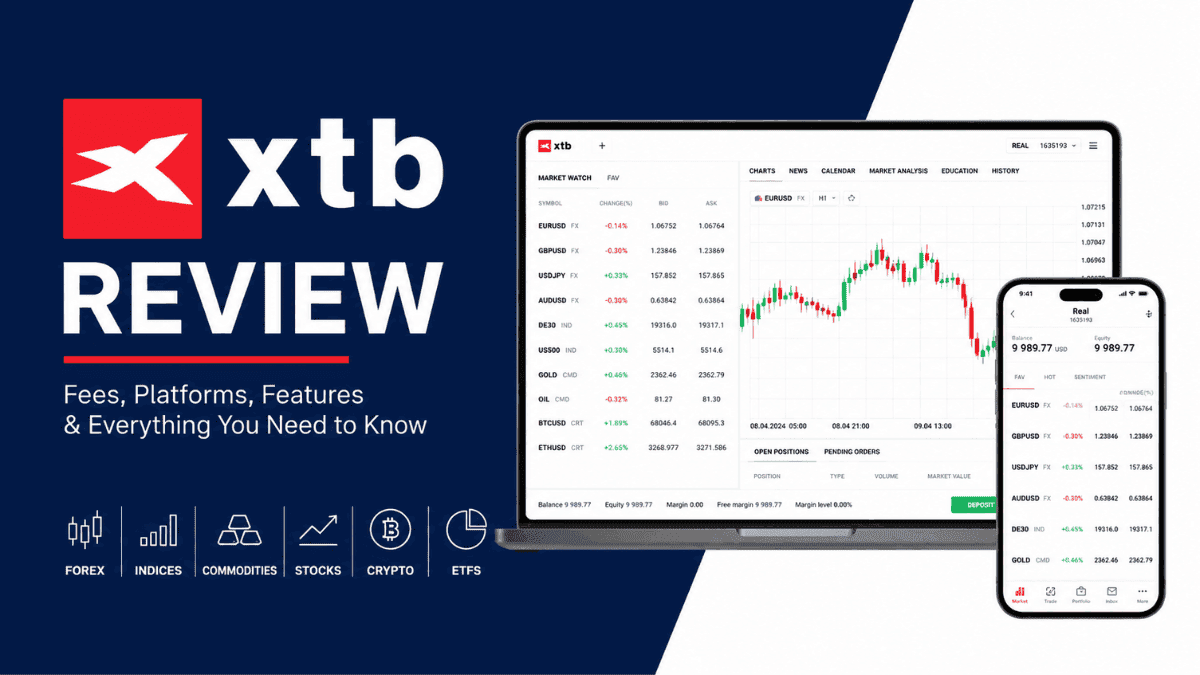
XTB has grown into one of the most recognized online brokers in the retail trading industry. Known for its proprietary xStation platform, competitive spreads, and strong regulatory background, XTB appeals to both beginner and advanced traders looking for access to forex, stocks, indices, commodities, ETFs, and cryptocurrencies from a single account.
This XTB Review takes a close look at the broker’s trading conditions, fees, platform performance, account features, regulation, customer support, and overall reliability. If you are considering opening an account with XTB, understanding both the strengths and limitations of the broker can help you make a more informed decision.

What Is XTB?
XTB is a global online broker that provides trading services across multiple financial markets. The company was founded in 2002 and has expanded its operations across Europe, Asia, the Middle East, and other international regions over the years.
One reason XTB stands out is its combination of simplicity and advanced functionality. New traders can start with a clean and intuitive trading interface, while experienced traders still get access to detailed charting tools, market analysis, and fast trade execution.
Unlike many brokers that rely entirely on MetaTrader platforms, XTB heavily promotes its proprietary xStation platform. That decision has helped the company create a more unified trading experience while keeping trading tools tightly integrated.
XTB Regulation and Safety
Regulation is one of the most important factors when evaluating any forex or CFD broker. This section explains how XTB handles compliance, client fund protection, and operational transparency.
XTB is regulated by several financial authorities across different jurisdictions. Depending on your location, you may register under different XTB entities.
Some of the key regulators associated with XTB include:
- Financial Conduct Authority (FCA) in the United Kingdom
- Cyprus Securities and Exchange Commission (CySEC)
- Financial Supervision Authority (KNF) in Poland
- Financial Services Authority (DFSA) for certain regions
This multi-regulated structure adds credibility because the broker must comply with strict operational and financial standards. Client funds are generally held in segregated bank accounts, meaning company funds and client deposits are kept separate.
XTB is also publicly listed on the Warsaw Stock Exchange, which increases transparency. Publicly traded brokers typically face more financial reporting obligations compared to privately owned companies.
XTB Account Types
Understanding the available account types can help you determine whether the broker fits your trading style and budget.
XTB has simplified its account structure over time. Instead of overwhelming users with multiple account categories, the broker mainly focuses on a standard retail account experience.
Standard Account
The Standard Account is the primary account type offered by XTB. It is designed for most retail traders and includes access to forex pairs, commodities, indices, cryptocurrencies, stocks, and ETFs.
Key features include:
- Variable spreads
- Commission-free forex and CFD trading on many instruments
- Access to xStation
- Educational resources
- Negative balance protection for eligible retail clients
The simplified setup is helpful for beginners because it removes confusion around choosing between ECN, STP, or market-maker style accounts.
Demo Account
XTB also offers a free demo account for traders who want to test strategies or learn the platform before risking real money.
This is particularly useful if you are transitioning from another broker or learning how CFDs and leveraged trading work. A demo environment allows you to practice under real market conditions without financial risk.
Trading Platforms at XTB
The trading platform often determines how smooth your trading experience feels. XTB focuses heavily on its proprietary technology rather than relying solely on third-party software.
xStation Platform
The xStation platform is the centerpiece of the XTB trading experience. It is available on desktop, web browser, and mobile devices.
The interface is clean and modern without sacrificing functionality. Traders can access advanced charting, technical indicators, market sentiment data, economic calendars, and integrated news feeds from one dashboard.
Some notable xStation features include:
- Fast order execution
- Built-in trading calculator
- Market heatmaps
- Advanced charting tools
- One-click trading
- Real-time performance statistics
The platform is especially appealing for traders who want something easier to navigate than MetaTrader while still offering advanced tools.
Mobile Trading
XTB’s mobile trading app performs surprisingly well compared to many competitors. The mobile interface retains most of the functionality available on desktop versions.
Charts load quickly, watchlists sync across devices, and trade execution remains smooth even during volatile market sessions. For traders who manage positions while traveling or away from their desks, this flexibility matters.
Markets Available on XTB
A broker’s market selection can significantly affect trading opportunities. XTB provides access to a wide range of instruments across global financial markets.
Forex Trading
Forex remains one of the broker’s strongest areas. Traders can access major, minor, and exotic currency pairs with competitive spreads.
Popular pairs such as EUR/USD, GBP/USD, and USD/JPY typically feature tighter pricing, making them attractive for day traders and scalpers.
Stock CFDs and Real Stocks
XTB offers both CFD trading and direct access to real stocks in selected regions. This flexibility allows traders to choose between leveraged short-term speculation and long-term investing.
The broker provides access to shares from major exchanges, including:
- United States
- United Kingdom
- Germany
- France
- Spain
For investors building diversified portfolios, having stocks and ETFs alongside forex trading can be convenient.
Indices and Commodities
Global indices such as the NASDAQ, S&P 500, Germany 40, and UK 100 are available through CFDs.
Commodity traders can also access markets like:
- Gold
- Silver
- Oil
- Natural gas
- Agricultural products
These markets are popular during periods of economic uncertainty because commodities often react strongly to inflation, geopolitical events, and central bank decisions.
Cryptocurrency CFDs
XTB provides cryptocurrency CFDs rather than direct ownership of crypto assets. Traders can speculate on price movements without needing a crypto wallet.
Available instruments may include Bitcoin, Ethereum, Litecoin, and other major cryptocurrencies, depending on your jurisdiction.
Because crypto markets are highly volatile, risk management becomes especially important when trading these products.
XTB Spreads, Fees, and Commissions
Trading costs directly impact profitability, especially for active traders. This section explains how XTB structures its fees.
Spreads
XTB primarily uses variable spreads. On major forex pairs, spreads are generally competitive compared to many large retail brokers.
Market volatility can widen spreads during major news events or periods of lower liquidity, which is normal across the industry.
Commission Structure
Many instruments on XTB are commission-free, with the broker earning revenue through the spread instead.
For stock investing in certain regions, there may be conditions regarding monthly trading volume before commissions apply. Always check the latest terms directly on the broker’s official website because fee structures can change over time.
Non-Trading Fees
Like many brokers, XTB may charge certain non-trading fees, including:
- Currency conversion fees
- Inactivity fees after extended account dormancy
- Overnight swap fees for leveraged positions held overnight
Swap fees are especially relevant for swing traders who keep positions open for several days or weeks.
XTB Leverage
Leverage allows traders to control larger positions with smaller deposits, but it also increases risk exposure.
Retail leverage limits depend on your region and applicable regulations. Under European regulations, leverage may be capped around:
- 30:1 for major forex pairs
- Lower ratios for commodities and cryptocurrencies
Professional accounts may qualify for higher leverage, although professional classification often reduces certain protections.
New traders should approach leverage carefully. While higher leverage can amplify profits, it can also magnify losses quickly during volatile market conditions.
XTB Deposits and Withdrawals
Funding and withdrawing from a trading account should ideally be simple and fast. XTB generally performs well in this area.
The broker supports several payment methods, including:
- Bank transfers
- Debit cards
- Credit cards
- Electronic payment systems in selected regions
Processing times vary depending on the payment provider and your country. Withdrawals are typically processed within one business day after approval, although actual arrival times depend on banking systems.
One advantage is that XTB usually avoids charging deposit fees on many standard payment methods.
Education and Research Tools
Educational support can make a major difference, especially for newer traders trying to understand risk management and market analysis.
Trading Academy
XTB offers educational content through webinars, articles, tutorials, and trading lessons. The broker’s educational resources are designed for different skill levels.
Beginners can learn topics like:
- Technical analysis basics
- Risk management
- Trading psychology
- Chart patterns
- Economic news interpretation
More advanced traders may benefit from market analysis and strategy-focused webinars.
Market Research
The broker also provides research tools directly within the platform.
These include:
- Economic calendar
- Breaking market news
- Sentiment analysis
- Technical analysis updates
Integrated research helps traders react more efficiently to market-moving events without constantly switching between external websites.
XTB Customer Support
Reliable customer support becomes important when you face technical issues, account verification delays, or urgent trade-related questions.
XTB provides customer support through multiple channels, including live chat, phone, and email support.
The broker has built a strong reputation for responsive support in many regions. Live chat response times are often relatively quick, especially during active market hours.
Support quality can still vary slightly depending on language and regional office, but overall feedback is generally positive compared to many competitors.
XTB Pros and Cons
Every broker has strengths and weaknesses. Looking at both sides helps create a more balanced evaluation.
Pros
- Strong regulatory oversight
- User-friendly xStation platform
- Competitive spreads on major forex pairs
- Wide market selection
- Good educational resources
- Publicly traded company with higher transparency
Cons
- No MetaTrader 5 support in some regions
- Inactivity fees may apply
- Cryptocurrency offerings are CFD-based only
- Certain features vary depending on jurisdiction
Who Should Use XTB?
Different brokers suit different types of traders. XTB tends to work best for traders who value ease of use, market access, and platform simplicity.
Beginner traders often appreciate the intuitive design of xStation and the educational resources available. Intermediate traders may enjoy the strong charting tools and competitive spreads.
Long-term investors may also benefit from access to real stocks and ETFs, especially if they want to combine investing and CFD trading under one platform.
Scalpers and advanced algorithmic traders, however, may prefer brokers focused heavily on MetaTrader ecosystems or raw-spread ECN accounts.
Is XTB Good for Beginners?
Many new traders ask whether XTB is beginner-friendly. In practice, the answer is generally yes.
The platform avoids unnecessary complexity while still offering advanced tools when needed. Educational resources are accessible, and the account opening process is relatively straightforward.
The demo account also gives beginners a safe way to practice before committing real capital.
That said, beginners should still understand the risks associated with leveraged CFD trading. Even the best broker cannot eliminate market risk.
Final Verdict on XTB Review
XTB has established itself as a reliable multi-asset broker with strong regulatory oversight, modern trading technology, and competitive overall trading conditions.
Its proprietary xStation platform is one of the broker’s biggest strengths. The platform combines usability with powerful tools in a way that works for both newer and experienced traders.
The broker may not suit every trading style, particularly traders deeply committed to MetaTrader ecosystems or ultra-low spread ECN environments. Still, for many retail traders looking for a balanced trading experience, XTB remains a strong contender in the online brokerage industry.
Before opening any trading account, it is wise to compare spreads, regulations, leverage rules, and platform features based on your region and trading goals. Testing the demo account first can also help you decide whether the broker fits your personal trading style.
Frequently Asked Questions About XTB
Is XTB regulated?
Yes. XTB operates under multiple financial regulators, including the FCA, CySEC, and KNF, depending on the jurisdiction.
Does XTB offer MetaTrader?
XTB mainly focuses on its proprietary xStation platform. MetaTrader availability may vary by region and account type.
Can beginners use XTB?
Yes. XTB is considered beginner-friendly due to its clean platform design, demo account availability, and educational resources.
Does XTB charge commissions?
Many CFD instruments are commission-free, with trading costs built into the spread. Certain stock trading conditions may differ.
Is XTB good for forex trading?
XTB is considered competitive for forex trading because of its tight spreads, fast execution, and strong platform functionality.
Trade on the Go. Anywhere, Anytime
If you’re ready to apply what you’ve learned, consider trading with a globally recognized forex and CFD broker like XM .
The platform offers competitive spreads, fast execution, and access to advanced trading tools, including real-time charts and flexible account types, making it suitable for both beginners and experienced traders. Open a trading account for free and start trading today and join millions of traders and investors on the global forex market.
Trading involves risk. Ensure you understand how the markets work before investing.

Vincent Nyagaka is the founder of Chweya, where he breaks down complex financial topics into simple insights. A trader since 2015, he uses his market experience to help readers better understand investing, trading, and personal finance.