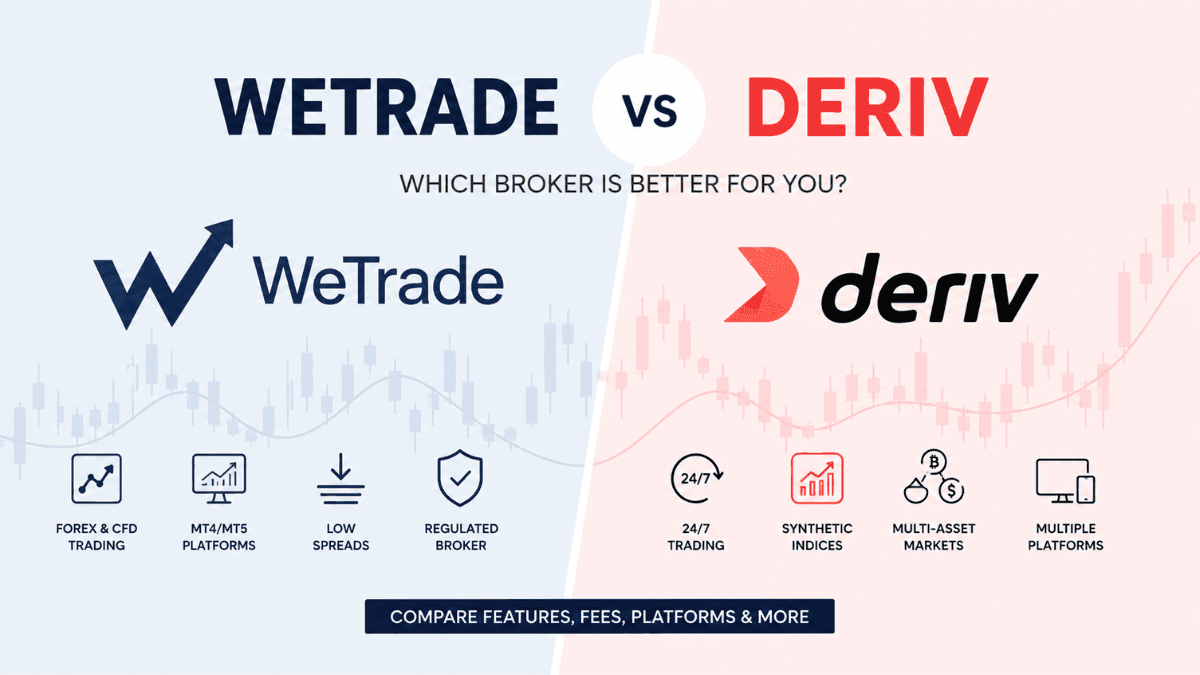
Choosing between WeTrade and Deriv can be challenging because both brokers target different types of traders. While WeTrade focuses on traditional forex and CFD trading with popular platforms like MetaTrader 4 and MetaTrader 5, Deriv has built a strong reputation around synthetic indices, proprietary trading platforms, and a broad range of trading products.
This WeTrade vs Deriv comparison examines regulation, trading platforms, account types, fees, instruments, customer support, and overall trading experience. By the end of this guide, you’ll have a clear understanding of which broker better suits your trading goals.
Click Here To Join our Telegram Community
| Feature | WeTrade | Deriv |
|---|---|---|
| Regulation | Regulated through multiple international entities | Regulated through multiple international entities with a long operational history |
| Minimum Deposit | From $50 (varies by account type and region) | From $5–$10 (varies by payment method and account type) |
| Trading Platforms | MT4, MT5, WebTrader, Mobile App | Deriv MT5, Deriv Trader, Deriv X, Deriv GO |
| Account Types | Standard, ECN, STP, VIP (availability may vary) | Standard Financial, Financial STP, Synthetic Indices Accounts |
| Spread | From 0.0 pips on select accounts | Variable spreads depending on asset and platform |
| Leverage | Up to 1:2000 (subject to regulation and asset class) | Up to 1:1000 (subject to asset class and jurisdiction) |
| Commission (If Available) | Commission may apply to ECN accounts | Commission varies by market and account type |
| Copy Trading | Available through selected platforms and social trading solutions | Limited copy trading options compared to dedicated social trading brokers |
| Deposit/Withdrawal Methods | Bank Transfer, Credit/Debit Cards, E-wallets, Local Payment Methods | Bank Transfer, Credit/Debit Cards, E-wallets, Cryptocurrencies, Local Payment Methods |
| Customer Support | Live Chat, Email, Phone Support | 24/7 Live Chat, Email, Help Center |
| ✅ Get Started | ✅ Trade with WeTrade | ✅ Open Account with Deriv |
WeTrade vs Deriv Overview
Before diving into the details, it’s helpful to understand the core differences between these brokers.
WeTrade is primarily designed for forex and CFD traders who prefer familiar trading environments and straightforward account structures. The broker offers access to major financial markets through MetaTrader platforms and provides competitive trading conditions.
Deriv takes a different approach. Alongside forex and CFDs, it offers synthetic indices—unique markets that simulate real-world volatility and operate 24/7. These products have made Deriv particularly popular among traders in Africa, Asia, and Latin America.
At a Glance
WeTrade is best for:
- Forex traders seeking MT4 and MT5 platforms
- Traders looking for competitive spreads
- Users who prefer a traditional broker setup
- Beginners wanting a simple account structure
Deriv is best for:
- Synthetic indices traders
- Traders seeking 24/7 market access
- Users interested in proprietary trading platforms
- Traders who want multiple asset classes from one account
Regulation and Safety
Trust is one of the most important factors when selecting a broker. Regulation helps ensure that brokers adhere to industry standards for client fund protection, transparency, and operational practices.
WeTrade Regulation
WeTrade operates through multiple regulated entities and is subject to regulatory oversight in several jurisdictions. The broker implements client fund segregation, meaning customer funds are kept separate from company operating capital.
The broker also employs security measures designed to protect client accounts and trading activities.
Deriv Regulation
Deriv has been operating for more than two decades and maintains licenses through several regulatory bodies worldwide. The company evolved from Binary.com, a well-known online trading brand established in 1999.
One of Deriv’s strengths is its long operational history. Few online brokers can point to such an extensive track record, which contributes to its credibility among traders.
Which Is Safer?
Both brokers maintain regulatory oversight and security measures. Deriv benefits from a longer operational history, while WeTrade offers a more conventional brokerage structure familiar to many forex traders.
For traders who prioritize longevity and brand history, Deriv may have a slight advantage. For traders primarily focused on traditional forex trading, both brokers offer a reasonable level of security.
Trading Instruments
The range of available markets can significantly impact your trading opportunities.
WeTrade Trading Products
WeTrade provides access to several popular financial markets, including:
- Forex currency pairs
- Commodities
- Indices
- Stocks
- CFDs on various assets
The broker’s product selection focuses on mainstream markets that most traders recognize and understand.
Deriv Trading Products
Deriv offers a wider variety of instruments, including:
- Forex
- Commodities
- Stocks
- Cryptocurrencies
- Indices
- ETFs
- Synthetic indices
The synthetic indices category is where Deriv truly stands out. These are algorithm-generated markets designed to mimic real-world volatility while remaining independent of economic events, news releases, and market closures.
Which Broker Offers More Markets?
Deriv generally provides a broader range of products, especially through its synthetic indices and proprietary trading offerings. Traders looking for maximum market diversity may find Deriv more appealing.
WeTrade remains competitive for traders focused mainly on forex and traditional CFD markets.
Trading Platforms
A broker’s platform can directly affect execution speed, chart analysis, and overall trading efficiency.
WeTrade Platforms
WeTrade supports:
MetaTrader 4 (MT4)
MT4 remains one of the most popular trading platforms globally. It offers advanced charting, technical indicators, Expert Advisors (EAs), and automated trading functionality.
MetaTrader 5 (MT5)
MT5 expands upon MT4 by providing additional order types, more technical indicators, enhanced charting tools, and access to a broader range of markets.
These platforms make WeTrade particularly attractive to traders already familiar with the MetaTrader ecosystem.
Deriv Platforms
Deriv provides several proprietary platforms, as well as MetaTrader integration.
Deriv MT5
Deriv offers MT5 access for traders who prefer a traditional trading environment.
Deriv Trader
This web-based platform allows traders to access multiple markets through a simple interface without downloading software.
Deriv X
Deriv X delivers advanced charting capabilities and customizable layouts for more experienced traders.
Deriv cTrader (availability may vary)
Some regions also receive access to additional platform options depending on regulatory jurisdiction.
Which Platform Experience Is Better?
The answer depends on your preferences.
If you already use MT4 or MT5 and rely on Expert Advisors, WeTrade offers a straightforward experience.
If you enjoy exploring different trading interfaces and proprietary tools, Deriv provides significantly more flexibility.
Account Types
Account variety allows traders to choose conditions that match their strategies.
WeTrade Account Types
WeTrade typically offers multiple account categories designed for different experience levels and trading styles.
These accounts often vary based on:
- Minimum deposit requirements
- Spread structures
- Commission models
- Additional trading benefits
The overall structure remains relatively easy to understand, making it beginner-friendly.
Deriv Account Types
Deriv offers several account options linked to different market categories.
For example, traders can access:
- Financial accounts
- Financial STP accounts
- Synthetic indices account
- Cryptocurrency-focused trading accounts
This segmentation helps traders access products tailored to specific market interests.
Which Broker Has Better Account Options?
Deriv provides more specialization, especially for synthetic market traders. WeTrade offers a cleaner and simpler structure that many new traders may find easier to navigate.
Spreads, Fees, and Trading Costs
Trading costs play a major role in long-term profitability.
WeTrade Fees
WeTrade generally offers competitive spreads across major forex pairs. Depending on the selected account type, traders may encounter either spread-only pricing or a combination of spreads and commissions.
The broker aims to keep costs attractive for active traders.
Deriv Fees
Deriv also maintains competitive pricing across many markets. Trading costs vary depending on the asset class and platform being used.
Synthetic indices often feature pricing structures that differ from traditional forex instruments.
Which Broker Is Cheaper?
There is no universal winner because costs vary by instrument and account type.
For standard forex trading, both brokers remain competitive. Traders should compare the specific assets they trade most frequently before making a decision.
Leverage and Margin
Leverage allows traders to control larger positions using smaller amounts of capital.
WeTrade Leverage
WeTrade offers flexible leverage options depending on regulatory jurisdiction and asset class.
Higher leverage can increase profit potential but also significantly raises trading risk.
Deriv Leverage
Deriv also provides substantial leverage opportunities across several instruments.
Synthetic indices and certain CFD products may have different leverage limits than forex pairs.
Which Broker Offers Better Leverage?
Both brokers provide competitive leverage. The better choice depends more on product availability and risk management preferences than on maximum leverage alone.
Deposits and Withdrawals
Funding convenience can greatly improve the trading experience.
WeTrade Payment Methods
WeTrade supports several common payment methods, including:
- Bank transfers
- Debit cards
- Credit cards
- Electronic payment solutions
Processing times vary depending on the payment channel selected.
Deriv Payment Methods
Deriv is particularly strong in this area. The broker supports:
- Bank cards
- Bank transfers
- E-wallets
- Regional payment systems
- Cryptocurrency deposits and withdrawals
Many traders appreciate Deriv’s extensive support for local payment methods.
Which Broker Has Better Banking Options?
Deriv generally offers more flexibility, especially for international traders and users in emerging markets.
Education and Research Tools
Educational resources help traders improve their knowledge and decision-making skills.
WeTrade Education
WeTrade provides educational materials covering trading basics, platform tutorials, and market insights.
The content is generally suitable for beginner and intermediate traders.
Deriv Education
Deriv offers educational articles, tutorials, webinars, platform guides, and product-specific training resources.
Special attention is given to helping users understand synthetic indices and proprietary trading tools.
Which Broker Educates Traders Better?
Deriv’s educational ecosystem is typically more extensive, particularly in terms of unique products and platform usage.
Customer Support
Reliable customer support becomes especially important when dealing with account or withdrawal issues.
WeTrade Support
WeTrade offers support through multiple communication channels, including email, live chat, and other customer service options, depending on the region.
Deriv Support
Deriv provides 24/7 support in many regions and offers multilingual assistance through live chat and help center resources.
Which Broker Has Better Support?
Deriv’s global presence and around-the-clock support availability give it an advantage for many international traders.
WeTrade vs Deriv: Pros and Cons
WeTrade Pros
- MT4 and MT5 support
- Competitive forex trading conditions
- User-friendly account structure
- Suitable for traditional CFD traders
WeTrade Cons
- Fewer proprietary tools
- Smaller product selection than Deriv
- Limited specialization compared with synthetic market providers
Deriv Pros
- Large range of tradable assets
- Popular synthetic indices
- Multiple platform choices
- Strong payment method support
- Long operating history
Deriv Cons
- Synthetic products may not suit all traders
- Proprietary platforms can require a learning curve
- Product complexity may overwhelm some beginners
Final Verdict: Is WeTrade or Deriv Better?
The right choice depends on how you trade.
Choose WeTrade if your primary focus is forex and CFD trading through MT4 or MT5. The broker offers a familiar environment, competitive pricing, and a straightforward user experience that appeals to many retail traders.
Choose Deriv if you want access to synthetic indices, a wider range of products, diverse platform options, and extensive payment methods. The broker’s long history and unique market offerings make it especially attractive for traders looking beyond traditional forex markets.
For most traders focused solely on forex trading, WeTrade offers everything needed for a solid trading experience. For traders seeking variety, innovation, and around-the-clock market opportunities, Deriv is often the stronger overall choice.
Frequently Asked Questions
1. Is WeTrade better than Deriv for forex trading?
WeTrade is often a strong choice for traders who focus mainly on forex and CFD markets. It offers access to MT4 and MT5, competitive spreads, and a traditional trading environment that many forex traders prefer. Deriv also supports forex trading but is better known for its synthetic indices and proprietary platforms.
2. What makes Deriv different from WeTrade?
The biggest difference is Deriv’s unique synthetic indices, which are available 24/7 and unaffected by economic news or market closures. WeTrade focuses more on traditional financial markets such as forex, commodities, and indices. This makes Deriv attractive to traders looking for alternative trading opportunities.
3. Are WeTrade and Deriv regulated brokers?
Both brokers operate under regulatory oversight through various entities and jurisdictions. They also implement measures such as client fund segregation and account security protocols. Traders should always verify the specific regulatory entity serving their country before opening an account.
4. Which broker has lower trading fees?
Trading costs depend on the account type and instruments being traded. Both WeTrade and Deriv offer competitive spreads, but pricing can vary across forex pairs, indices, and other assets. Comparing the costs of your preferred markets is the best approach.
5. Can beginners use WeTrade or Deriv?
Yes, both brokers are suitable for beginners. WeTrade offers a simpler and more familiar trading experience, while Deriv provides educational resources and user-friendly platforms. New traders may find WeTrade easier to learn initially.
6. Does Deriv offer more trading instruments than WeTrade?
Yes, Deriv generally offers a broader range of markets. In addition to forex, stocks, commodities, and cryptocurrencies, it offers synthetic indices not available through most traditional brokers. This gives traders more opportunities to diversify their strategies.
Trade on the Go. Anywhere, Anytime
If you’re ready to apply what you’ve learned, consider trading with a globally recognized forex and CFD broker like XM .
The platform offers competitive spreads, fast execution, and access to advanced trading tools, including real-time charts and flexible account types, making it suitable for both beginners and experienced traders. Open a trading account for free and start trading today and join millions of traders and investors on the global forex market.
Trading involves risk. Ensure you understand how the markets work before investing.

Vincent Nyagaka is the founder of Chweya, where he breaks down complex financial topics into simple insights. A trader since 2015, he uses his market experience to help readers better understand investing, trading, and personal finance.