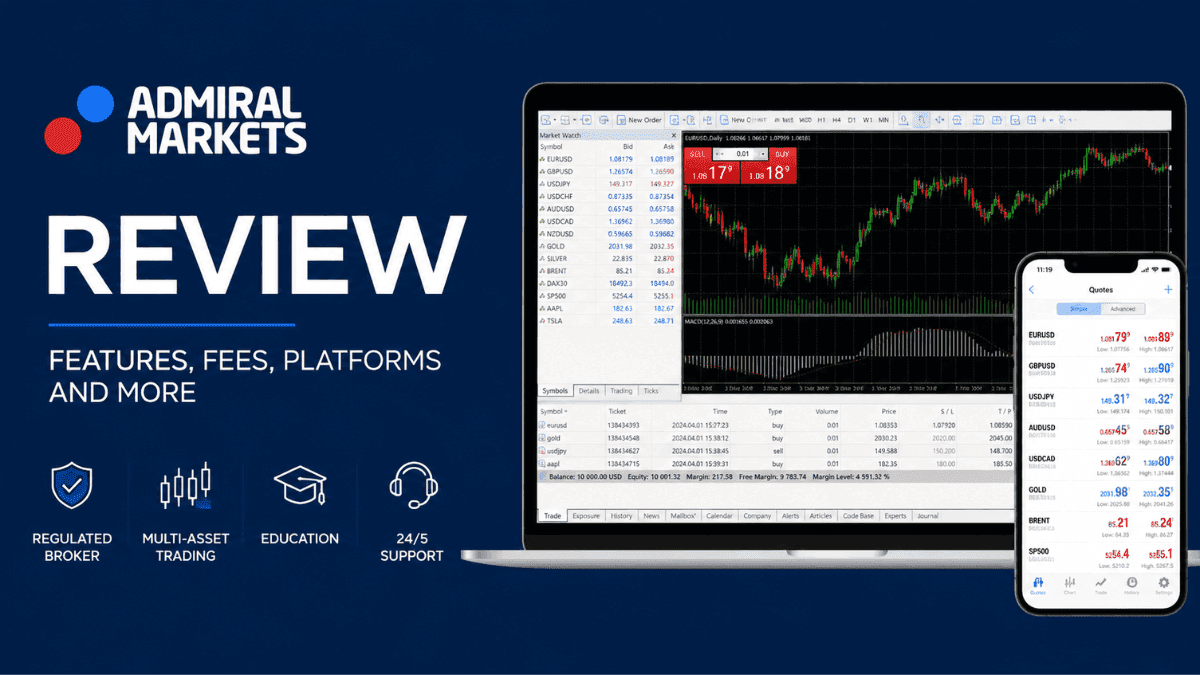
Choosing the right broker can shape your entire trading experience, from execution speed and trading costs to how secure your funds are. This Admiral Markets Review takes a close look at one of the most recognized multi-asset brokers in the online trading industry.
Admiral Markets has built a reputation around MetaTrader integration, educational resources, and access to thousands of financial instruments. But is it actually a good fit for your trading style in 2026?

This review breaks down everything you need to know, including regulation, spreads, trading platforms, account types, fees, customer support, and the overall user experience. Whether you are a beginner exploring forex trading or an experienced trader comparing brokers, this guide will help you make a more informed decision.
What Is Admiral Markets?
Admiral Markets is an online brokerage company that provides access to forex, stocks, indices, commodities, ETFs, cryptocurrencies, and CFDs (Contracts for Difference). Founded in 2001, the broker has expanded globally and now serves traders across multiple regions.
One reason Admiral Markets stands out is its strong focus on professional-grade trading tools. Instead of building a flashy proprietary platform, the company heavily supports the widely respected MetaTrader ecosystem, including both MT4 and MT5.
The broker also appeals to traders looking for diversification. You can trade traditional forex pairs, invest in real stocks and ETFs, or speculate on global market movements through CFDs from a single account ecosystem.
Is Admiral Markets Regulated and Safe?
Safety should always come before spreads or bonuses. A broker may offer attractive trading conditions, but regulation is what protects traders from poor practices and operational risks.
Admiral Markets operates under multiple regulated entities in different jurisdictions. Depending on your country of residence, you may register under different regulatory frameworks.
Key Regulatory Authorities
Admiral Markets is regulated by several recognized financial authorities, including:
- Financial Conduct Authority (FCA)
- Australian Securities and Investments Commission (ASIC)
- Cyprus Securities and Exchange Commission (CySEC)
- Jordan Securities Commission
These regulators impose requirements related to client fund segregation, operational transparency, risk management, and compliance standards.
Client Fund Protection
Admiral Markets keeps client funds separate from company operating capital. This process is known as segregated accounts, and it helps reduce the risk of misuse of customer deposits.
Some regulated entities may also provide investor compensation protections depending on local regulations. Still, traders should always verify which legal entity they are signing up under because protections vary by region.
Admiral Markets Account Types
Account flexibility matters because not every trader uses the same strategy. A scalper trading EUR/USD daily has very different needs compared to a long-term ETF investor.
Admiral Markets offers several account types designed for different trading preferences.
Trade.MT5 Account
This is the broker’s primary CFD trading account for MetaTrader 5 users. It supports forex, commodities, indices, cryptocurrencies, and shares via CFDs.
The account is popular because it combines broad market access with competitive spreads and strong charting functionality.
Invest.MT5 Account
This account targets investors rather than short-term traders. Instead of CFDs, it allows access to real stocks and ETFs from major exchanges.
For traders who want both investing and active trading under one broker, this structure can be convenient.
Zero.MT5 Account
The Zero account is designed for traders who prioritize tighter spreads. Instead of wider all-inclusive pricing, the broker charges commissions alongside lower raw spreads.
This setup often appeals to:
- Scalpers
- Algorithmic traders
- High-frequency traders
- Professional forex traders
Trading Platforms Available
A broker is only as good as the platform it provides. Even strong pricing can feel useless if execution is unstable or charting tools are limited.
Admiral Markets focuses heavily on the MetaTrader ecosystem.
MetaTrader 4 (MT4)
MetaTrader 4 remains one of the most widely used forex trading platforms globally. Admiral Markets supports MT4 with advanced tools, custom indicators, and Expert Advisors (EAs).
MT4 works especially well for traders who focus mainly on forex and CFD trading.
MetaTrader 5 (MT5)
MetaTrader 5 is the newer and more advanced version of MetaTrader. It includes additional timeframes, more order types, faster strategy testing, and broader market support.
Most modern traders will likely prefer MT5 because of its expanded capabilities.
Supreme Edition Plugin
One unique feature is the MetaTrader Supreme Edition add-on offered by Admiral Markets. This plugin enhances the standard MetaTrader experience with advanced trading tools and analytics.
Features include:
- Sentiment analysis
- Mini terminal trading
- Correlation matrix
- Advanced risk management tools
- Tick chart trader
These extras can provide a meaningful advantage for active traders who rely on technical analysis and fast execution.
Markets and Instruments Offered
A major strength of Admiral Markets is its broad product offering. Traders can access thousands of instruments across multiple asset classes.
Forex Trading
Forex remains the broker’s core offering. Traders can access major, minor, and exotic currency pairs with competitive leverage and spreads.
Popular pairs include:
- EUR/USD
- GBP/USD
- USD/JPY
- AUD/USD
- USD/CAD
Stocks and ETFs
The Invest.MT5 account provides access to real shares and ETFs from major global exchanges.
This makes Admiral Markets attractive for traders who also want long-term investment exposure instead of purely speculative CFD trading.
Commodities and Indices
The broker offers CFDs on commodities like gold, silver, oil, and natural gas, along with major global stock indices.
Popular instruments include:
- Gold (XAU/USD)
- Brent Crude Oil
- NASDAQ 100
- S&P 500
- DAX 40
Cryptocurrency CFDs
Crypto trading is also available through CFDs. Traders can speculate on price movements without owning the underlying digital assets.
Available instruments may include Bitcoin, Ethereum, Litecoin, and other major cryptocurrencies.
Admiral Markets Spreads and Fees
Trading costs directly affect profitability, especially for active traders. Small differences in spreads become significant over hundreds of trades.
Admiral Markets generally offers competitive pricing, though costs vary depending on the account type and instrument traded.
Forex Spreads
Typical spreads on major pairs can start from:
- Around 0.5 pips on standard-style accounts
- Near 0.0 pips on Zero accounts plus commission
Spread conditions may fluctuate during high market volatility or low liquidity periods.
Commission Structure
Commission-free pricing is available on some accounts, while raw spread accounts apply fixed commissions per lot traded.
Professional traders often prefer raw spread accounts because tighter spreads improve execution efficiency.
Non-Trading Fees
Like many brokers, Admiral Markets may charge:
- Currency conversion fees
- Overnight swap fees
- Inactivity fees after extended periods
You should always review the fee schedule carefully before opening an account.
Leverage at Admiral Markets
Leverage allows traders to control larger positions with smaller deposits. While this can increase profits, it also increases losses.
Leverage limits depend on your region and regulatory jurisdiction.
Retail traders under stricter regulators like the FCA or ASIC often receive lower leverage limits compared to offshore jurisdictions.
Typical leverage examples include:
- Forex: up to 1:30 for retail clients in regulated regions
- Professional accounts: potentially higher leverage
- Commodities and indices: variable leverage depending on asset volatility
New traders should approach leverage carefully because excessive leverage is one of the fastest ways to blow a trading account.
Deposit and Withdrawal Methods
Funding flexibility matters because traders want fast, reliable transactions without excessive processing delays.
Admiral Markets supports several payment methods depending on your country.
Common Payment Methods
Available options may include:
- Bank transfers
- Credit and debit cards
- Skrill
- Neteller
- PayPal in supported regions
Processing times vary by method, though many electronic payments are processed relatively quickly.
Minimum Deposit
The broker’s minimum deposit requirement is considered accessible for many retail traders. However, the ideal deposit amount depends on your strategy and risk management approach.
A trader using conservative position sizing may require more capital than the platform minimum suggests.
Educational Resources and Research Tools
Education is one area where Admiral Markets performs strongly. The broker invests heavily in trader education through webinars, articles, tutorials, and market analysis.
This is especially valuable for beginners who need more than just a trading platform.
Trading Education
Educational content covers topics like:
- Forex basics
- Technical analysis
- Risk management
- Trading psychology
- Platform tutorials
The educational material is structured in a way that supports gradual learning instead of overwhelming beginners with advanced concepts immediately.
Market Research
The broker also provides market commentary and analysis tools that help traders stay informed about economic events and price movements.
Research resources can be useful for both short-term and long-term trading strategies.
Mobile Trading Experience
Modern traders expect reliable mobile access, especially during volatile market conditions.
Admiral Markets supports mobile trading through the MetaTrader mobile apps for both Android and iOS devices.
The mobile experience includes:
- Live charting
- Order execution
- Market watchlists
- Technical indicators
- Push notifications
While desktop platforms still provide the best full-featured experience, mobile trading works well for monitoring positions and managing trades on the go.
Customer Support Quality
Customer support often becomes important only when problems appear. Fast withdrawals and stable execution are great, but responsive support matters during technical issues or account verification delays.
Admiral Markets provides support through multiple channels, including:
- Live chat
- Phone support
- Help center resources
Support availability and response speed may vary by region and time zone.
In general, the broker maintains a fairly professional support reputation compared to many smaller offshore competitors.
Pros and Cons of Admiral Markets
Every broker has strengths and weaknesses. Understanding both sides helps traders avoid unrealistic expectations.
Pros
- Strong global regulation
- Excellent MetaTrader integration
- Broad range of tradable markets
- Educational resources for beginners
- Access to real stocks and ETFs
- Competitive spreads on key instruments
Cons
- Some features vary by region
- Inactivity fees may apply
- No heavily customized proprietary trading platform
- Leverage restrictions for retail traders under strict regulators
Who Should Use Admiral Markets?
Not every broker fits every type of trader. Admiral Markets is particularly well-suited for traders who value regulation, platform reliability, and market variety over flashy marketing.
The broker may be a good fit for:
- Forex traders using MetaTrader
- Intermediate and advanced technical traders
- Traders interested in CFDs and real investments
- Investors seeking ETF and stock access
- Traders who value educational resources
Complete beginners can also benefit, especially because of the educational ecosystem and relatively user-friendly platform structure.
Final Verdict
Admiral Markets has earned its position as a respected global broker by focusing on regulation, platform quality, and trader tools rather than gimmicks.
Its biggest strengths include strong MetaTrader support, broad market access, educational resources, and multi-jurisdiction regulation. The broker also balances active trading and investing features better than many competitors.
That said, no broker is perfect. Trading costs vary by account type, leverage restrictions may frustrate some traders, and the absence of a proprietary platform could disappoint users looking for a more customized interface.
For most retail traders seeking a reliable and professional trading environment in 2026, Admiral Markets remains a strong option worth considering.
Frequently Asked Questions About Admiral Markets
Is Admiral Markets a legit broker?
Yes, Admiral Markets is considered a legitimate broker regulated by multiple financial authorities, including the FCA, ASIC, and CySEC.
Does Admiral Markets support MetaTrader 5?
Yes, Admiral Markets fully supports both MetaTrader 4 and MetaTrader 5 trading platforms.
Can beginners use Admiral Markets?
Yes, beginners can use Admiral Markets thanks to its educational resources, demo accounts, and beginner-friendly platform environment.
What is the minimum deposit for Admiral Markets?
The minimum deposit depends on the account type and region, but it is generally accessible for retail traders.
Does Admiral Markets offer cryptocurrency trading?
Yes, Admiral Markets offers cryptocurrency trading through CFDs on selected digital assets like Bitcoin and Ethereum.
Admiral Markets vs Other Brokers
Let us compare Admiral Markets with any other broker by selecting the other broker below.
The most popular Admiral Markets comparisons:
- Admiral Markets vs FP Markets
- AAAFx vs Admiral Markets
- Admiral Markets vs IG
- Admiral Markets vs FXPrimus
- Admiral Markets vs IC Markets
- Exness vs Admiral Markets
- XM vs Admiral Markets
- ActivTrades vs Admiral Markets
Trade on the Go. Anywhere, Anytime
If you’re ready to apply what you’ve learned, consider trading with a globally recognized forex and CFD broker like XM .
The platform offers competitive spreads, fast execution, and access to advanced trading tools, including real-time charts and flexible account types, making it suitable for both beginners and experienced traders. Open a trading account for free and start trading today and join millions of traders and investors on the global forex market.
Trading involves risk. Ensure you understand how the markets work before investing.

Vincent Nyagaka is the founder of Chweya, where he breaks down complex financial topics into simple insights. A trader since 2015, he uses his market experience to help readers better understand investing, trading, and personal finance.