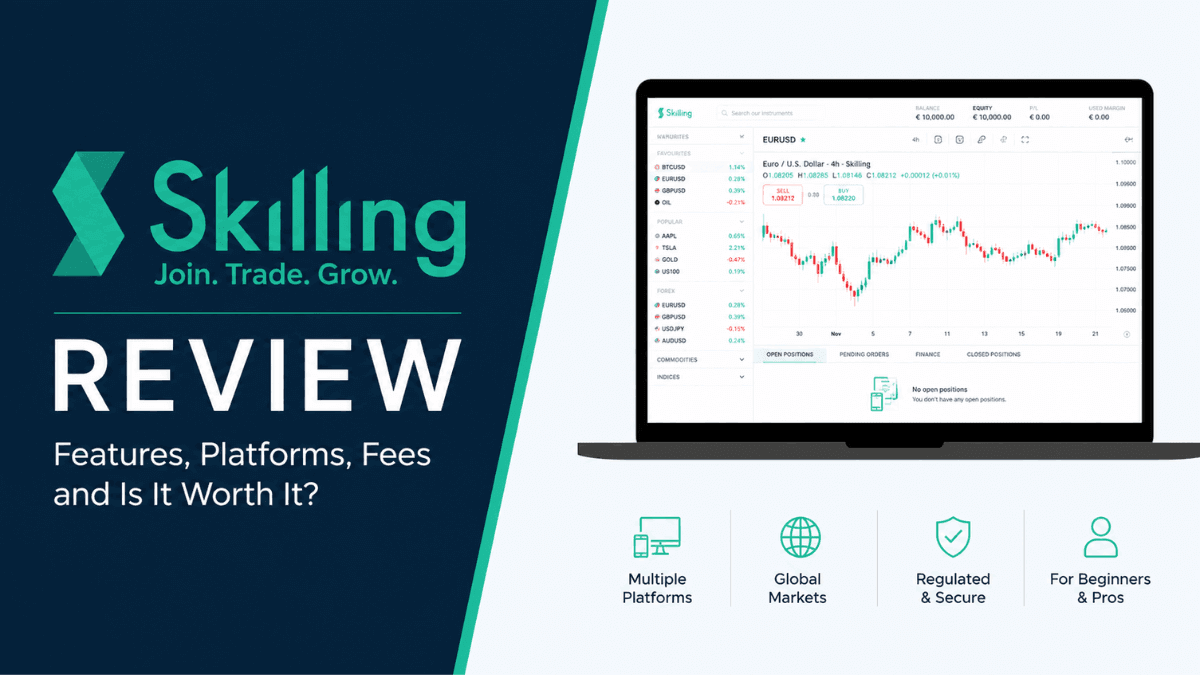
Choosing the right forex broker can shape your entire trading experience. A platform with poor execution, hidden fees, or unreliable customer support can quickly turn trading into frustration. That is why this Skilling Review takes a close, practical look at what the broker actually offers and whether it fits different types of traders.
Skilling has gained attention for its clean trading interface, competitive spreads, and focus on simplicity. The broker markets itself as a modern trading platform built for both beginners and experienced CFD traders. But does it really deliver on those promises?

This review explores Skilling’s regulation, trading platforms, spreads, account types, instruments, fees, customer support, and overall reliability. By the end, you should have a clear idea of whether Skilling is the right broker for your trading style.
What Is Skilling?
Before evaluating features and costs, it helps to understand what kind of broker Skilling actually is and who it targets.
Skilling is an online forex and CFD broker that provides access to global financial markets through Contracts for Difference (CFDs). Traders can speculate on price movements in forex, stocks, indices, commodities, cryptocurrencies, and other markets without owning the underlying assets.
The broker launched in 2016 and has positioned itself as a user-friendly platform focused on technology and accessibility. Unlike some traditional brokers that overwhelm new traders with complicated layouts, Skilling emphasizes simplicity and fast platform performance.
One thing that stands out is its approach to platform design. Skilling offers its own proprietary platform alongside popular industry platforms such as MetaTrader 4 and cTrader. That flexibility appeals to traders with different experience levels and strategies.
Is Skilling Regulated and Safe?
Safety is one of the most important factors when choosing a broker. This section explains how Skilling is regulated and what that means for traders.
Skilling operates through regulated entities in different jurisdictions. Regulation helps ensure that brokers follow strict financial standards, maintain client fund protection measures, and operate transparently.
The broker is regulated by reputable financial authorities, including:
- Cyprus Securities and Exchange Commission (CySEC)
- Financial Supervisory Authority (FSA) of Seychelles
CySEC regulation is particularly important for traders in Europe because it requires compliance with investor protection rules under MiFID II regulations. These rules include segregated client funds and negative balance protection for retail traders.
Negative balance protection means you cannot lose more money than you deposit into your trading account. That feature is especially valuable during highly volatile market conditions.
Skilling also uses encrypted technology to protect user data and transactions. While no broker is entirely risk-free, the company’s regulatory standing gives traders an added layer of confidence.
Skilling Trading Platforms
A broker’s platform can heavily influence execution speed, analysis quality, and overall trading efficiency. Skilling offers several platform options designed for different trading preferences.
Skilling Trader
Skilling Trader is the broker’s proprietary platform. It is web-based, beginner-friendly, and designed with a modern interface that feels less cluttered than many traditional trading terminals.
The platform includes integrated charts, technical indicators, market analysis tools, and risk management features. Navigation is straightforward, which makes it attractive for traders who want simplicity without sacrificing functionality.
Another advantage is speed. The platform loads quickly and works smoothly across desktop and mobile devices.
MetaTrader 4 (MT4)
MetaTrader 4 remains one of the most widely used trading platforms in the forex industry. Skilling supports MT4 for traders who prefer a familiar environment with extensive customization options.
MT4 is popular because it supports:
- Expert Advisors (EAs) for automated trading
- Custom indicators
- Advanced charting
- Strategy backtesting
If you already use MT4 with another broker, transitioning to Skilling can feel seamless.
cTrader
cTrader is often preferred by advanced traders and scalpers because of its clean interface and fast execution capabilities.
The platform provides detailed market depth information, advanced order management tools, and sophisticated charting functionality. Traders who rely on precision execution or algorithmic strategies may appreciate cTrader more than standard platforms.
Tradable Markets on Skilling
A broker’s market selection determines how much flexibility traders have when building strategies or diversifying exposure.
Skilling provides access to several CFD asset classes, including forex, commodities, stocks, indices, and cryptocurrencies.
Forex Trading
Forex is one of Skilling’s strongest offerings. The broker provides access to major, minor, and exotic currency pairs.
Popular pairs include:
- EUR/USD
- GBP/USD
- USD/JPY
- AUD/USD
Spreads on major forex pairs are generally competitive, especially on premium-style accounts.
Cryptocurrency CFDs
Crypto traders can speculate on digital assets without owning the actual coins.
Skilling offers CFDs on cryptocurrencies such as:
- Bitcoin
- Ethereum
- Litecoin
- Ripple
Crypto CFD trading allows traders to go long or short depending on market direction. That flexibility can be useful during bearish market conditions.
Stocks and Indices
Skilling also offers stock CFDs and major global indices. This gives traders exposure to companies and broader market sectors without purchasing shares directly.
Available index CFDs may include instruments tied to the US, European, and Asian markets.
Commodities
Commodity traders can access markets like gold, silver, oil, and other popular instruments.
Gold trading is especially popular among forex traders because it often reacts strongly to inflation data, interest rates, and geopolitical events.
Skilling Account Types
Understanding account types is important because spreads, commissions, and platform access can vary significantly.
Skilling generally offers different account structures depending on the platform and trader preferences.
Standard Account
The Standard Account is designed for beginner and intermediate traders who prefer commission-free trading.
Instead of charging a separate commission, costs are built into the spread. This pricing model simplifies trade calculations and can feel easier for newer traders.
Premium Account
The Premium Account targets active traders who want tighter spreads.
These accounts may include:
- Lower spreads
- Faster execution benefits
- Reduced trading costs for high-volume traders
Premium-style pricing often benefits scalpers and day traders who place frequent trades.
Demo Account
Skilling also provides a demo account for practice trading.
A demo account allows traders to:
- Test strategies
- Learn platform features
- Practice risk management
- Understand market behavior
Using a demo account before trading live capital is usually a smart decision, especially for beginners.
Skilling Spreads and Fees
Trading costs directly affect profitability, particularly for active traders. This section breaks down what traders should expect when using Skilling.
Skilling uses a spread-based pricing model, with tighter spreads available on certain account types.
Forex spreads can vary depending on:
- Market volatility
- Account type
- Trading session liquidity
Major forex pairs typically offer more competitive spreads than exotic pairs.
Some accounts may include commissions alongside raw spreads, while others operate commission-free with wider spreads. Traders should compare the total cost structure rather than focusing only on advertised minimum spreads.

Additional fees may include:
- Overnight swap fees
- Currency conversion fees
- Inactivity fees after extended dormant periods
One positive aspect is transparency. Skilling generally presents pricing information clearly, which reduces confusion for traders.
Skilling Leverage
Leverage allows traders to control larger positions using a smaller deposit. While leverage can increase profits, it also magnifies losses.
Retail leverage limits depend on regulatory jurisdiction. Under European regulations, leverage is capped for retail traders to reduce excessive risk exposure.
Typical leverage ranges may include:
- Up to 1:30 for major forex pairs
- Lower leverage for cryptocurrencies and volatile assets
Professional traders may access higher leverage if they qualify under broker requirements.
New traders should approach leverage carefully. High leverage can quickly amplify losses during sudden market movements.
Deposit and Withdrawal Methods
Funding and withdrawing from a trading account should be simple and reliable. Skilling supports multiple payment methods to accommodate traders globally.
Common payment methods include:
- Bank transfers
- Credit and debit cards
- E-wallets
Processing times vary depending on the method used. Card deposits are often processed quickly, while bank transfers may take longer.
Many traders appreciate brokers that avoid excessive withdrawal delays. Fast withdrawals often improve trust and overall user satisfaction.
Mobile Trading Experience
Mobile trading has become essential for traders who monitor positions throughout the day.
Skilling offers mobile applications that allow traders to:
- Execute trades
- Monitor charts
- Manage positions
- Access account information
The mobile interface is relatively smooth and modern compared to some older broker apps that feel outdated or overcrowded.
For active traders, stability matters more than flashy design. Frequent app crashes or lag during volatile conditions can become a serious problem. Fortunately, Skilling’s mobile experience is generally reliable.
Educational Resources and Market Analysis
Educational tools can help traders improve their decision-making and understand market behavior more effectively.
Skilling provides educational materials that may include:
- Trading guides
- Webinars
- Market analysis
- Platform tutorials
The content is especially useful for beginners learning concepts like leverage, technical analysis, and risk management.
That said, experienced traders may still rely on third-party research platforms for deeper institutional-grade analysis.
Customer Support
Strong customer support becomes important when technical issues, withdrawals, or execution concerns arise.
Skilling offers customer support through multiple channels, including live chat and email support.
Response times are generally reasonable, and support agents tend to communicate clearly. That matters because poorly trained support teams can create unnecessary frustration during urgent situations.
Availability and language support may vary depending on region and operating hours.
Pros and Cons of Skilling
Every broker has strengths and weaknesses. This section highlights the areas where Skilling performs well and where traders may find limitations.
Pros
- User-friendly trading interface
- Multiple platform choices, including MT4 and cTrader
- Regulated broker structure
- Competitive spreads on certain accounts
- Access to forex, crypto, stocks, and commodities
- Demo account availability
Cons
- Product availability may vary by region
- Some advanced research tools are limited
- Higher leverage restrictions for retail clients under EU rules
- Certain instruments may carry wider spreads during volatility
Who Should Use Skilling?
Different brokers suit different types of traders. Skilling is particularly appealing for traders who want simplicity without losing access to advanced tools.
Beginners may appreciate the clean interface and educational support. The platform avoids the overwhelming complexity seen with some institutional-style brokers.
Intermediate and advanced traders may value:
- cTrader support
- MT4 compatibility
- Competitive forex pricing
- Fast execution infrastructure
Scalpers and active day traders should still compare execution quality and total trading costs carefully before committing large trading volumes.
Final Verdict
This Skilling Review shows that the broker has built a strong reputation around simplicity, accessibility, and modern trading technology.
The broker combines beginner-friendly design with enough platform flexibility to satisfy more experienced traders. Support for MT4 and cTrader gives traders more freedom compared to brokers locked into a single ecosystem.
Skilling’s regulation, transparent pricing structure, and broad CFD market access make it a legitimate option for forex and CFD traders. While it may not offer every advanced research feature found at larger institutional brokers, it provides a balanced trading experience that works well for many retail traders.
For beginners looking for an easy-to-use broker or intermediate traders seeking platform flexibility, Skilling is worth considering. As always, using a demo account first and testing execution quality yourself is the smartest approach before committing significant capital.
Frequently Asked Questions About Skilling
Yes, Skilling operates under financial regulation in multiple jurisdictions, including oversight from CySEC in Europe. Regulation helps ensure that the broker follows strict financial standards and keeps client funds segregated from company operating funds. Retail clients under regulated entities may also receive negative balance protection. That means you cannot lose more money than you deposit into your trading account during extreme market volatility.
Yes, Skilling supports MetaTrader 4 (MT4), which remains one of the most popular trading platforms in the forex industry. MT4 is widely used because it supports automated trading through Expert Advisors (EAs), advanced charting, and custom indicators. Traders who already use MT4 with another broker can transition easily without learning an entirely new system. Skilling also supports cTrader and its own proprietary trading platform.
Skilling offers CFD trading across several financial markets, including forex, stocks, indices, commodities, and cryptocurrencies. Forex traders can access major, minor, and exotic currency pairs, while crypto traders can speculate on assets like Bitcoin and Ethereum. Commodity traders can also trade instruments such as gold and oil. This broad market selection allows traders to diversify strategies within one trading account.
Skilling is generally considered beginner-friendly because of its clean platform layout and simplified trading experience. The proprietary Skilling Trader platform avoids the clutter that some older trading platforms have. Beginners can also use a demo account to practice strategies and understand market movements before risking real money. Educational materials and platform tutorials further support new traders during the learning process.
Withdrawal fees can depend on the payment method and the trader’s location. In many cases, Skilling does not charge direct deposit fees, but third-party banking or payment providers may still apply their own charges. Processing times can also vary between bank transfers, cards, and e-wallets. It is always smart to review the latest funding and withdrawal conditions directly on the broker’s website before opening an account.
Yes, Skilling offers cryptocurrency CFDs, allowing traders to speculate on price movements without owning the actual digital coins. This means traders can potentially profit from both rising and falling crypto markets by taking long or short positions. Popular crypto CFDs available may include Bitcoin, Ethereum, Litecoin, and Ripple. Crypto CFDs can be highly volatile, so proper risk management remains essential.
Skilling vs Other Brokers
Compare Skilling with any other broker by selecting the other broker below.
The most popular Skilling comparisons:
- Skilling.com vs eToro
- Skilling vs xChief Review
- Skilling vs Swissquote
Trade on the Go. Anywhere, Anytime
If you’re ready to apply what you’ve learned, consider trading with a globally recognized forex and CFD broker like XM .
The platform offers competitive spreads, fast execution, and access to advanced trading tools, including real-time charts and flexible account types, making it suitable for both beginners and experienced traders. Open a trading account for free and start trading today and join millions of traders and investors on the global forex market.
Trading involves risk. Ensure you understand how the markets work before investing.

Vincent Nyagaka is the founder of Chweya, where he breaks down complex financial topics into simple insights. A trader since 2015, he uses his market experience to help readers better understand investing, trading, and personal finance.